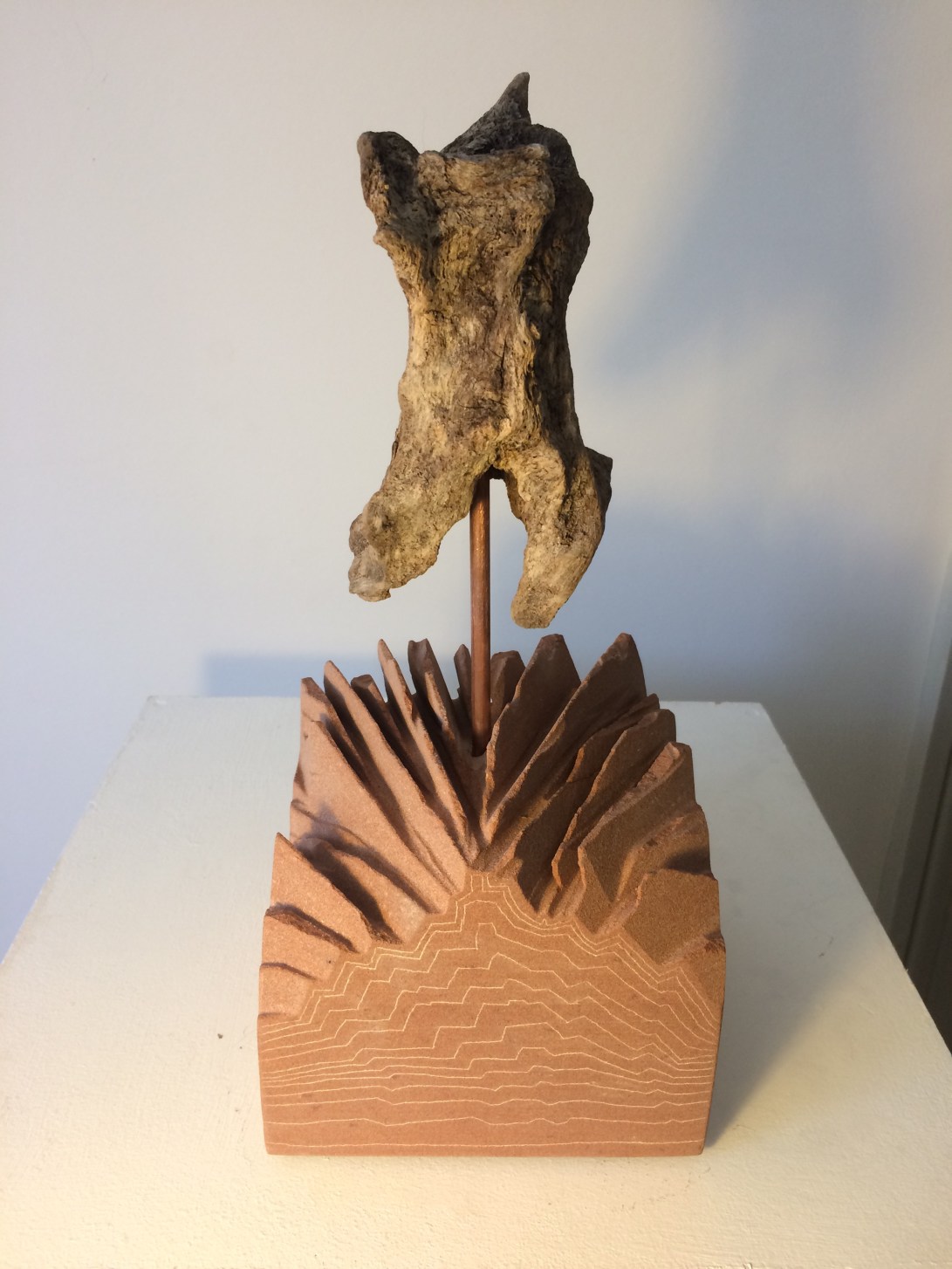
If as Dali/Breton said, ‘found objects have been waiting in the unconscious’ I might extend this to all art. I found this piece of what I think is pine, a wild and small sea pine, in Provence by the coast amongst vineyards and forest maybe 5 years ago. Its been sitting, neglected, amongst other found objects in my basement (!) since then.
At art school we would go to the British Museum and draw sculpture. I wasnt very good at life drawing but I was ok at constructing drawings of sculpture. Less pressure, more time.There are some draped figures of Nike there and the marble drapery is cut so deep I could put my entire forearm amongst the folds. This scrap of wood reminded me of the posture of the goddess of Victory, one arm raised, back curved, striding forward.
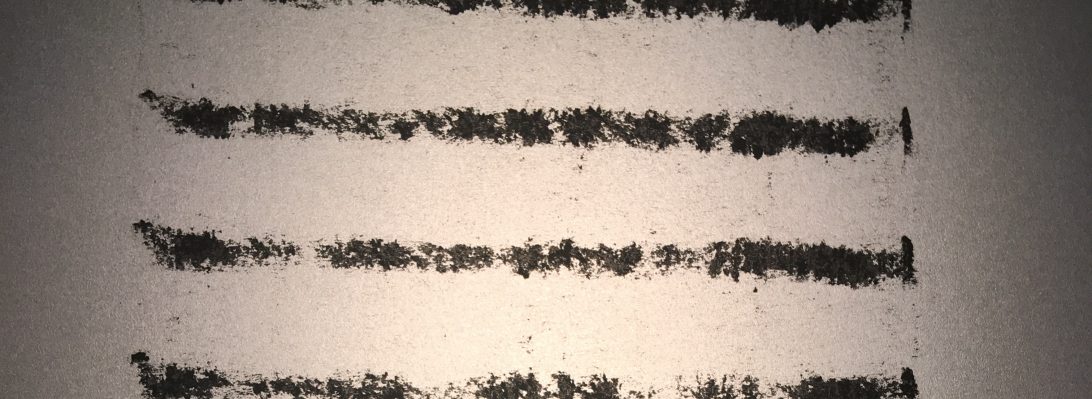
I started with a block of red sandstone as the proportions worked. I intended to act without intention. to simply act. as i began i thought of a ploughed field. I wanted to cut and smash. Id been thinking about why i worked with stone and i think one of the causes is that it involves destruction. where other mediums, painting, clay, involve smearing liquid matter stone requires destruction, removal of dry matter and this for some reason appeals to me. revealing through removal like an archaeology of the self. You get rid of stuff and whats left is Essential. I used a 5″grinder to cut the first furrows at varying depths and did so without drawn lines. I planned to then cut through them at 90 degrees but found myself smashing the ridges off with a lump hammer and cutting another sequence of furrows converging on one point i have no idea why. I smashed some of these off, kept others and continued until it was as seen. Then i had the idea of scribing lines that echoed the furrows like Chinese whispers down into the depths. This was strangely exhausting and I struggled to control my concentration and the tungsten scribe with both hands, the pressure hurting my fingers, trying to flat line near the bottom, little blips of activity popping up like signs of electrical activity, signs of life and then the line disappears into the distant unseen.
Since I wrote this a month ago I have reinterpreted this piece to be not of Nike but, of course of Ariadne partnered as she is with the Minotaur and connected as she is, it seems by a thread to the blood red stone. This is exactly the way I had hoped this project would evolve as the Archetype (this time of The Labyrinth) uses me as a conduit to express itself.
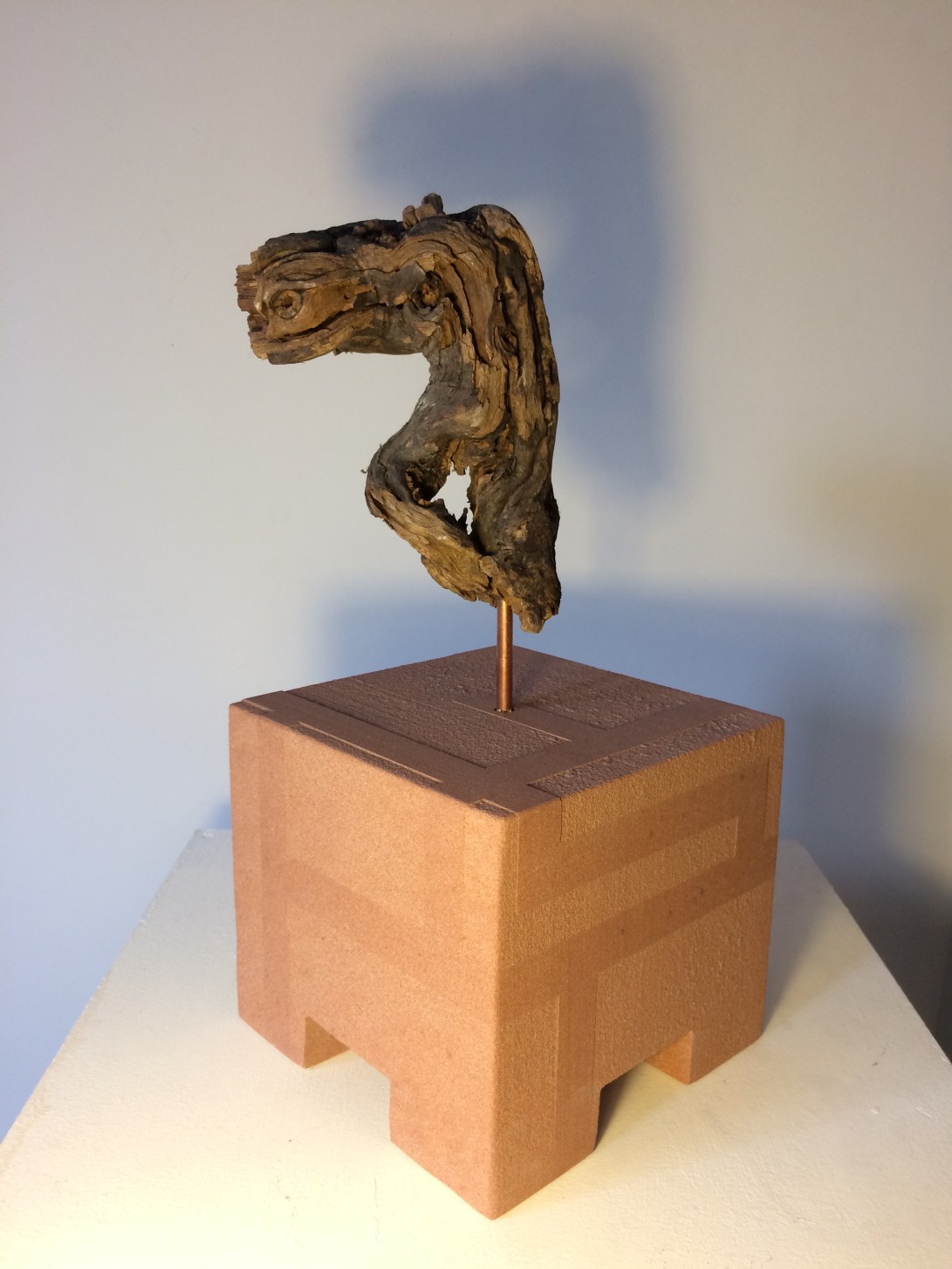
This the second in the series begun after Field For Nike was finished. This fragment of old grapevine was spotted from the road on a walk through the vineyards of Provence laying on and coated in the clay soil of a newly planted field, a vestige then of ancestor vines discarded in the ruthless regeneration. It caught my eye from 20 yards in the exaggerated contrasts of light and shade, heat and cool, waiting…
i saw a minotaur immediately in fact Ovids minotaur captured in the act of metamorphoses it ended up in the basement of my house for years until last week when I took it to be rehoused.
Again i had a piece of red sandstone that lent itself to the project. Ive been thinking about plinths for a while but more for other sculptures rather than for found objects. Brancusi was a master of the art of plinth making to the extent that his sculptures were not just placed on them, framed by them as it were but completed by them. I have been thinking about how, if a sculpture was in and of itself complete it shouldnt require a plinth (by plinth I mean both a base and/or a stand to raise a sculpture off the floor) (but really i should play a little with this and not take it so seriously)
in a way i am trying to subvert the idea of what sculpture, and what a sculptor, is. The plinth is a secondary item, a device, like a canvas or a frame, or lighting that smooths the way from the artist to the viewer, it facilitates, sets off, contains, completes. The contemporary artist is the Creator, taking all the credit and ownership, you the viewer/buyer/consumer are honoured to be a witness, owner of the vision of the Genius. The Gallery Museum cultivates the ambience of the Place of Worship. Listen to the Creed, the Dogma on the head phones as you waltz around. The plinth is the catafalque, the sepulchre, carrying, containing The Relic raising it up, above, separate. But if all art is an expression of the unconscious (if not then what?) the artist is a conduit for shared data available to all. By sculpting the plinth for a found object i am facilitating the availability of that data to all through metaphor.
I had intended to scribe on by hand some representation of a labyrinth as with the ploughed and excavated Field For Nike as a metaphor for the mechanics of the Unconscious, the labyrinth being a rich symbol of the journey from birth, to life, to death and rebirth.
The idea of using tape and sand blasting came to me at the point at which i was about to start scribing. I polished the stone through the grades from sawn to 400 grit. jetwashed and dried to remove dust to allow masking tape to stick and then applied tape without plan or thought just balancing the space and area. Double taped it to resist the sand and blasted it. Messy. washed it again. thrilled at the effect. Drilled it, drilled the wood, cut the copper, put it all together.
The male and female coupling was pleasing and unexpected and continued into the next pairing of found objects, Queen and King.
 JON WHITBREAD ART