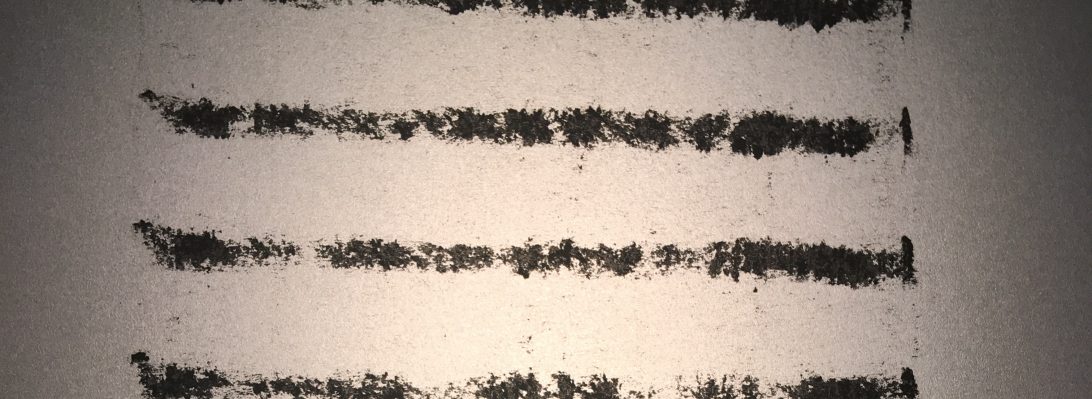


: sandblast sculpture
materials: compressed air, sand, 90 gsm paper, charcoal, pva, timber
equipment: compressor, sand blaster, clamps, a-frame, banker, water wall dust extractor
intent materiality: dust noise vibration pressure wind vortex chaos melting erosion
reason:
environment: MA
purpose: exploration
conclusions: paper and pva resist sand blasting. sandblasting turns paper brown
emotions: trepidation fear horror surprise disappointment curiosity
This pseudo-scientific introduction is reminiscent of doing o level chemistry
(apparatus: bunsen burner litmus paper acid alkali potassium pomangenate…)
(a metaphor for contemporary art practice with its epistomology, ontology, metaphysics, theory, discourse, categories, research, exploration, fragmentation, findings from failure, vitrines and tele-micro scopic differentiations. Ironic that contemporary, post-modern art uses the language and method of Enlightenment Modernism. But does it do so ironically? Indeed does it do this at all or is this me imposing my modernism upon post-modernism?)
Here I seem to have attempted to penetrate my modernist aesthetic using a suitably wide set of materials and methods akin to alchemy, or proto/pseudo-science (is contemporary science really pseudo-alchemy? Alchemy was as much proto-psychology as proto-science, or even a new expression of older ongoing psychology and ideas of individuation)
Philosophy seems to have expended its energy on our relationship with things. But all it has to show is what we have always known: We can only have relationship with ourselves. There is the territory: the only territory we can explore with written/spoken/thought language. However there are other languages eg faith (aot religion, and which btw i lack but do not discount) and art. Maybe there are others. In fact much, no, all, of art and literature has left a record of the exploration of that territory and its’ topology. What else can it be a record of? Even the language of mathematics has to interface with us at a certain wavelength. Or rather we are the interface of that language.
At the same time I am thinking, looking at this object that ‘I have made’ and reflecting on life, as my father dies, that life generates from a centre, not a beginning. That life is non-linear but generative, multi-dimensional and even non-temporal in the human sense: think of the big bang as a centre rather than as a beginning and therefore, of our lives as layers of expression rather than linear narrative.
‘When you will have made of him a body without organs, then you will have delivered him from all his automatic reactions and restored him to his true freedom’ (Artaud)
when I work I am demolishing structure, attacking solid form and creating dust clouds. The dust cloud is made of the material I am attacking and is equivalent to it. If i am sandblasting a me shaped impression in stone or paper I am creating a dust cloud shaped ‘me’ in the atmosphere. Some of that dust goes onto me and some goes into me.
What is it like to be me? What is my me-ness? my haecceity? where is it located? What are my structures? Do they serve me well? Am I conducting experiments in attempting to demolish my structures?
‘what is it in this stone by which as by a proximate foundation it is absolutely incompatible with the stone for it to be divided into several parts each of which is this stone, the kind of division that is proper to a universal whole as divided into its subjective parts?’ (Duns Scotus, ordinatio II)
Am I attempting to demolish metaphor so that in my work ‘this is like that ‘ becomes ‘this is that’? But then isnt that a metaphor for my desire to isolate my me-ness as an expression of univocity? Can I separate my work from me so that it is a thing directly of nature rather than a creative act with me as Transcendent Creator?
Is the this-ness of an art object, its haecceity, within it? Within the space it occupies/displaces? Or is it also to be found around it? That is, amongst the factors that led to its existence – the process and the material. Is it the everything-ness of the thing? Can only the everything-ness, all of its data, be the thing? But the everything-ness must include all responses to it, all opinion, and this involves flux.
 JON WHITBREAD ART