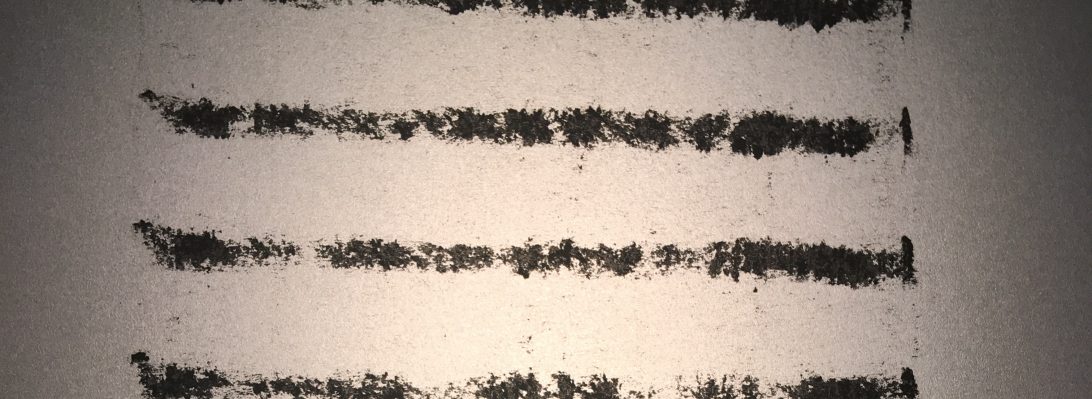
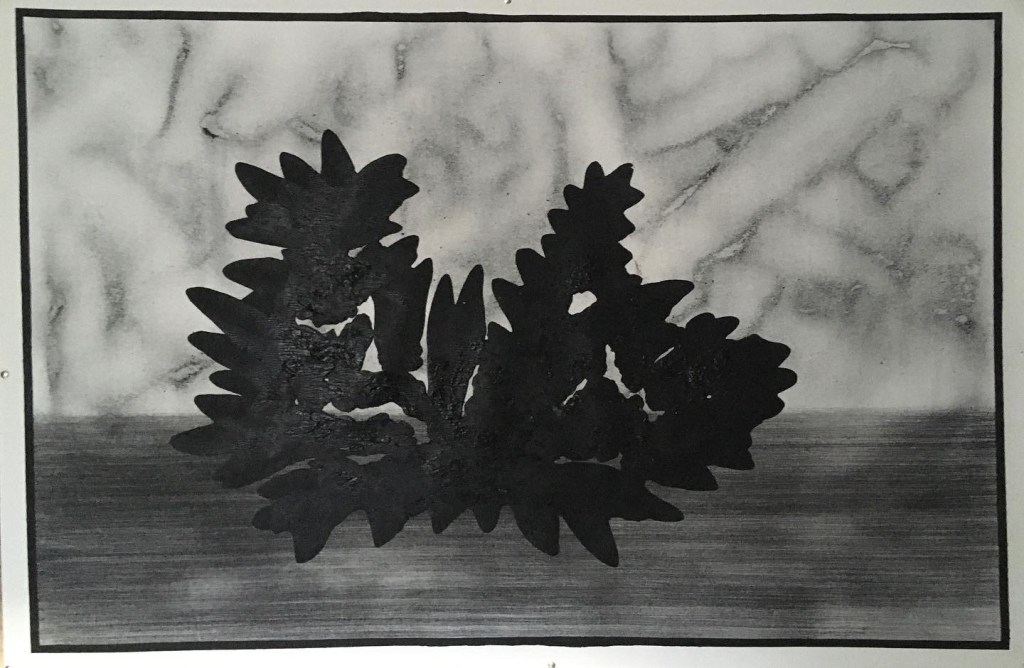

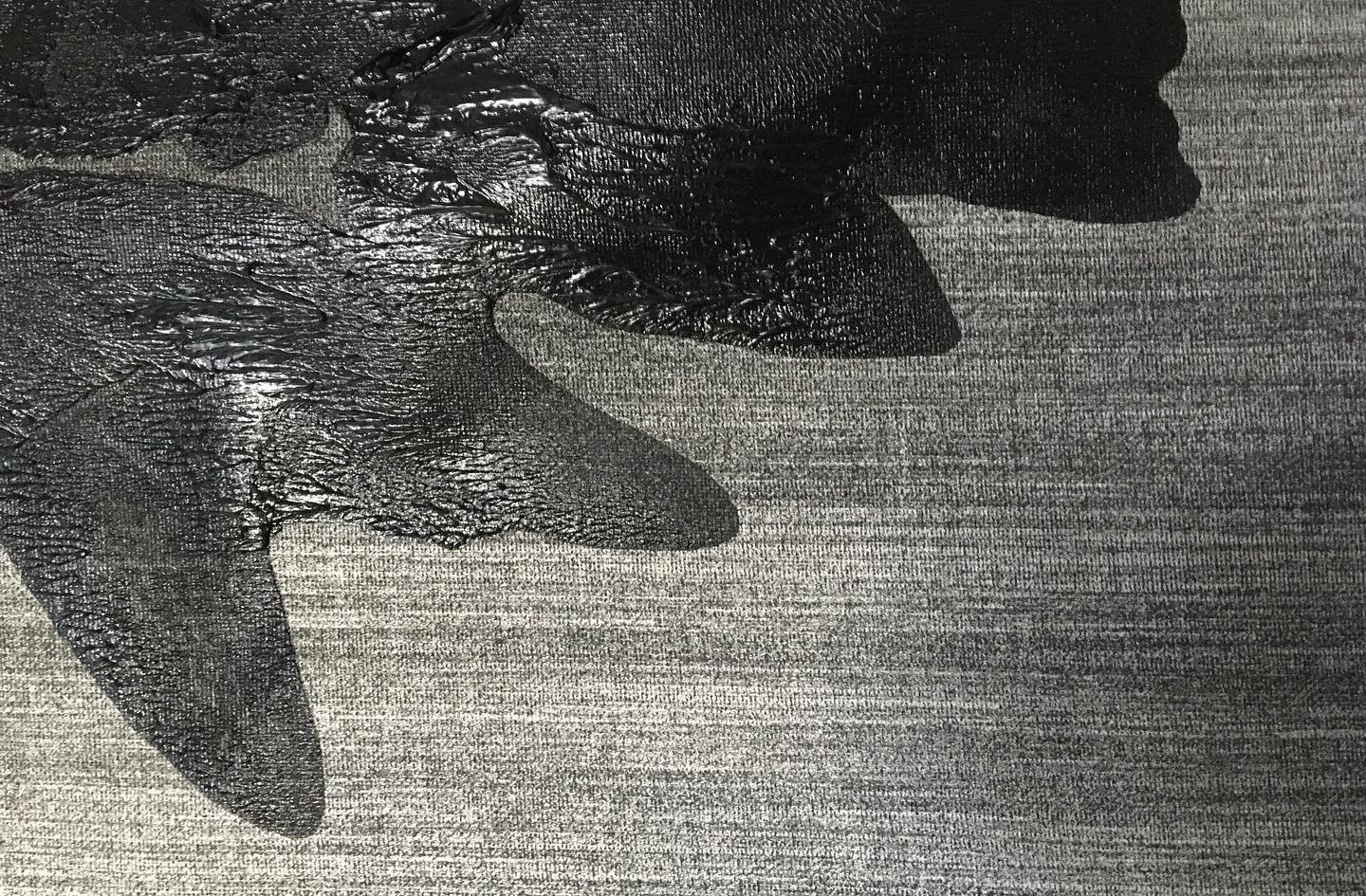
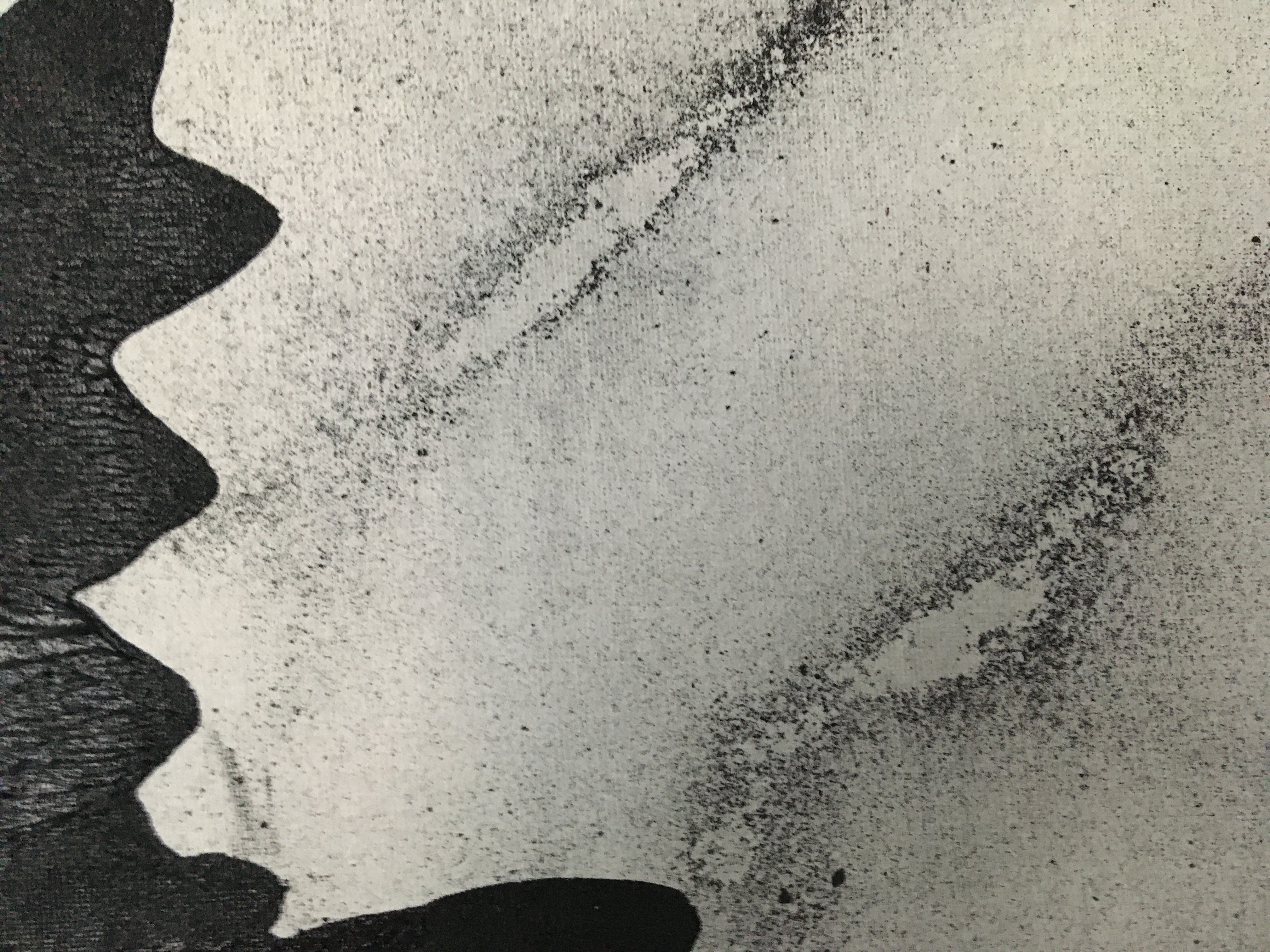
A 1.5 by 2m length of canvas pinned to a piece of 3mm ply. The canvas was fairly floppy. When I shook the board the carbon settled into interesting drifts which I sprayfixed. Ive been using acrylics because of the drying time so I had a large tube of oil paint left over. I squeezed it out randomly, this time with the canvas still on the floor to avoid any run off, put a sheet of tracing paper on top and started moving the paint with the blade. My only intention was to try to keep the paint from closing all the internal gaps so that the background wasn’t completely covered by a blot.
When one is trying to surrender some agency to the material, the picture self-composes. I don’t mind that. There is tension in the off-centred paint in relation to the frame. It’s unsatisfactory and adds to the movement and nausea. It’s trying to avoid the centre. Or find it.
I like the carbon dust coalescing into tube like clouds of spores that seem to emanate from the oil that has taken on a kind of plant crustacean form. Or maybe the plant-crab is forming itself from the particles that pour in through the cracks.
Gives me the creeps.
Deleuze talks about rhizomes, striation, smooth shapes, holey space, lobsters
(“God is a lobster, the double-pincered abstract machine of natural stratification, and thus part, but only part, of nature”)
And i seem to see a kind of representation of all of these things here.
In fact I haven’t read any Deleuze for over a year. Though I have just finished Federico Campagana’s Prophetic Culture, Timothy Morton’s Hyperobjects and Nagerastani’s Cyclonopedia which have all combined to bring on a feeling of creeping Deleuzian nausea in me.
But I have never sought to paint or sculpt a representation of what I have read, like an illustrator. And there is no conscious intention to the painting beyond the mechanical practicalities – the behaviour.
Perhaps its the plasticity of the finished oily forms that lends them to what one has read, or heard, or seen. Or the placing of an apparent blob in an apparent landscape. I make the painting and then I look for meaning. Or familiarity. Or metaphor, sign or symbol.
That’s what the human mind does.
And it watches itself looking.
I’m interested in making art that is unopinionated, that isn’t a representation, statement or metaphor, or sign or symbol.
The work happens quickly.
Materials + Process
No slow building up of detail and generalities or layers.
But I can’t stop the mind, any mind, then taking the finished piece and colonising it. It does this in two ways. First it invades the space, the canvas or sculpture, occupying it in detail. Then it absorbs it whole, categorises it, placing it hierarchically, externally with opinion as the weapon of control.
Opinion, good or bad, is generally unhelpful. It raises barriers, closes doors. To live, or die, without opinion would be a good thing. We express thousands of little opinions every day, about every little thing our senses encounter. They are little closed units of categorisation and judgement that serve to defend our sense of our own importance in the world. They are an expression of vulnerability. And they are invariably boring.
 JON WHITBREAD ART