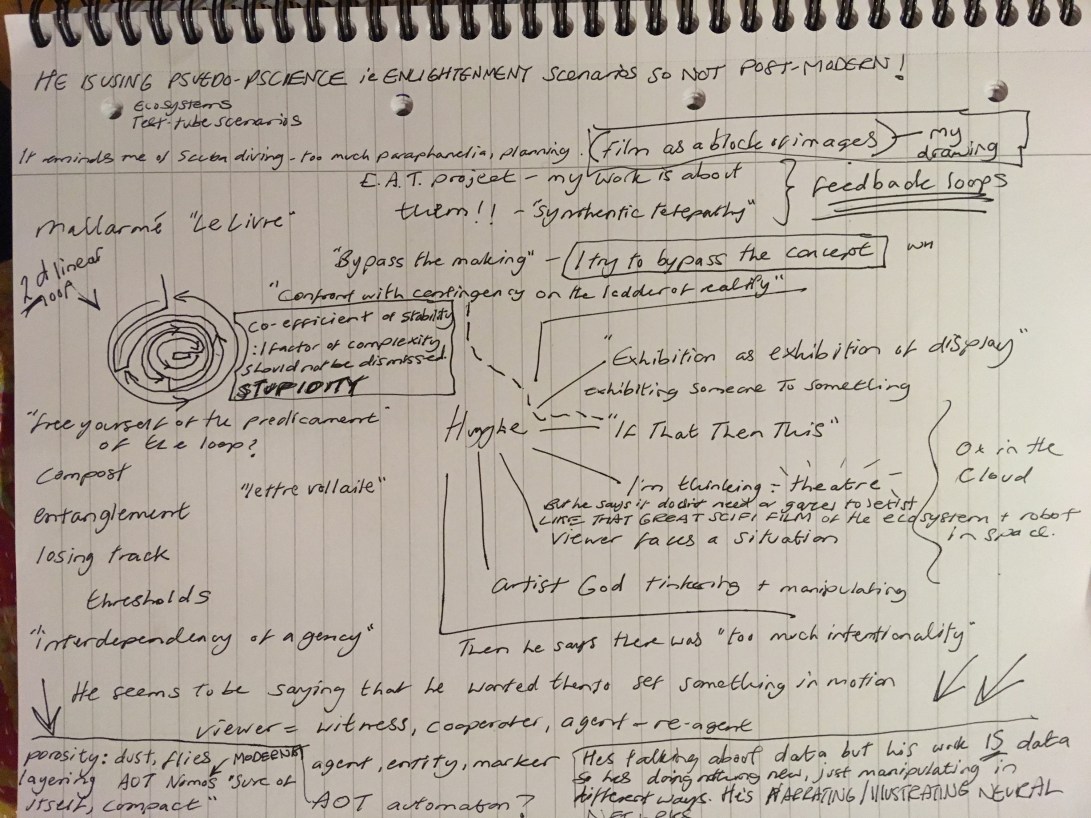
Huyghe is interested in effect. He makes art like one plays chess – “how can I justify this move? Can I justify this move?”. He treats (in the exact sense of that word) the space as his stage and engages in/with scientific discourse as though it is all an experiment in which he is setting up the apparatus and then lets go but really he knows what the conclusions will be: the Witnesses will experience a manufactured encounter with the dog with the pink leg and consume the experience, be made to feel special and changed, and then disseminate their narrative of the encounter. He then harvests their narrative, moves to the next environment and repeats, God-like, playing with automatons that bore him. Its Fried’s nightmare but its also ironically Modernist, employing alchemical technique as though alchemy was proto-science and not an occidental expression of the drive toward individuation. In ‘by-passing the making’ he is a an illustrator of the conceptual, whereas I try to by-pass the concept through behaving (making) in order to discover or look at the nature of desiring/needing to discover.


: sandblast sculpture
materials: compressed air, sand, 90 gsm paper, charcoal, pva, timber
equipment: compressor, sand blaster, clamps, a-frame, banker, water wall dust extractor
intent materiality: dust noise vibration pressure wind vortex chaos melting erosion
reason:
environment: MA
purpose: exploration
conclusions: paper and pva resist sand blasting. sandblasting turns paper brown
emotions: trepidation fear horror surprise disappointment curiosity
This pseudo-scientific introduction is reminiscent of doing o level chemistry
(apparatus: bunsen burner litmus paper acid alkali potassium pomangenate…)
(a metaphor for contemporary art practice with its epistomology, ontology, metaphysics, theory, discourse, categories, research, exploration, fragmentation, findings from failure, vitrines and tele-micro scopic differentiations. Ironic that contemporary, post-modern art uses the language and method of Enlightenment Modernism. But does it do so ironically? Indeed does it do this at all or is this me imposing my modernism upon post-modernism?)
Here I seem to have attempted to penetrate my modernist aesthetic using a suitably wide set of materials and methods akin to alchemy, or proto/pseudo-science (is contemporary science really pseudo-alchemy? Alchemy was as much proto-psychology as proto-science, or even a new expression of older ongoing psychology and ideas of individuation)
Philosophy seems to have expended its energy on our relationship with things. But all it has to show is what we have always known: We can only have relationship with ourselves. There is the territory: the only territory we can explore with written/spoken/thought language. However there are other languages eg faith (aot religion, and which btw i lack but do not discount) and art. Maybe there are others. In fact much, no, all, of art and literature has left a record of the exploration of that territory and its’ topology. What else can it be a record of? Even the language of mathematics has to interface with us at a certain wavelength. Or rather we are the interface of that language.
At the same time I am thinking, looking at this object that ‘I have made’ and reflecting on life, as my father dies, that life generates from a centre, not a beginning. That life is non-linear but generative, multi-dimensional and even non-temporal in the human sense: think of the big bang as a centre rather than as a beginning and therefore, of our lives as layers of expression rather than linear narrative.
‘When you will have made of him a body without organs, then you will have delivered him from all his automatic reactions and restored him to his true freedom’ (Artaud)
when I work I am demolishing structure, attacking solid form and creating dust clouds. The dust cloud is made of the material I am attacking and is equivalent to it. If i am sandblasting a me shaped impression in stone or paper I am creating a dust cloud shaped ‘me’ in the atmosphere. Some of that dust goes onto me and some goes into me.
What is it like to be me? What is my me-ness? my haecceity? where is it located? What are my structures? Do they serve me well? Am I conducting experiments in attempting to demolish my structures?
‘what is it in this stone by which as by a proximate foundation it is absolutely incompatible with the stone for it to be divided into several parts each of which is this stone, the kind of division that is proper to a universal whole as divided into its subjective parts?’ (Duns Scotus, ordinatio II)
Am I attempting to demolish metaphor so that in my work ‘this is like that ‘ becomes ‘this is that’? But then isnt that a metaphor for my desire to isolate my me-ness as an expression of univocity? Can I separate my work from me so that it is a thing directly of nature rather than a creative act with me as Transcendent Creator?
Is the this-ness of an art object, its haecceity, within it? Within the space it occupies/displaces? Or is it also to be found around it? That is, amongst the factors that led to its existence – the process and the material. Is it the everything-ness of the thing? Can only the everything-ness, all of its data, be the thing? But the everything-ness must include all responses to it, all opinion, and this involves flux.
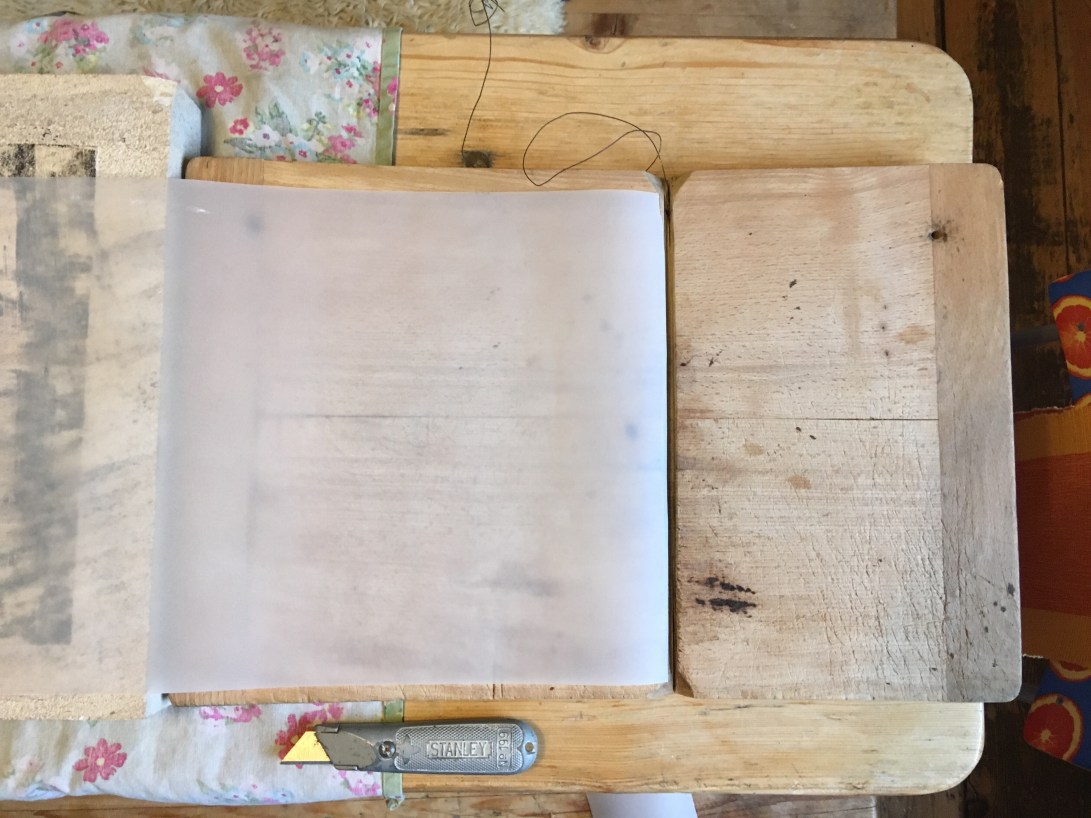
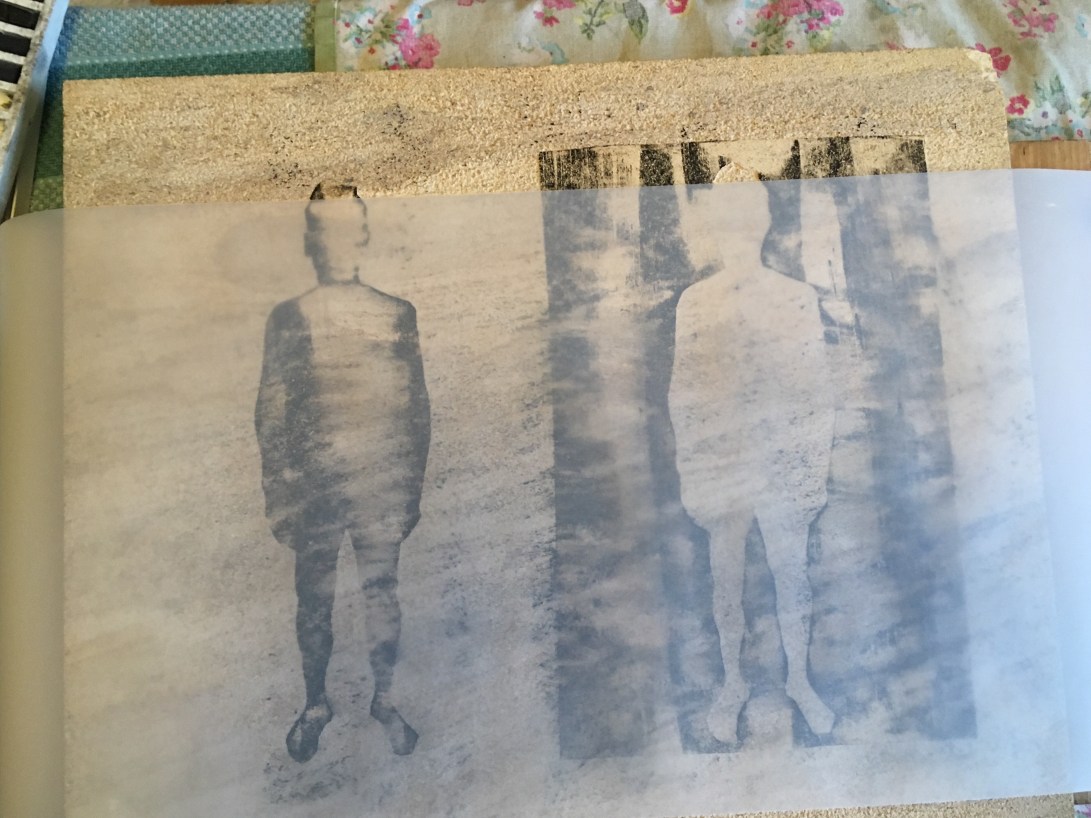
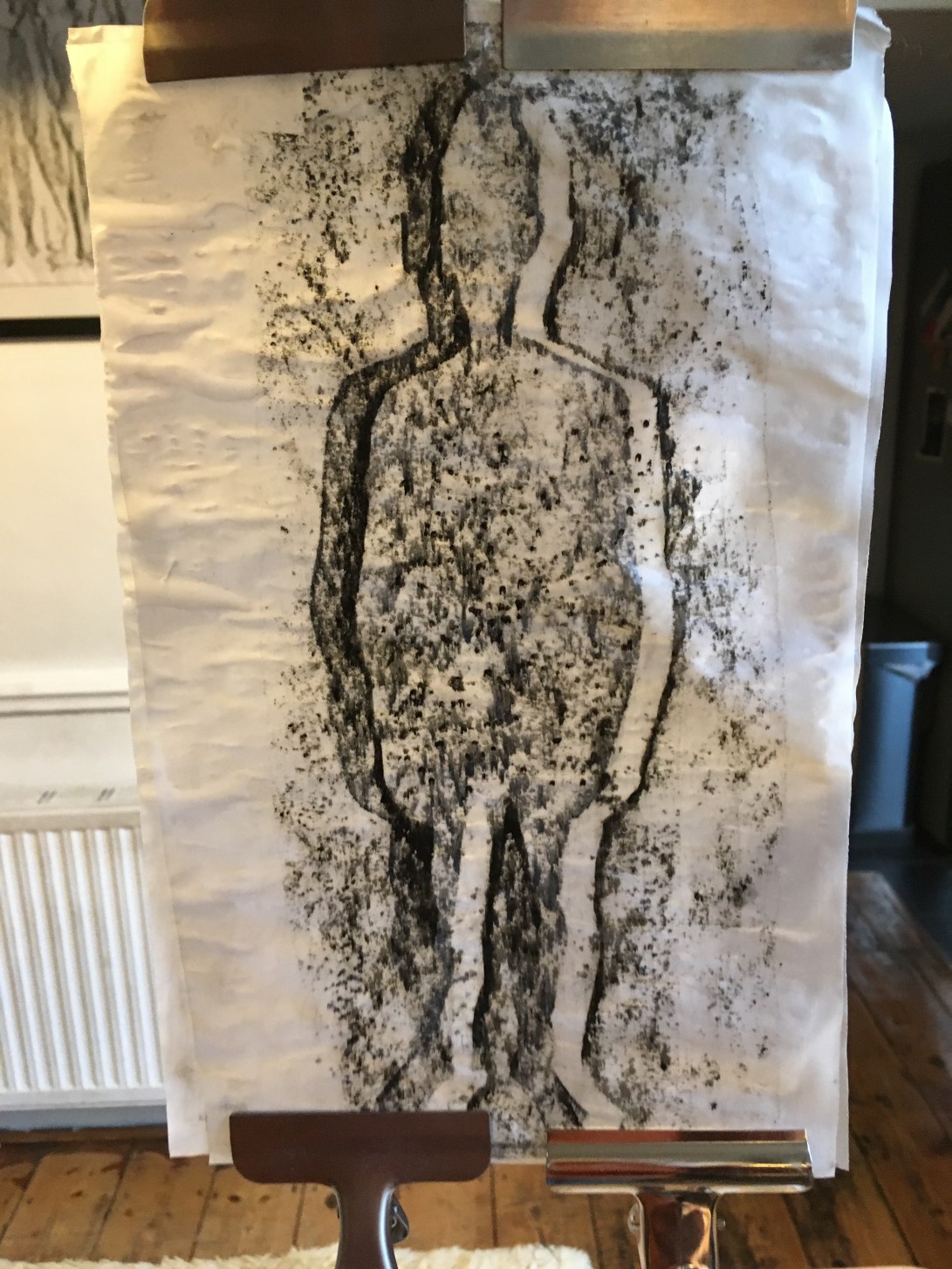
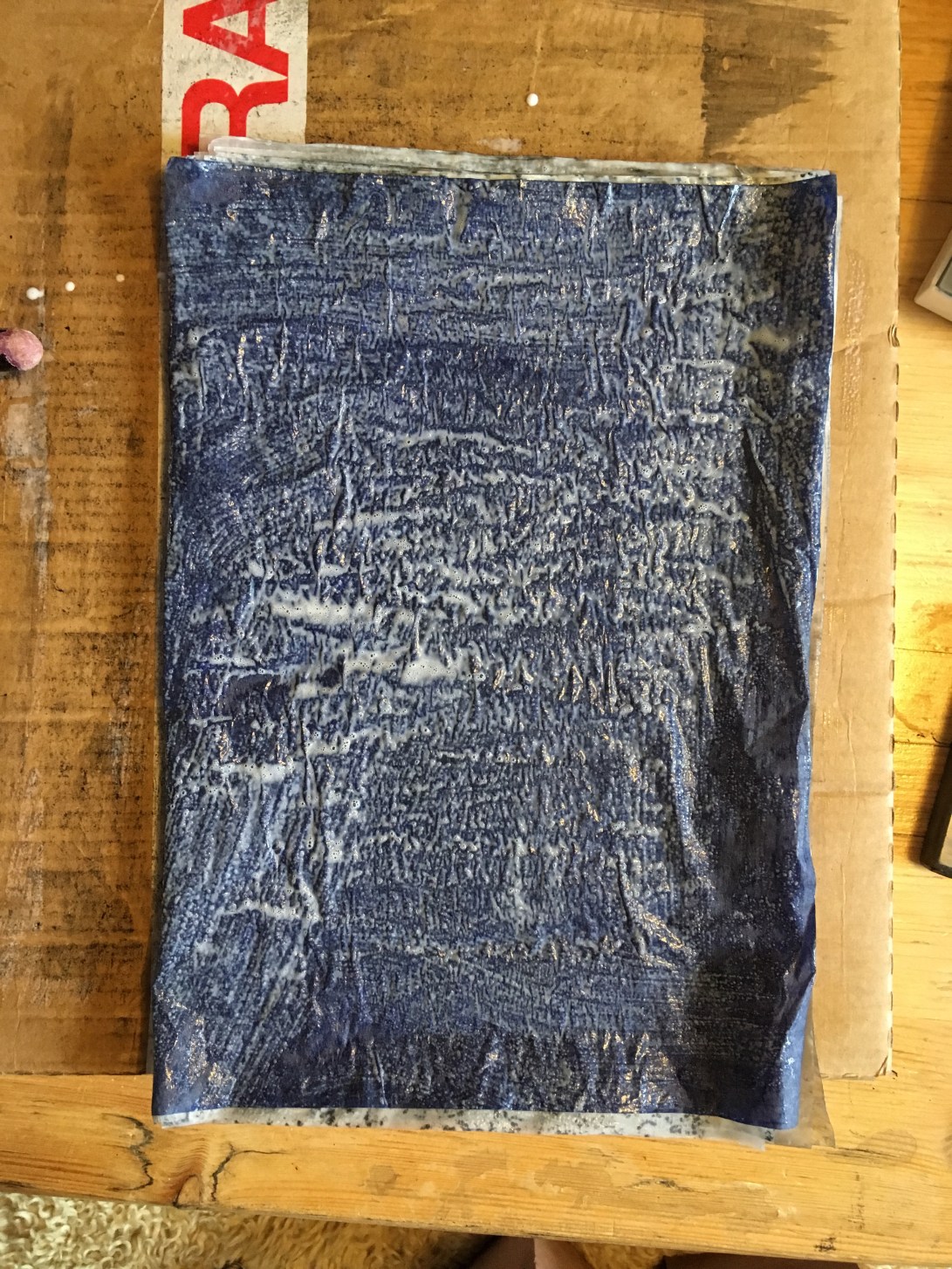
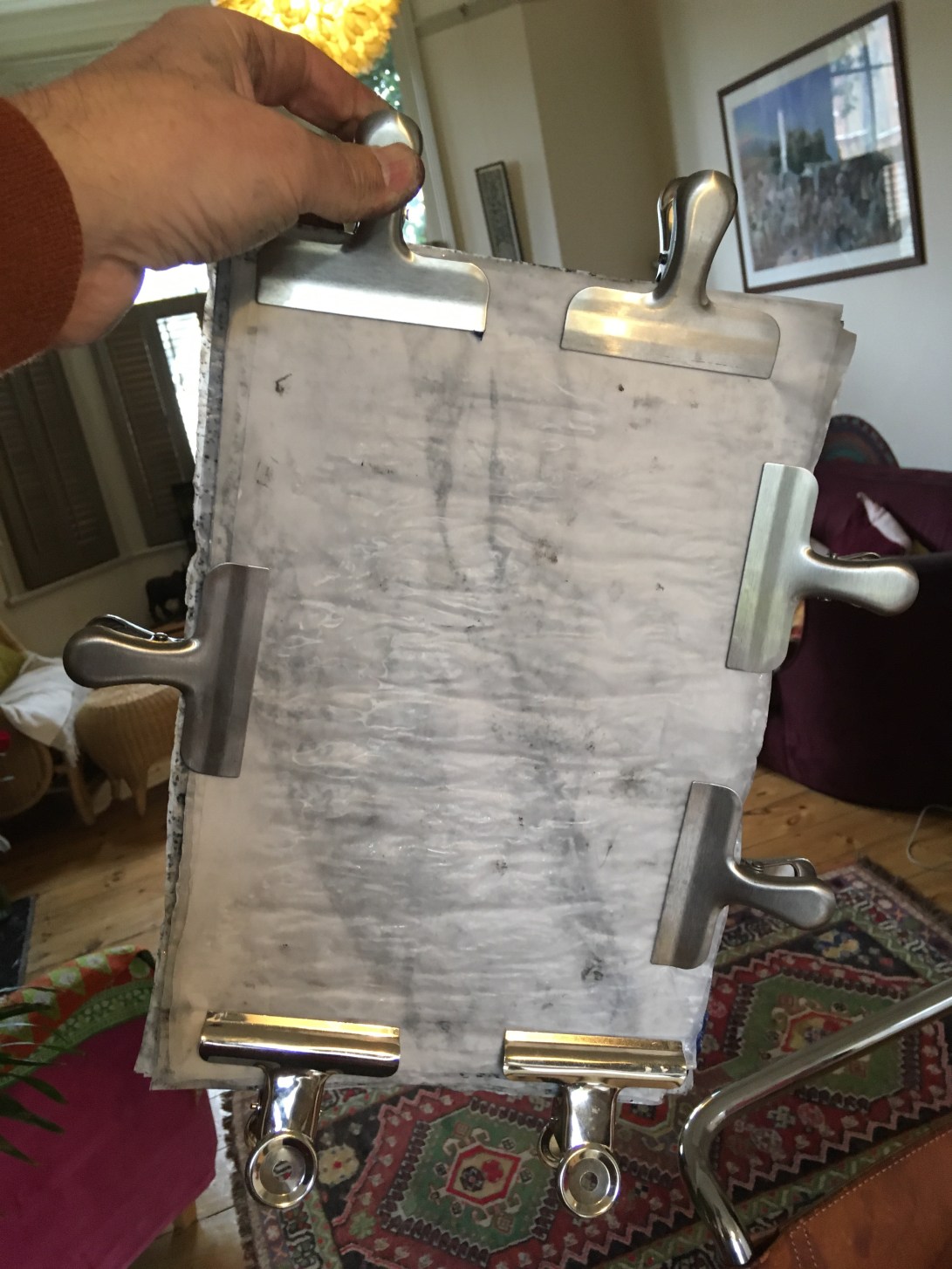
90 gsm paper, carbon paper, charcoal, pva, water, grandfathers cheese slicer from his shop, metal clips, stanley knife, sand blasted limestone, tripod, iphone, table
intent: hand print images then sand blast them
in my attempt to lose my own thread, get lost in the maze, i cant quite remember where this all began. I know that ive made some sculptures, some drawings, some drawn on sculptures, some sculptures that are drawn with air and sand, some drawings lifted from sculpture then fed back in to sculpture. here i seem to be building a sculpture made from drawings of sculpture that i intend to sculpt with sand. The sand and compressed air, or sand and wind, is an accelerated erosion. Destroy to reveal. Obliterate to read. So what?
pressing the wet, gluey paper together it felt fleshy meanwhile my dad is dying in a hospice, desiccating, oxidising. When i touch him there is only skin and bone. As i built this object it became about me and him. The last few drawings were slight and gestural. the last two were blank. skin. trace. no trace.
addressing materiality – list
above tools and equipment
plus
sensual nature of materials including
sound
texture
sight
other
other?
do i believe in the materiality of art making?
do I even consider the material?
what is the material?
Its a medium.
a sound
a sight
a texture
thus a sensuality
thus a way between.
a between.
between what
the real and the known?
the reality and the knowable?
the me and the other?
the unity and the duality?
the transcendence and the immanence?
(palpating the unknowable (Deleuze), layers of catholic ‘magic’ (Campagna, 2018) unknowable imagery with protestant ‘technic’ knowable word)
the slicing and separation
the refamiliarising and appliance
the gluing and layering
the conversation…
What does Language do? What is it good at/for?
It works with sensory data which it divides and fractures into discrete packages (I wonder if Language actually does this directly rather than our brains doing it and then turning the data into Language).
It categorises, classifies and defines.
Defining is the act of making distinct from something else (Derrida, La Saussure) – the act of separating, fragmenting, then relating – bringing back into relationship but within categories.
It has evolved, like everything does, as a mutation that favours survival.
In this case it serves to protect from Everything, Reality, or the Real by fragmenting it into words. It protects us, or the Psyche from the Real. The Real is overwhelming to the Ego. Therefore Language will/can not describe the Real, or Everything, only its components that can be apprehended by our senses.
So Language is not the correct tool for apprehending Everything, only its ingredients.
We are necessarily outside of Everything because of Language. Language does this in order to save us from annihilation when confronted with, or finding that we are a part of Everything and therefore we are Everything and not Something (Spinoza’s and Deleuze’s Univocal Immanence?).
On the other hand, if according to Sufism, the Apparent is a bridge to the Real, and Language describes the Apparent, is Language also a bridge to the Real? Or a path to the bridge?
In fact If we take ‘the Apparent is a bridge to the Real’ to mean that while the Real can not be apprehended directly but requires the Apparent as a mediator, a bridge (over what? the Void? The Abyss? That is, madness, or oblivion for the Ego?) then can we say the Apparent requires a bridge to the Real made of Language? or is Language a thicket of brambles blocking our path to the bridge? Am i in danger here of only addressing Latin/indo-european language? Are there languages, Arabic, Basque, that are able to make the sounds and shapes of the non-apparent/material?).
Language is, like us, on the outside (transcendent), yearning for the inside (immanent). Or rather, we are on the outside and language is of the outside as inside there is no language. And therefore no art. The outside is, therefore, a great place to be for an artist. The stresses created by these dynamics form the landscape which poetry describes, and on which we place our sculpture.


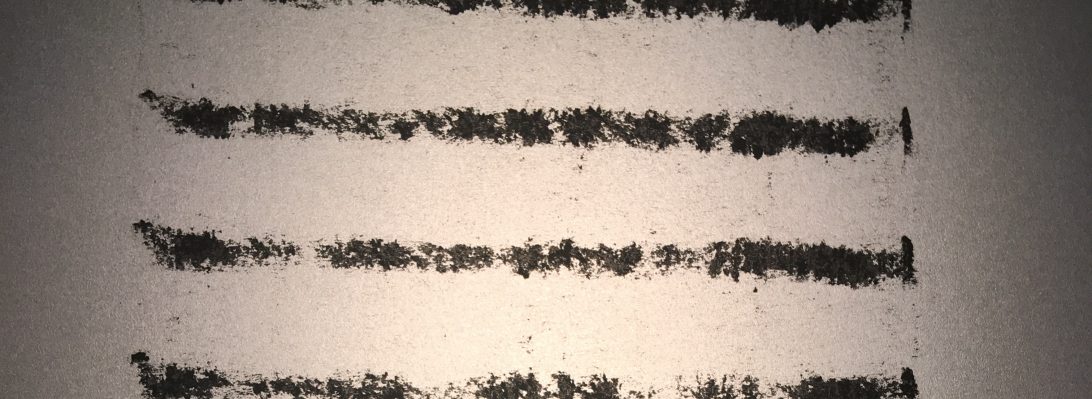
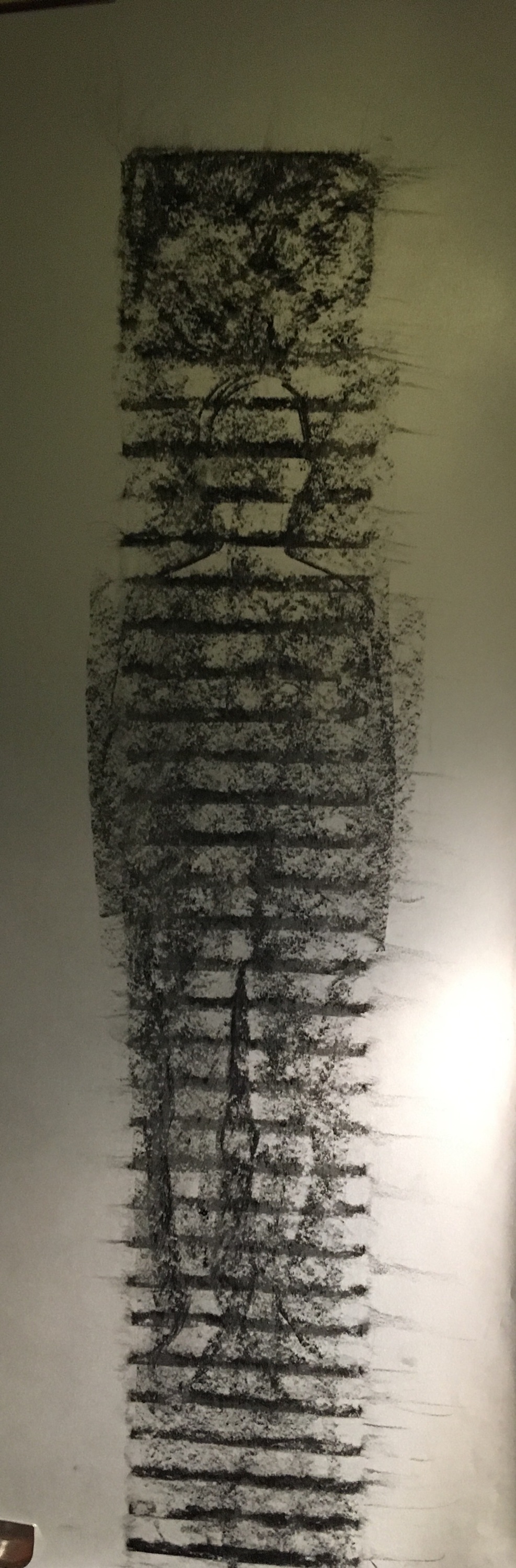
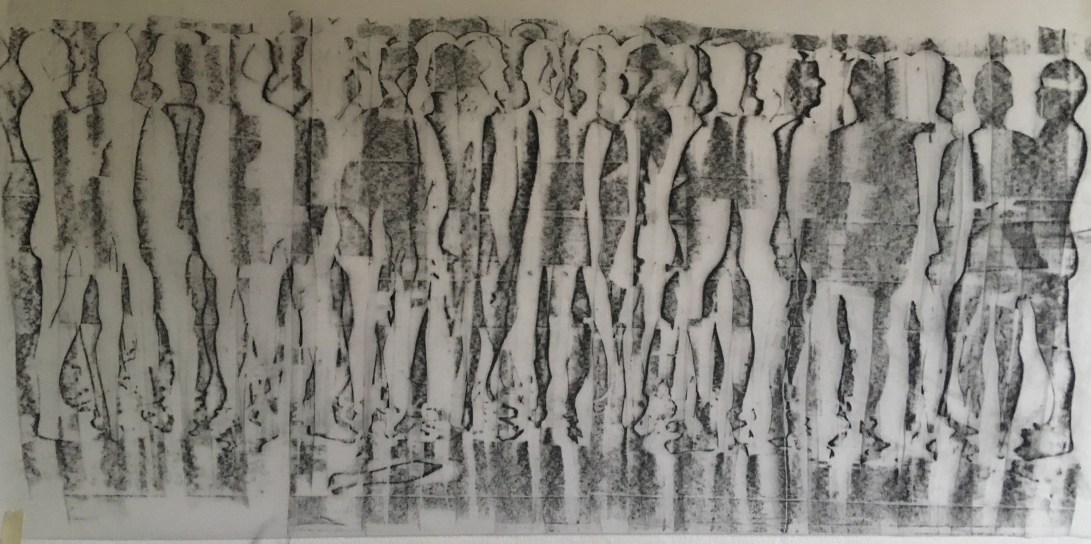
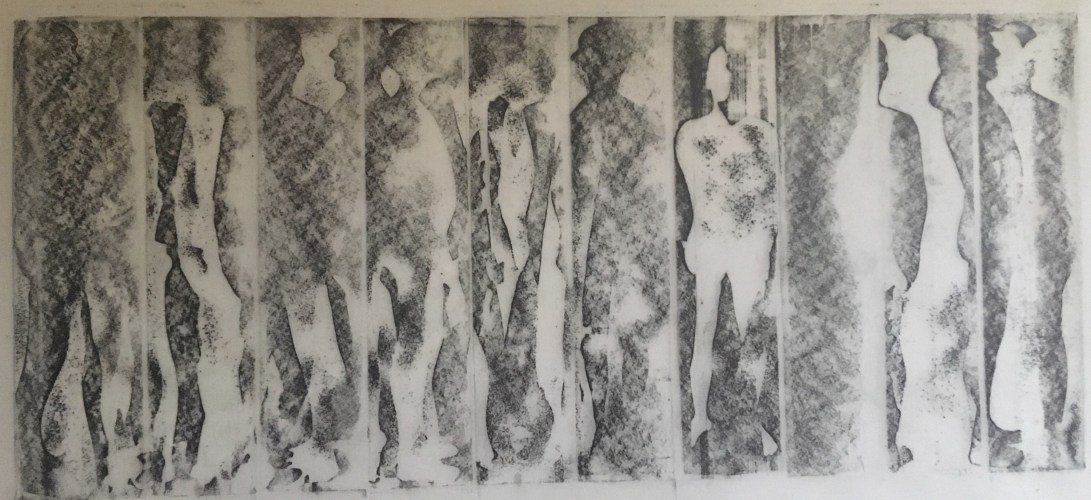
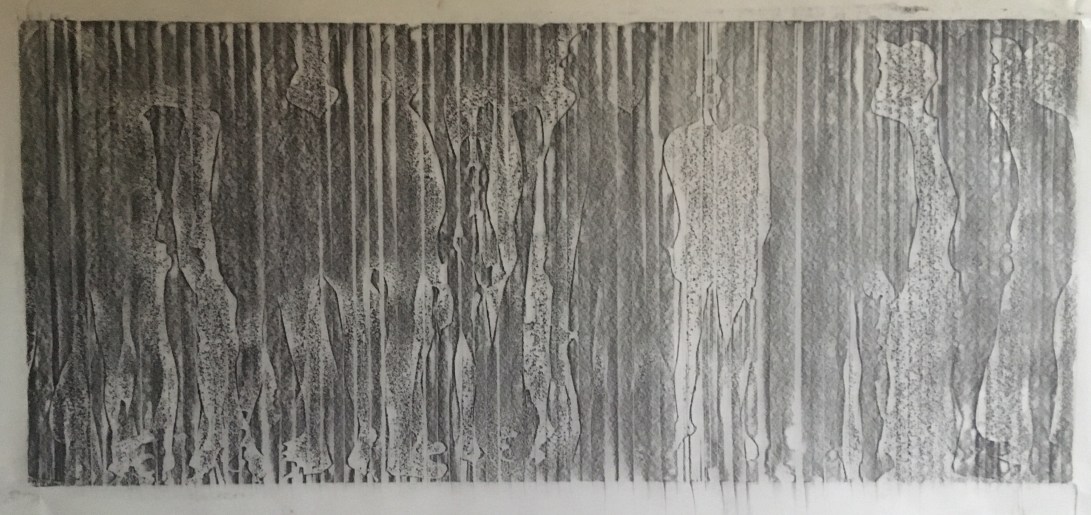
These drawings are interrogations of one of my recent sculptures (Data Flow, red sandstone, 2018) from which I used frottage to lift a 2d image. I intend to feed the data back into a production circle. Why? to attempt to disrupt my linear relationship with making , causation and time. Im interested in the non-conceptual . What is beneath. The product gives me ideas that are then not directly used in art but in thought. I don’t start with an idea, in fact i don’t start at all. Rather I behave with intention and interact with materials (the material) then examine (as opposed to making Illustration which is the art of externality). My intention in this case was to make a profiled object and then shatter the external elements ie smash the fragile parts leaving an apparently broken but in fact created landscape of remnant surface and exposed core – a sort of post-my-modernist gesture. But in the end the amount of work (time/energy) I expended/invested made this an impossible step to take. I didn’t have the will. This is in itself of interest. As though my modernist heritage is too dominant.
(There is another element to this that I find difficult to address. As I was making it, through a series of unintended consequences, it came to symbolise Grenfell Tower. My uncle was the architect who designed and built Grenfell Tower. As I made this sculpture it became about my relationship with him and the tower as I started to recognise its brutalist influence on me – from an early age I was aware of it. Having it pointed out to me as a child whilst being driven along the Westway (a modernist masterpiece in its own right, that unintentionally created a literal sub-culture of its own in Ladbroke Grove). My Father and Uncle grew up in Ladbroke Grove, where I was born and spent my early years. My Uncle still lives there in the house where he was a child. He could see his building burning from his flat. I had no thought of Grenfell as i started making this piece. It was intended as a structure that I could demolish to leave a fractured outline of form. I cut the stone but when I started to demolish the slats I realised I had not cut it deep enough and what would be left was not a jagged but a recessed outline and I was left with a tower block-like sculpture that I associated with Grenfell and so to actually break off the protrudencies became impossible. My Uncle was proud of the structure he had built and would speak to me of how as an architect, his aim was to build structures to which communities of humans would give meaning. The terrible ironies kept piling up as post-modern aesthetics required the cladding of brutal modernism, yet the processes of post-modern decision making led to a brutal end of what had indeed become a community).
 JON WHITBREAD ART