
Gursky at the Hayward
Big flat expensive perspective defying photographs
one mans battle against parallax
technical experimentation, cut and paste, photograph as painting
postmodern materialism and its effluent.
He takes photography, flattens it, abstracts it, then with nowhere left to go, paints it.
I was occasionally minded of a cross between Jacques Tati, Monet and Wheres Wally.
The Hayward is a fascinating space. I know its surface textures intimately from my skateboarding youth but I haven’t been inside the gallery before. The skylight ceiling upstairs is a joy. The pace and measure of the show was human, generous and belied the weight of the material that could have overwhelmed but didn’t.
*
PICASSO 1932 – LOVE, FAME, TRAGEDY at Tate Modern
Picasso the soap opera
This had the lot – love, fame, tragedy, octopuses.
Shock revelation – artist responds to life.
I hope to go back for another look. I didnt leave feeling as energised as I have done after other Picasso shows.
Despite the materialist pedagogy of the exhibition (which wasn’t uninteresting – just banal) seeing Picasso’s work always offers glimpses into the interplay of internal and external stimuli – conscious and unconscious forces in his work.
Unpleasant dynamics and usual confusion as to which way to go etc. When a show is hung by date, and room by Ikean room, one feels constrained to pursue it by the calendar or miss some important connection. But because everyone is following the same path there is congestion and so one is forced to break rank and go against the order of things. Like the Bad Machine in Midnight Express. It suggests that there is an understanding to be gained by following all the clues, history and succession of the work and that if you miss a clue or see it in the wrong order you will not ‘get it’. And of course there is understanding to be gained in this way. However it therefore requires 2 visits – one for the pedagogy and the other for ones own experience. The conceit at the heart of this show was a sort of partial rehang of Picasso’s first big retrospective and although it was a bit like a Dan Brown recap it was great to see those works.
WHITEREAD AT TATE BRITAIN
The casts of the beehive like undersides of chairs is beautiful and some how evocative of my childhood – translucent colours of exotic soaps or perspex skateboard decks and wheels full of trapped light – desperate to touch them but the non-touching is a type of touching.
No plinths (see Research essay) but tape on floor and tripwires.
But once in I spent very little time in front of each piece. Having done a bit of casting I marvelled at the craftpersonship of the casts and at the technical audacity and ambition. I think the sheer density of the effect of the Holocaust Memorial is overwhelming. The demolished House cast joyous, magnificent and tender.
But mattresses and hot water bottles whilst fun are less demanding of my time and i find myself outside after 10 minutes thinking that she needed to diversify somehow.
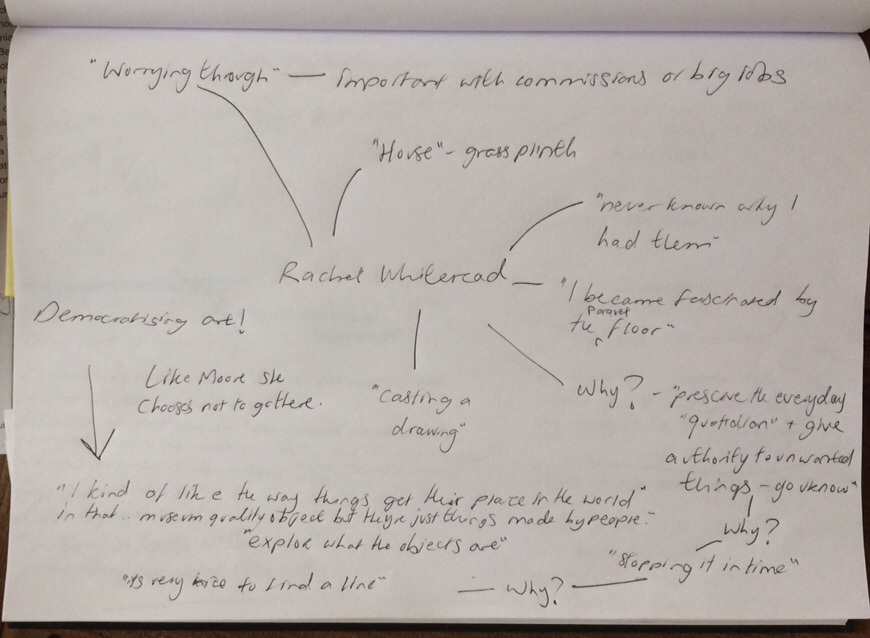
Beautifully curated with dividing walls removed from the gallery making a vast but well used room. (For more of my views on Whiteread see Research paper and response to the Whiteread film).


 JON WHITBREAD ART