Value And Portal 2

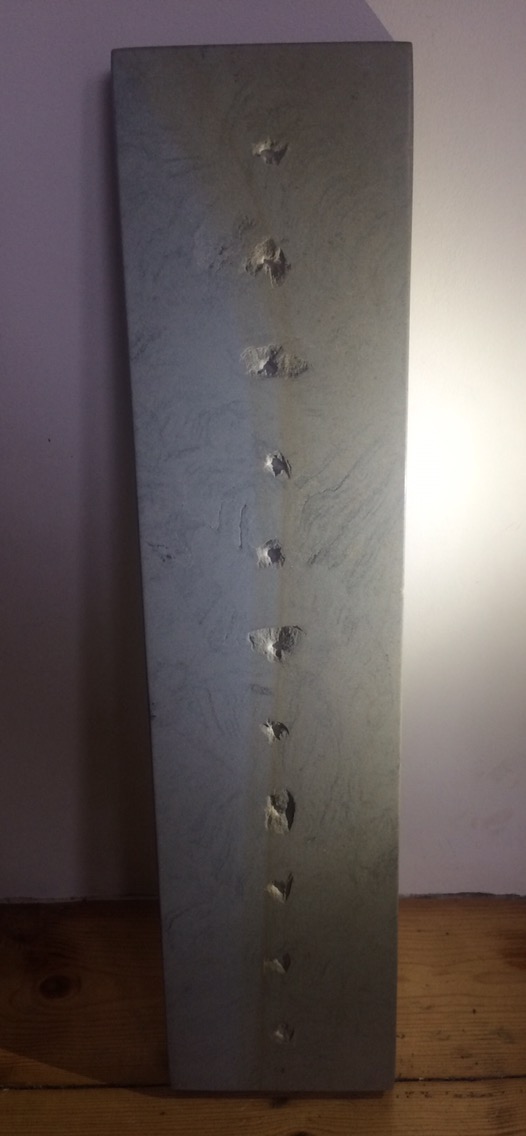
Taking donated, salvaged portland stone from a V and A Museum restoration contract.

Slicing it up on the saw, using an angle grinder to cut a slot – I plan to fill this with concrete, allow to set, then cut off face, hopefully slicing through the stone, cement and shingle then honing the rest to a smooth surface.

A partner piece to Portal.

Taking things that might be considered valueless and attempting to render valuable – perhaps ask the OCAMA16 cohort if it helps them to define value?

Curiosity, Uncertainty and Exploration

Ive been taking oil pastels and carving them with a toothed stone tool called a drag then, in the pics below, attempting a response to the fires in SF, USA. Why did I carve the pastel? it was an instinctive gesture – a connection to my usual way of working – removing material to leave behind a mark. Also it enables me to suggest sediment – depth –  layers – representing Psyche but also perspective.  Used same drag to tear paper for horizon – destruction and creation.

Now im working on the next phase of the experiment combining my project of making Plinths for found objects (in this case half a copper tie i cut from old masonry on some forgotten job and some brass ties I cut from some stone steps in a monastery that held rods to keep a carpet in place) that have been sitting, neglected for years in my found object collection. I plan to set these into stone using sandblasting but in the meantime I am studying them in the basement, turning off the light and rendering them blind onto paper with minimal gesture. Why? Alexa Cox talked about ‘authenticity of line’ and here I am attempting to find such a thing. But also im playing with the Dali/Breton idea that all found objects have been waiting in the unconscious.

Certainty/ Uncertainty and Cabinet

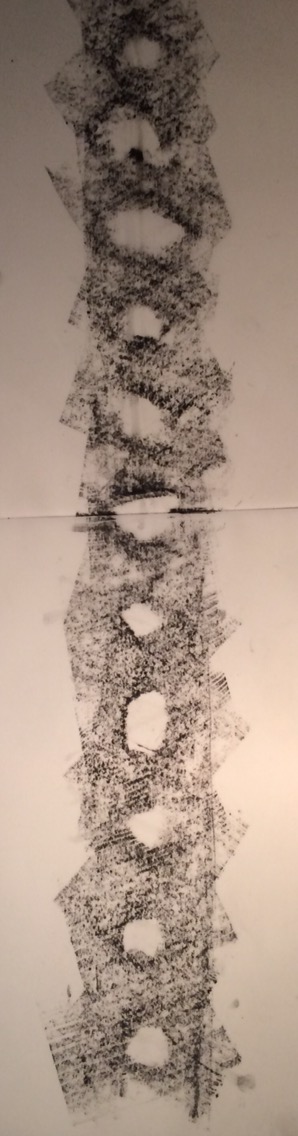
Uncertainty is at the heart of my practice. I plan as little as possible. I want to unearth, not realise. So – how to challenge that in a meaningful way? I have grown averse to drawing in my pursuit of direct sculpture. As part of the Certainty/Uncertainty module Elena suggested I approach drawing in a different way. She is right – drawing doesn’t have to be pre-sculptural or pencil line 2d render of a planned object. It can be  surprising and liberating. She gave me Land Art (sketched) (Cabinet) to read. The drawings are of memories of photographs of The Lightning Field earth sculpture discussed in the previous article Land Art (photographed). Without going into too much detail with respect to that article and project (which seemed to be about artistic control of viewer experience and the imposition of an Authentic Experience) it has fed into my practice in an entirely unexpected way. I have a large cellar underneath my house.  I cleared some space (working from the bottom up is what i am interested in – behavioural, non-cerebral, non-conceptual) found some oil pastels, some 90g/m2 tracing paper that i use for work and started to play. Its a natural dark room in fact I had some enlargers down therefor a while that i had intended using until I decided to have a clear out.

I start repeating single gestures, overlaying and using paper edge to impose internal boundaries, re-overlaying at angles and back lighting to create artificial landscapes in a dark basement. Im working in a darkroom but here the chemical solutions are physical and psychological – chemistry, physics and biology.

*


Bibliography


Mann, Thomas, Doctor Faustus, 1947, (Penguin Modern Classics 1978 issue)

Calvino, Italo, Difficult Loves, 1970

Hemingway, Ernest, A Moveable Feast, 1964 (Cornerstone, London, 1994)

Hemingway, Ernest, The Sun Also Rises, 1926 (Arrow Classic, 1994)

Hesse, Hermann, My Belief, 1974, (Grafton, London, 1989)

Kapuscinski, Ryszard, The Emperor, 1978, (Penguin, 2006)

Nelson and Shiff, Critical Terms For Art History, UCP, 2003 chapters on Modernism and Postmodernism

Bickers and Wilson, Talking Art 1, (Ridinghouse, London, 2007)

http://www.sculpture.org/documents/scmag01/june01/bien/bien.shtm Here Time Becomes Space:
A Conversation with Harald Szeemann

Ahmet, Cos, The Plinth In Art http://www.cos-ahmet.co.uk/section249469_304089.html

Bachelard, Gaston, The Poetics of Space, Penguin, New York (1964), 2014 Edition

Berger, John, Landscapes, 2016 (Verso, London)

Cabinet, Curiosity and Method,  10 Years Of Cabinet Magazine, 2012


Clayton, Eleanor, ‘The Whole Question of Plinths’ in Barbara Hepworths 1968 Tate Retrospective’ Tate Papers, no 25, Spring 2016, http://www.tate.org.uk/research/if your Griffey publications/tate-papers/25/whole-question-of-plinths, accessed 6 February 2018

Brian Robertson quoted by Eleanor Clayton in her bibliography as 14. Bryan Robertson, Anthony Caro:Sculpture, 1960-1963, exhibition catalogue, Whitechapel Art gallery, London 1963, p.1

Csikszentmihalyi, Mihaly, Why We Need Things,  https://llk.media.mit.edu/courses/mas714/fall02/csik-things.pdf

Dewey, John, Art As Experience, 1934, Perigee (Penguin, New York, 2005)

Derrida, Jacques and Prenowitz, Eric, Archive Fever: A Freudian Impression, 1995 (John Hopkins University Press)

Getsy, David,Fallen Women:The Gender of Horizontality and the Abandonment Of The Pedestal by Giacometti and Epstein in Display and Displacement:Sculpture and the Pedestal from the Renaissance to Postmodernism Ed. Alexandra Gerstein Pub. Courtauld Institute of Art Research Forum and Paul Holberton Publishing, London, 2007

Greengerg, Clement, Avant-Garde and Kitsch, 1939, http://www.share.ca/greenberg/kitsch.html

Groys, Boris Politics of Installation http://www.e-flux.com/journal/02/68504/politics-of-installation/

Heidegger, Martin, The Age Of The World Picture, 1938 pdf at http://www.users.globalnet.co.uk/~alfar2/cosmos/Worldpic.pdf

Hickey, David Air Guitar, (Art Issues Press, 1997)

Ingold, Tim, On Human Correspondence, Journal of the Royal Anthropological Institute, 2016

Lawson, Mark, Is Modern Art Off Its Head? https://www.theguardian.com/commentisfree/2006/jun/16/arts.visualarts

Plimpton, Taylor, What Is The Political Responsibility of the Artist?ww.theparisreview.org/blog/2017/11/21/political-responsibility-artist/


Schama, Simon ‘Artist Rachel Whiteread talks to Simon Schama’, Financial Times, September 1, 2017

Searle, Adrian ‘Rachel Whiteread review:the secret life of things, The Guardian, Sept 11, 2017.

Wood, Jon, Homage, Double Act and Decoy:Three Contemporary Considerations of the art Gallery Plinth in Display and Displacement: Sculpture and the Pedestal from the Renaissance to Postmodernism Ed. Alexandra Gerstein (Pub. Courtauld Institute of Art Research Forum and Paul Holberton Publishing, London, 2007)

The Politics of Display edited by Sharon McDonald (Routledge, London, 1998)

Talking Art 1, Art Monthly Interviews with artists since 1976, Ed. Patricia Bickers and Andrew Wilson, (Pub. Art Monthly and Ridinghouse, London, 2007)

http://www.luhringaugustine.com/artists/rachel-whiteread/a-press

David Roberts Art Foundation Exhibition Leaflet, 2013:

Pose Piece For Three Plinths Work:

http://davidrobertsartfoundation.com/wp-content/uploads/2016/06/study-3.pdf

and

http://davidrobertsartfoundation.com/exhibition/study-pose-piece-for-three-plinths-work-bruce-mclean/