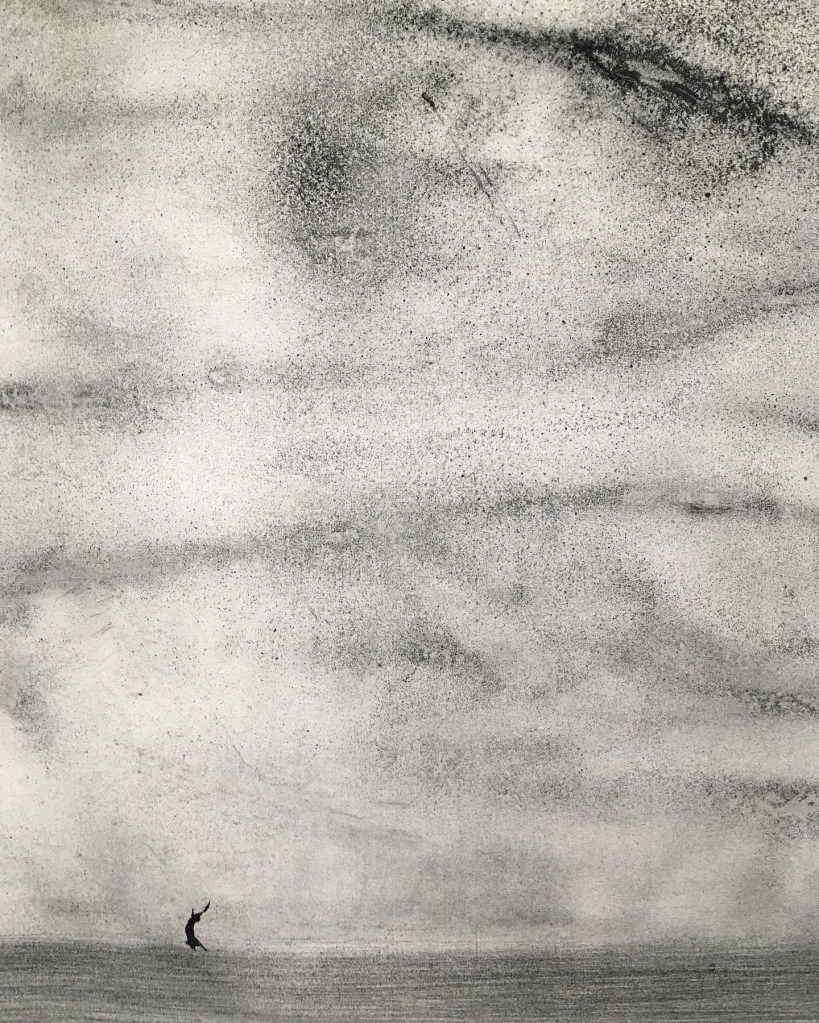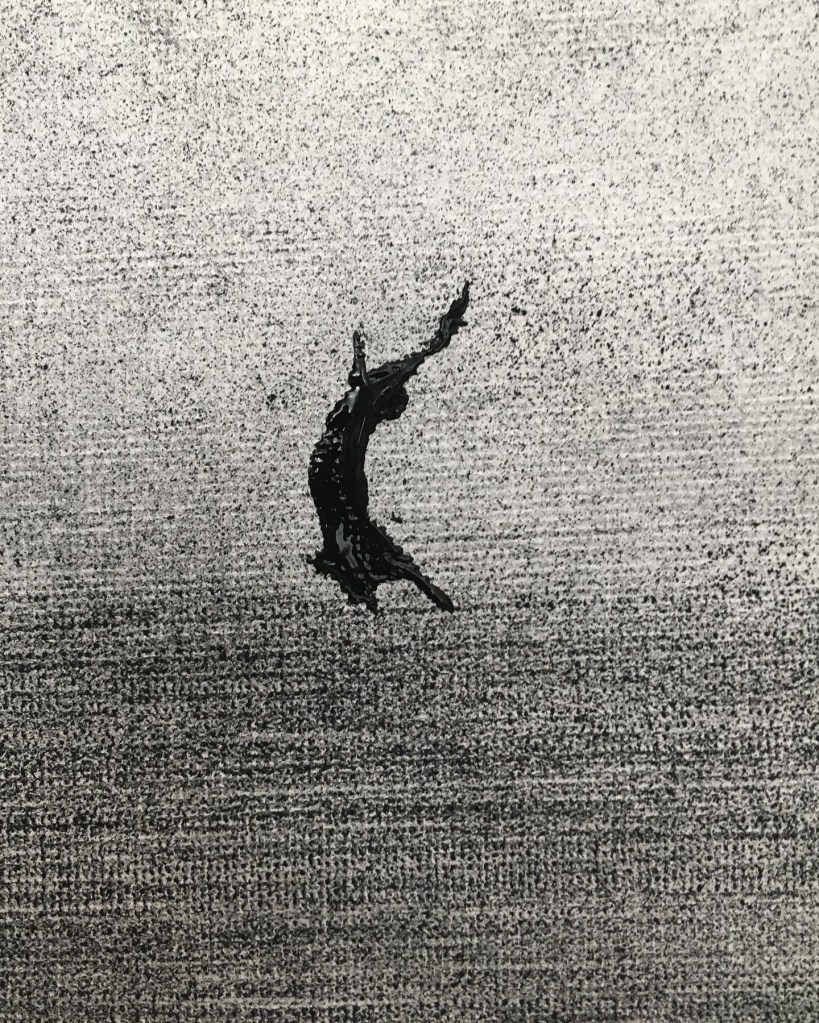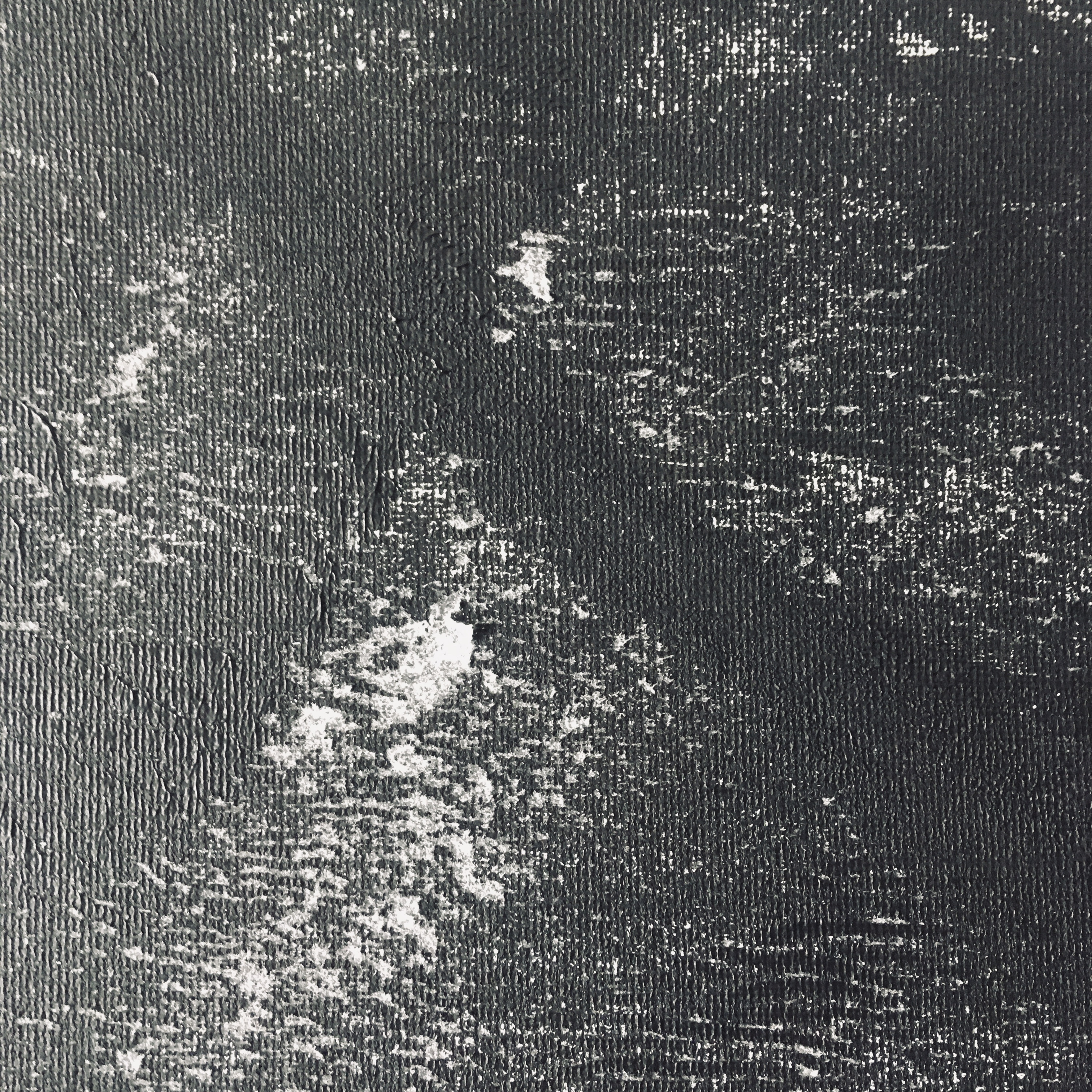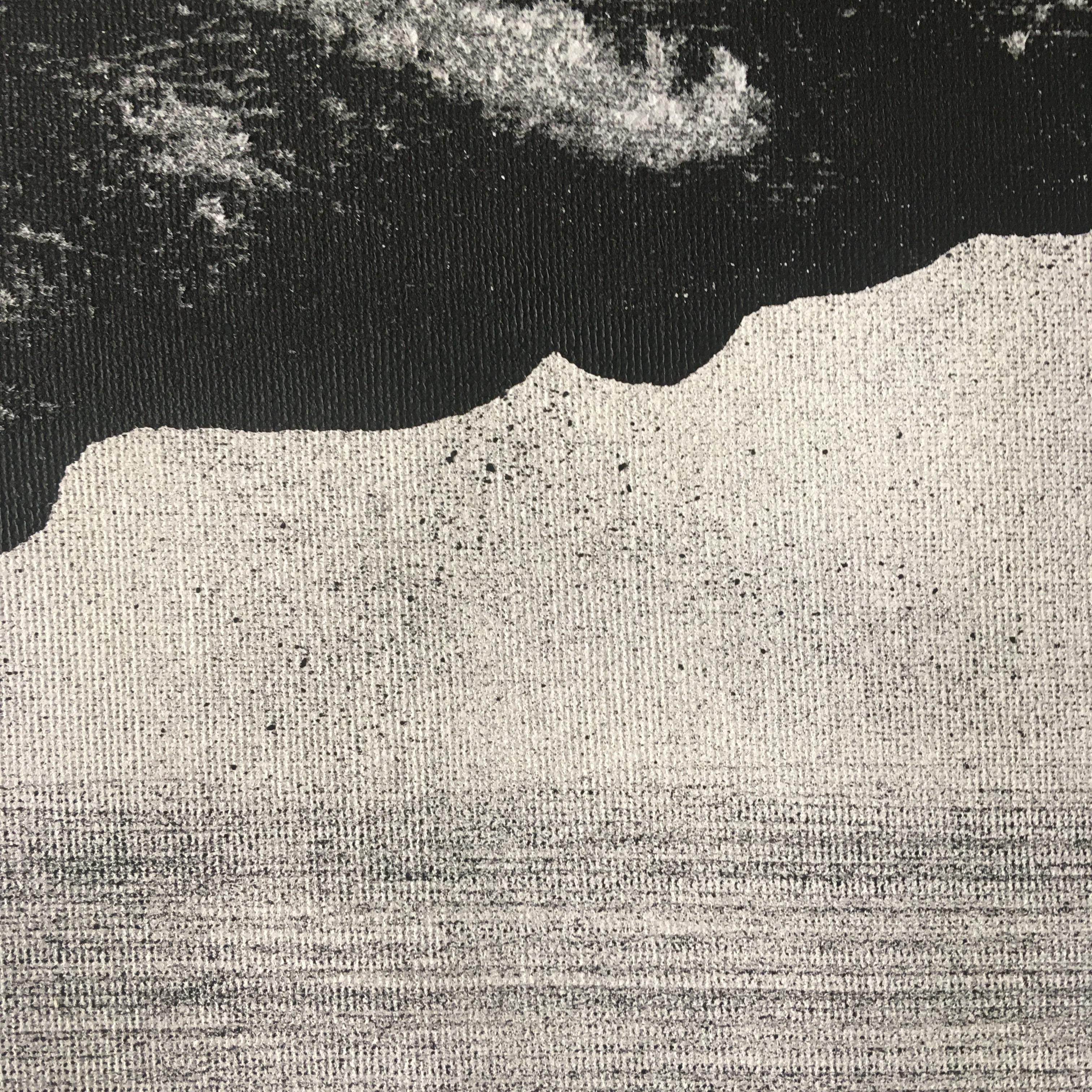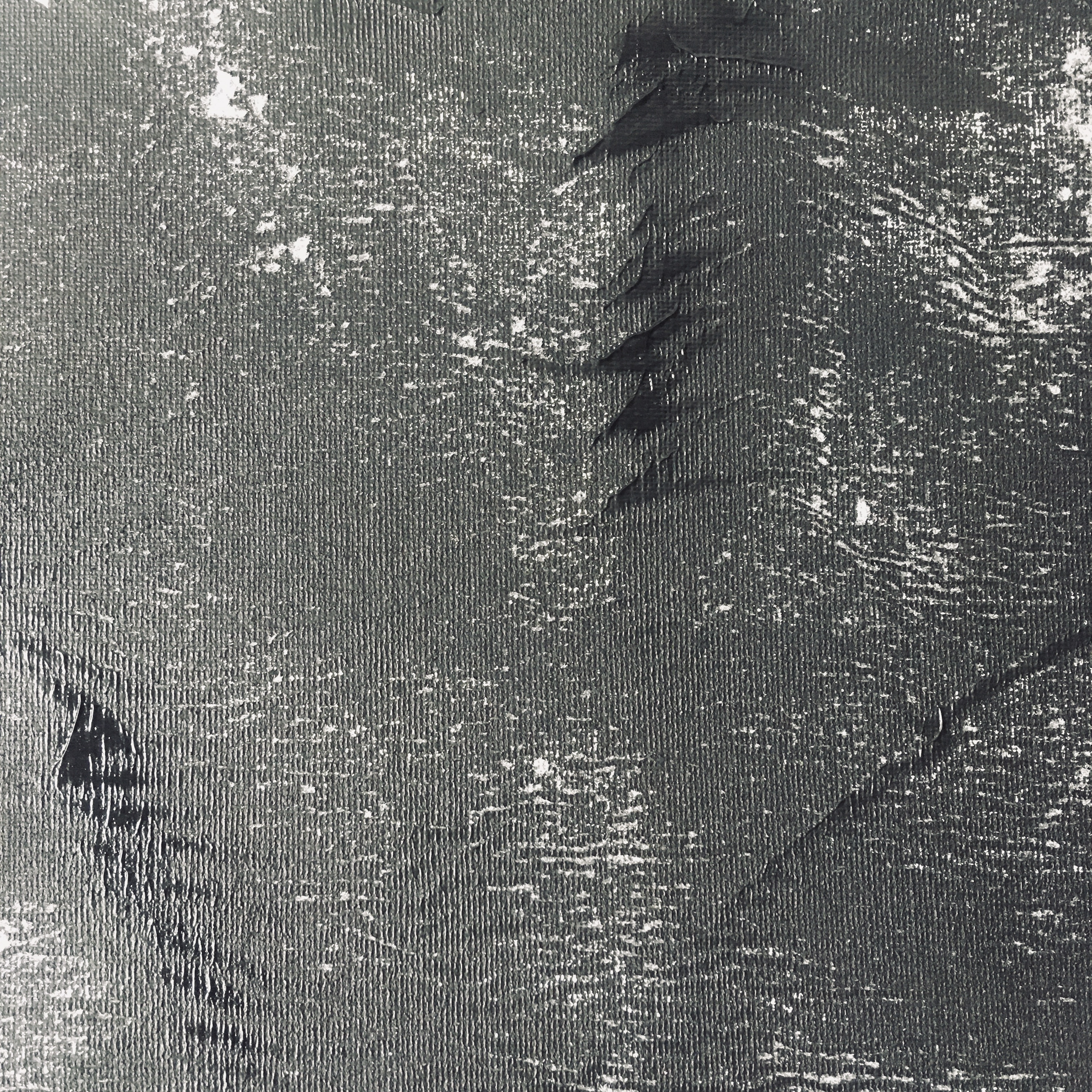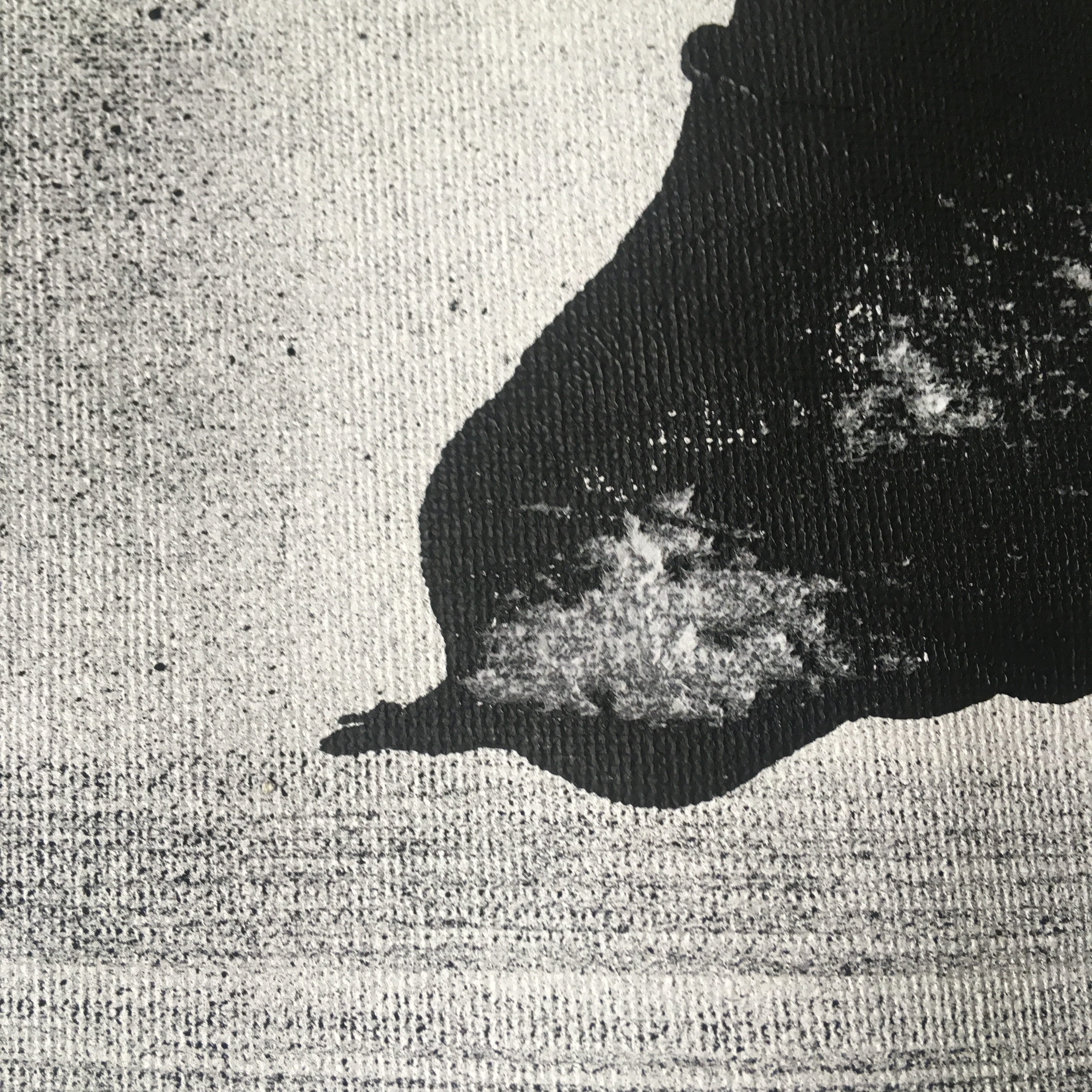
Thought Fields

A particle is a localized excitation of a field, whereas a field is a continuous entity that represents something at every point (such as a force).’

As well as being and becoming and the nature of matter in time Ive been thinking about thoughts, their behaviour, origins, nature…

When I’m not studying or working my subjective thought beam isn’t focussed on an object so the beam becomes unfocused and diffuse but thoughts continue to happen often unbidden, unwanted, over-familiar and detrimental.

They can seem to appear almost from both an internal and external source – they involve my memories but with a kind of third party voice – hence ‘they’..

And suddenly I have become the object of thoughts subjective action – i am the third party

The observer

This type of thought can ping into existence like a proton emerging from a field of potential

And the subject and object intertwine and whirl around each other exchanging energy from order to disorder

Yes i know

I’m using pseudo scientific language – a language that is itself already metaphorical as it seeks to extract Magic from Technic

But in a post-mod era where language itself reflects our uncertainty…

“…i was like thinking about like I don’t know, like kind of thinking about like kind of thinking…” is, it seems, an acceptable sentence in contemporary speech…

..then ill use whatever is to hand.

There isn’t a future tense in English. We use intention – I will visit the mountain, I am going to see the film.

That’s because language evolved as part of our evolutionary experience in partnership with the senses. But now its lagging behind.

What are the words that describe the position of the flower tomorrow in relation to today?

Thoughts on Time, Being and Becoming

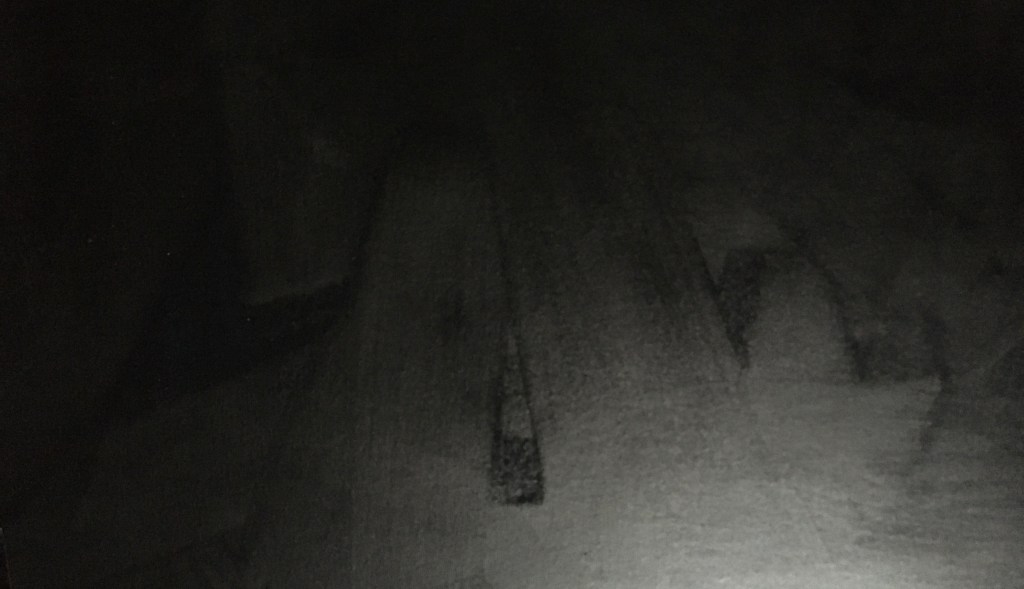
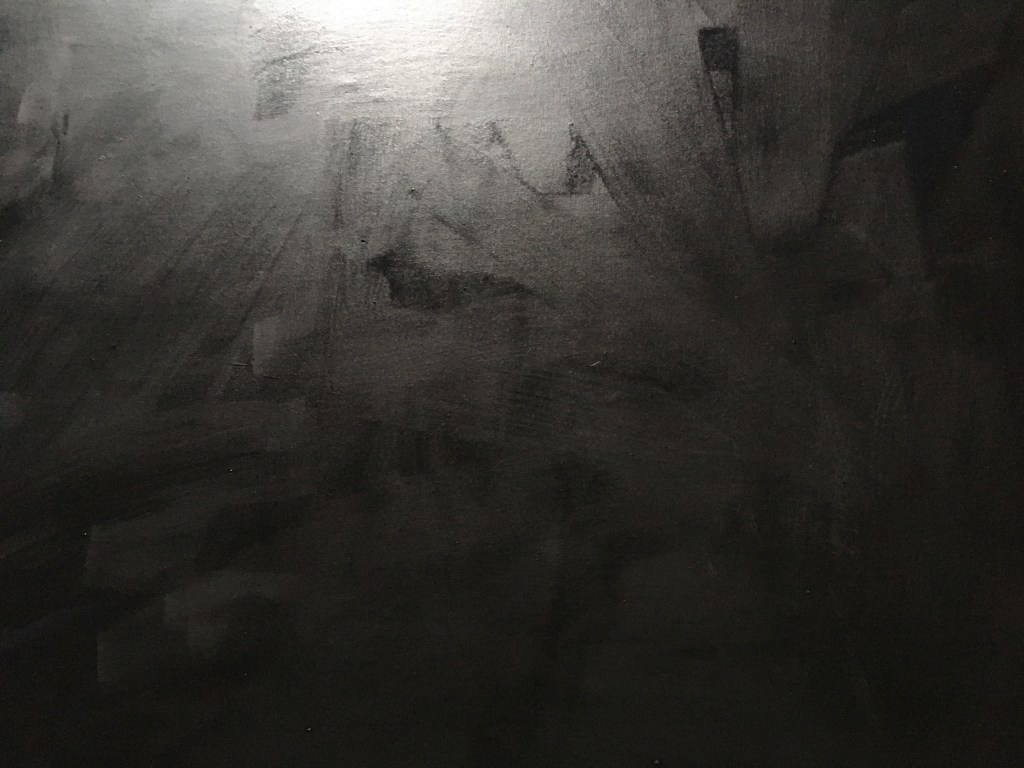
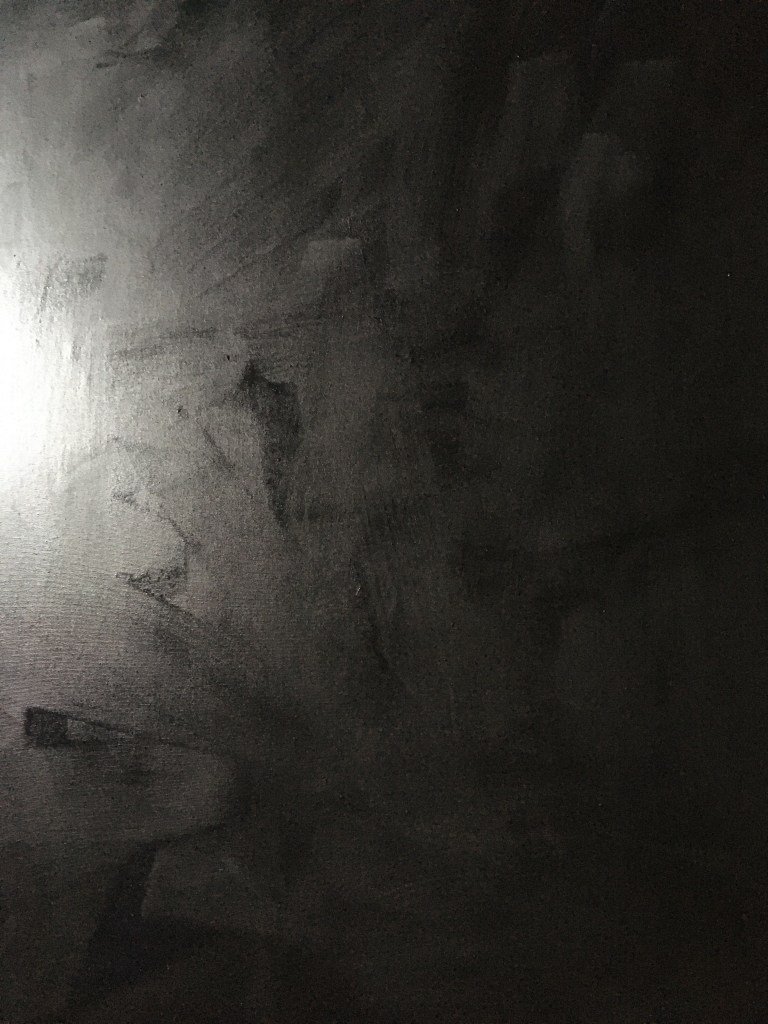
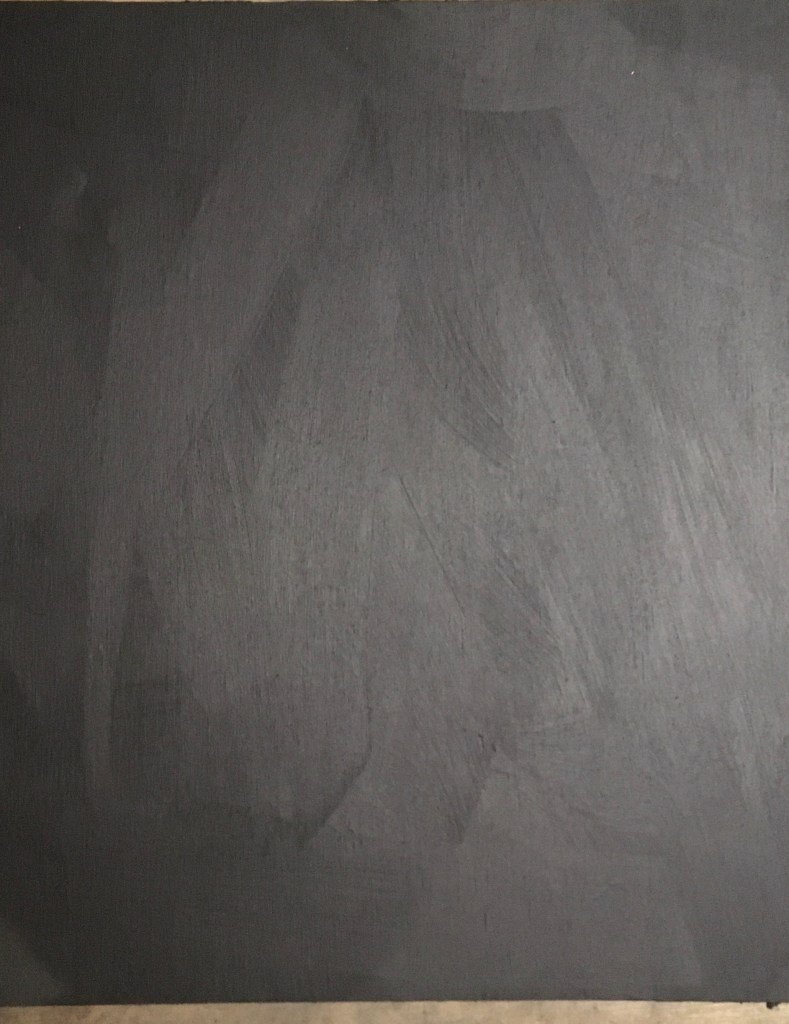
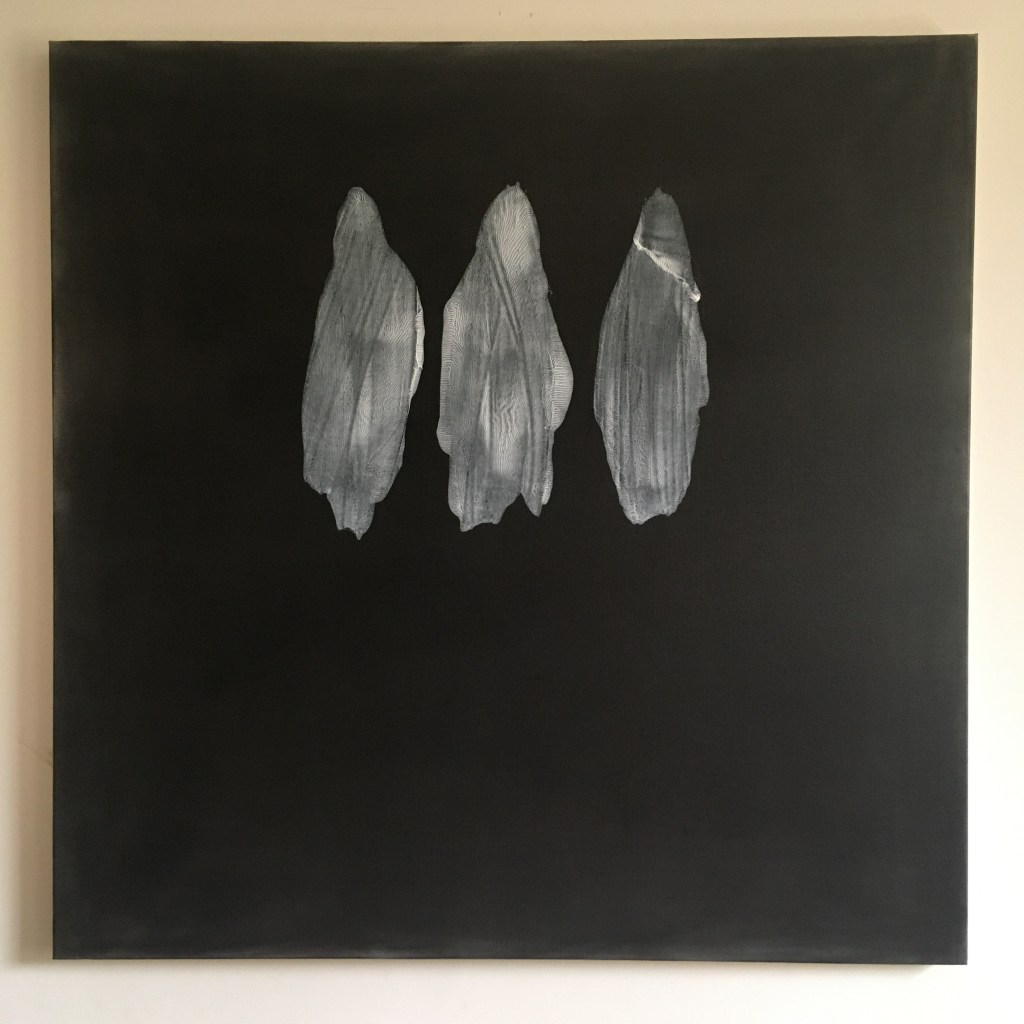
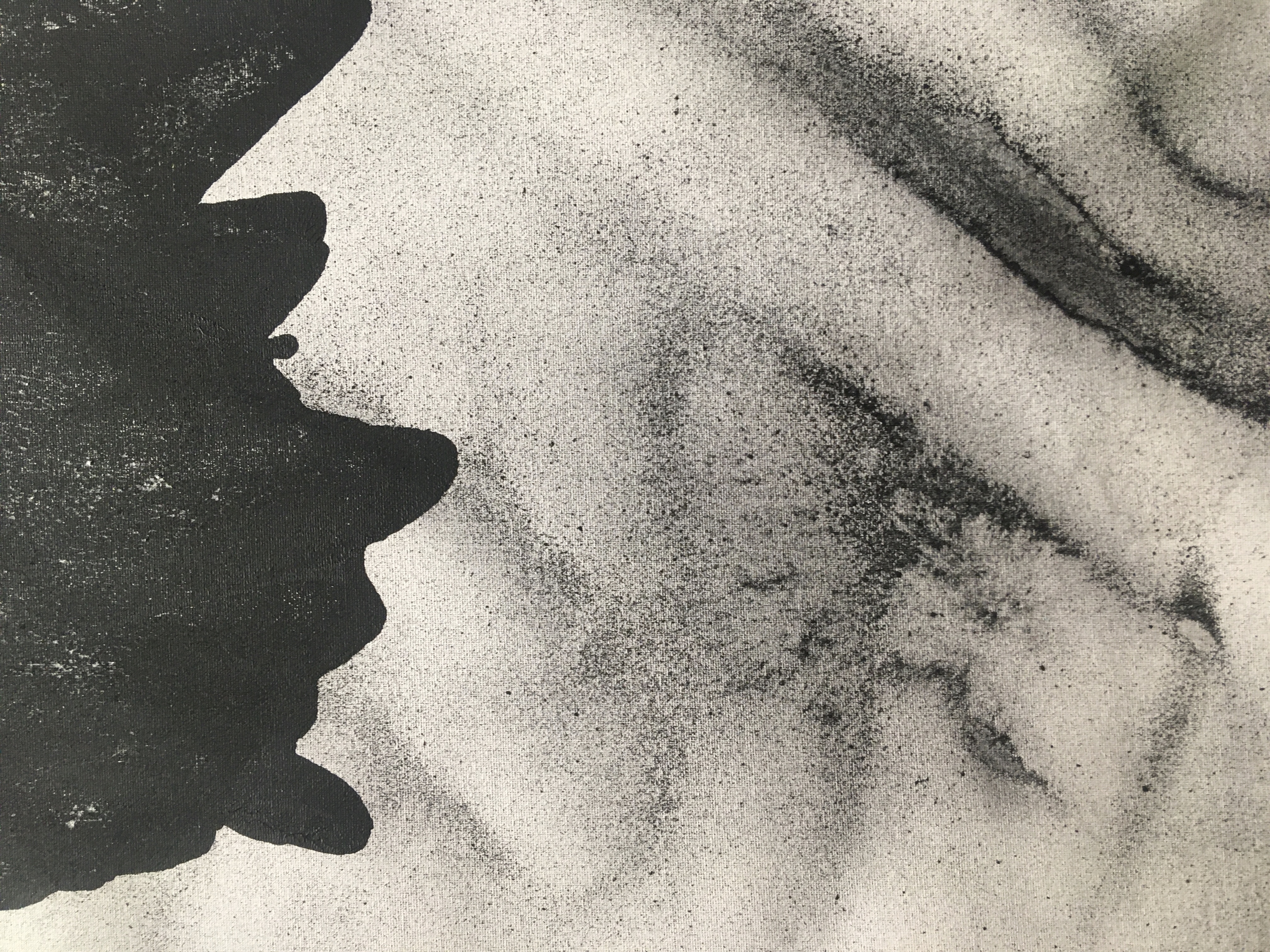
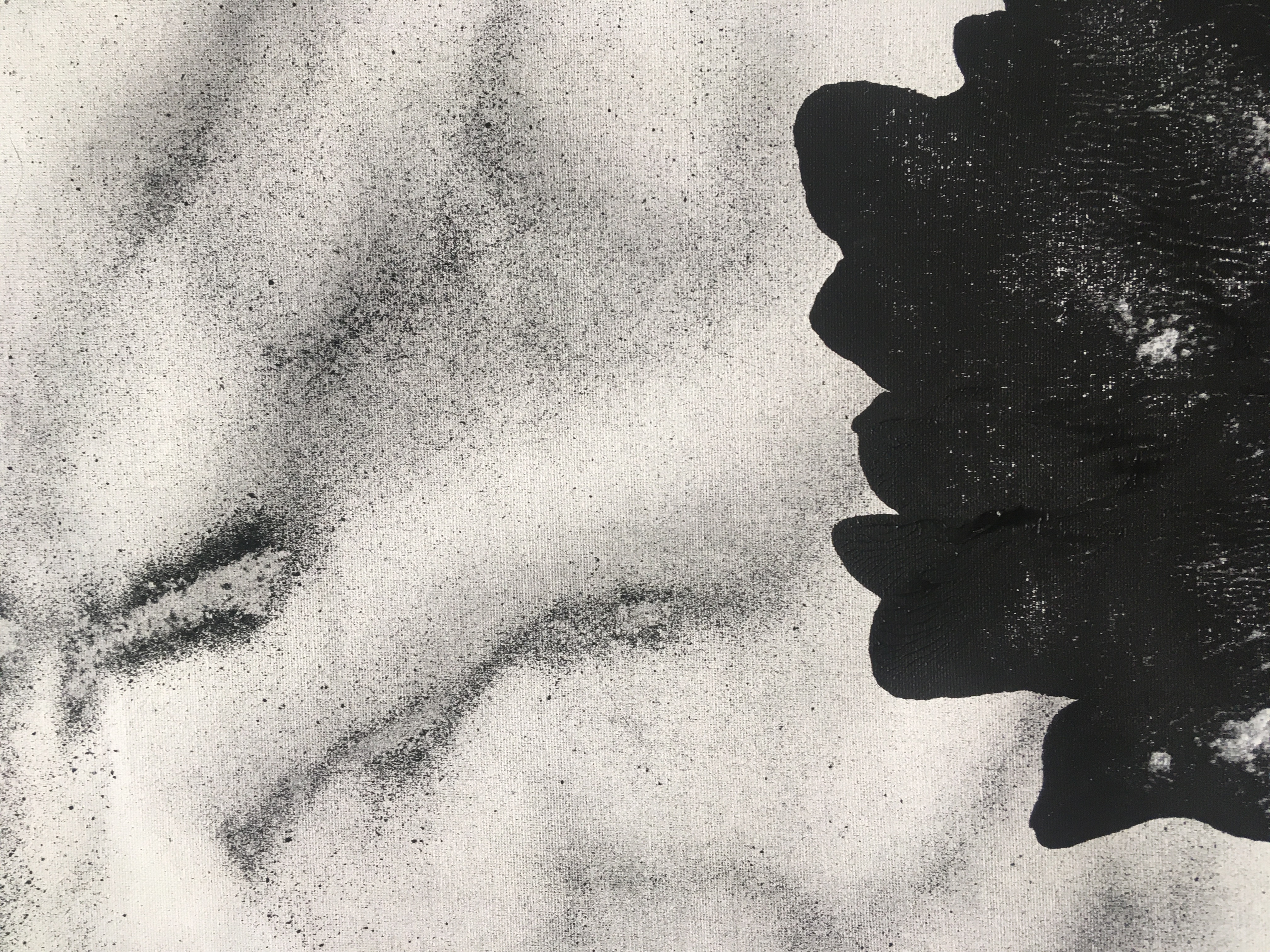
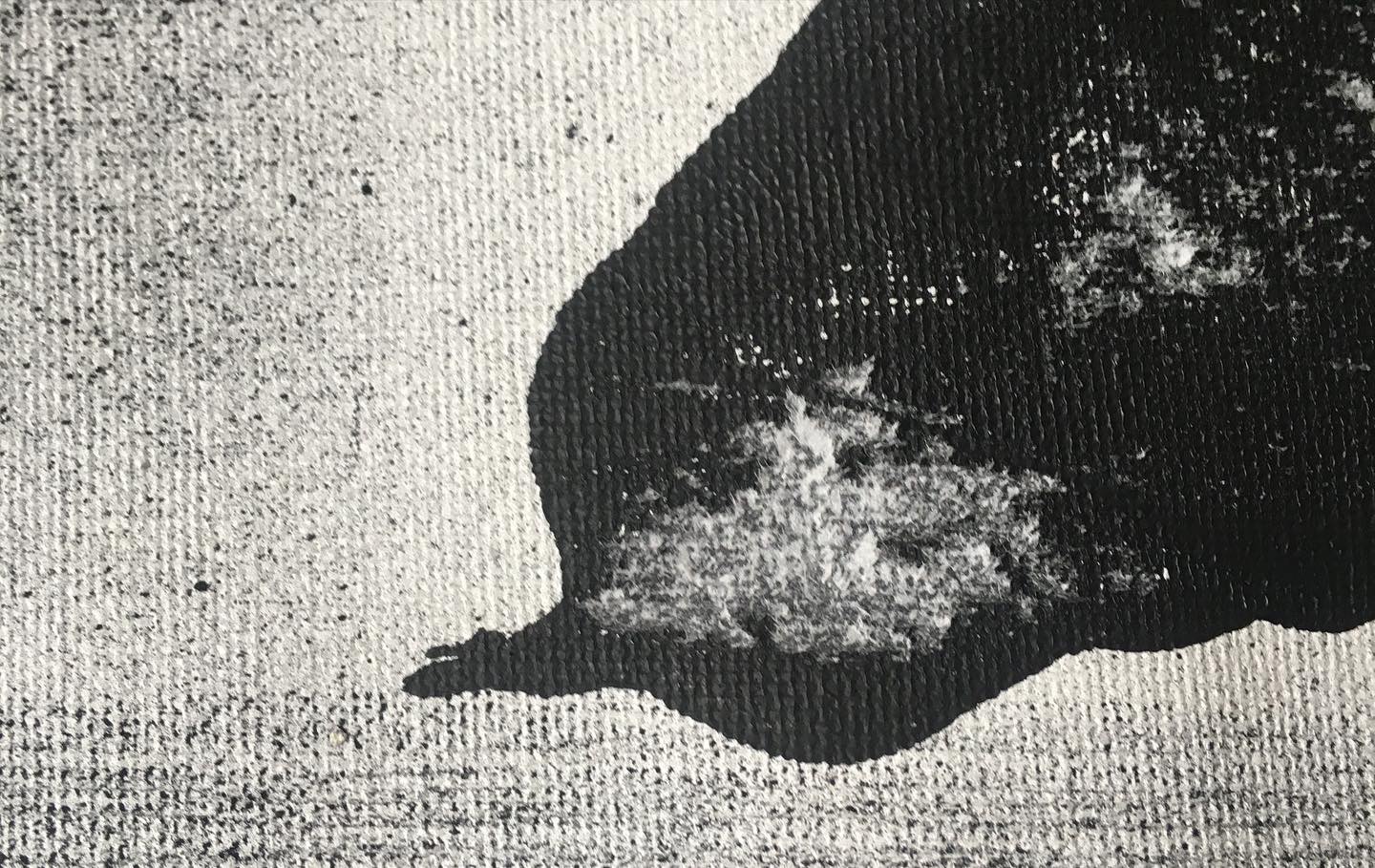
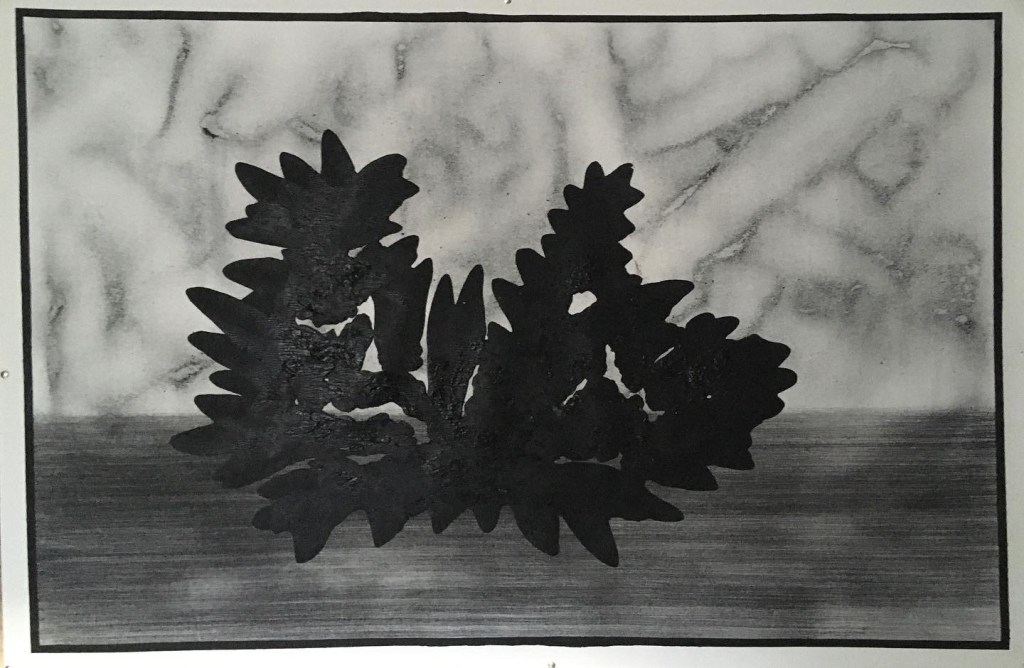
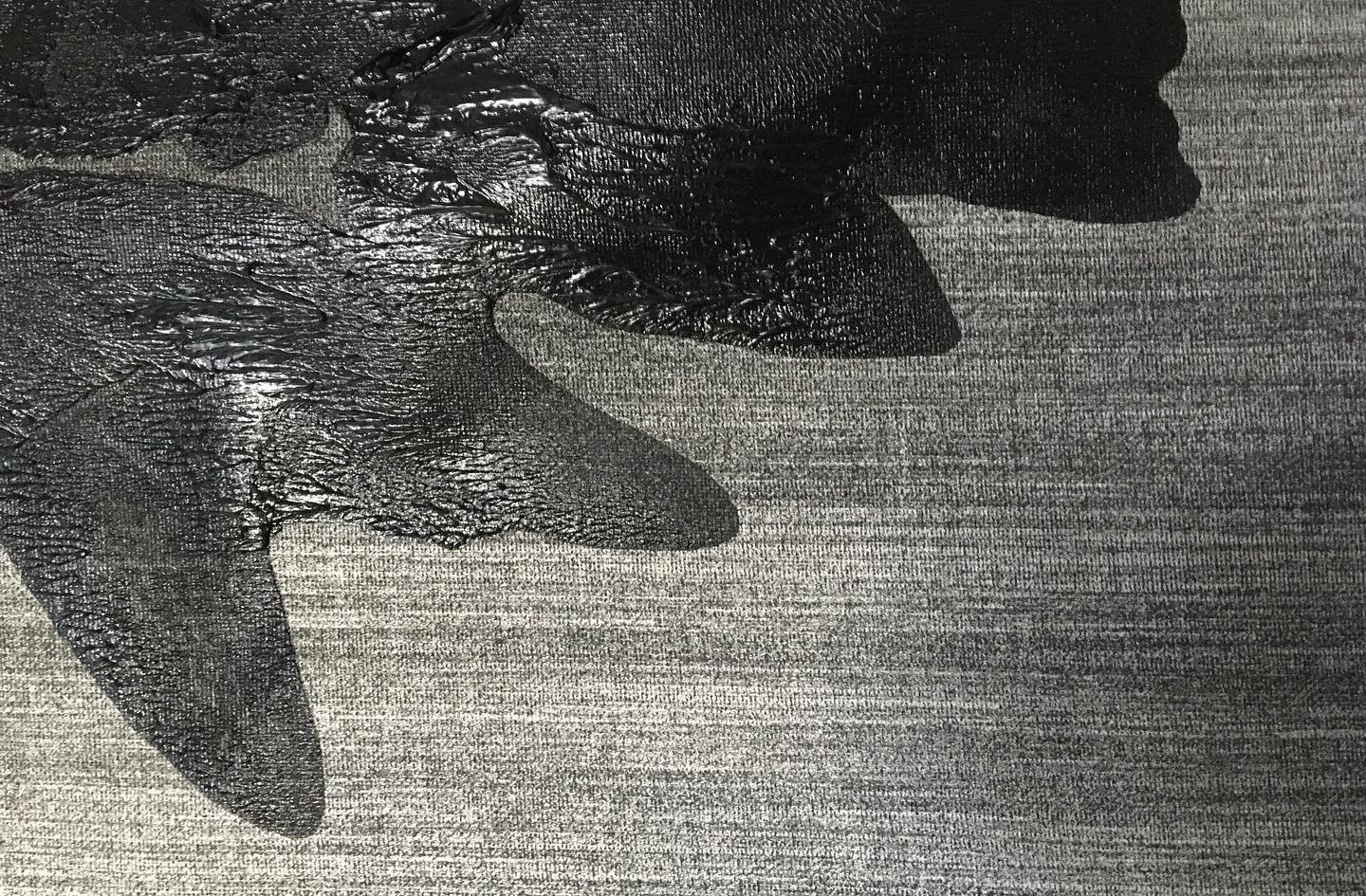
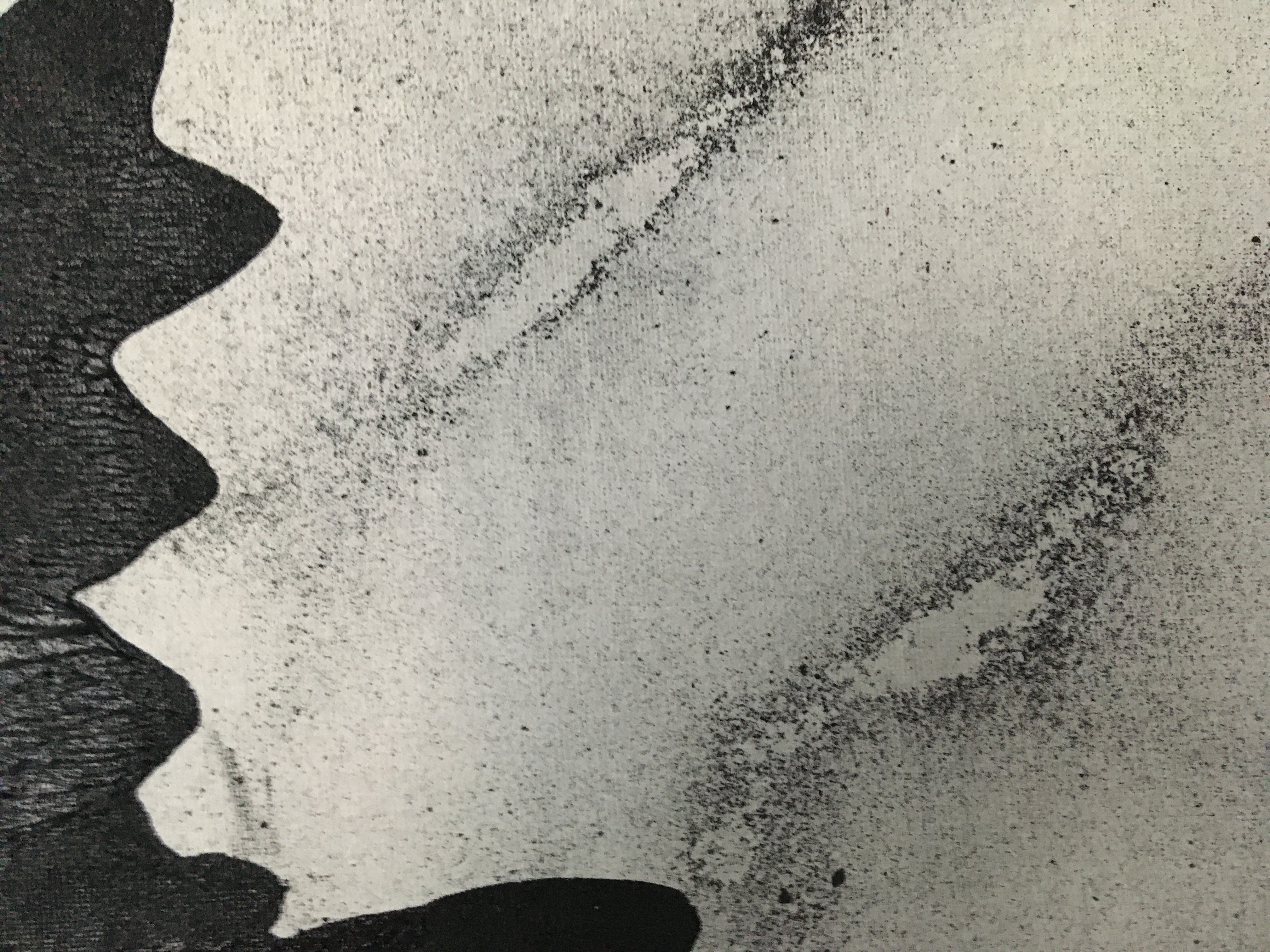
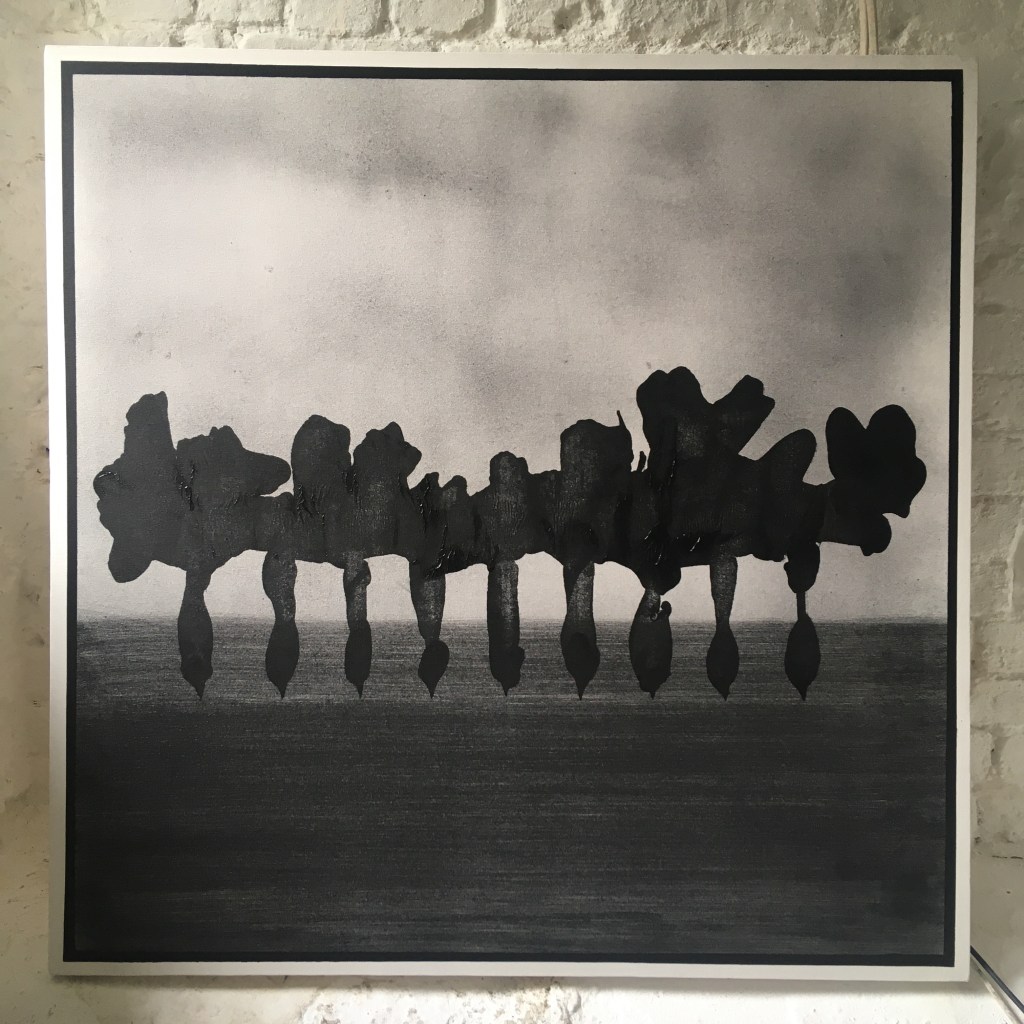
Three Pre-Objects (carbon dust, acrylic, paint, canvas 100/100cm)

Here’s a thought experiment.

You plan to visit a mountain tomorrow.

To look at it, walk up it, maybe climb it.

You are confident it is there now as you plan your trip.

You are confident it will be there tomorrow when you arrive.

But given that tomorrow is the future and therefore does not yet exist, where is The Tomorrow Mountain whilst you make your plans?

Option A: It already exists in the future and you will visit it like walking onto a stage in a theatre.

But if thats the case then so do the flowers that grow on it thus everything already exists in the future including you visiting it.

QED all Existence is simultaneous.

Impossible right? So…

Option B: It exists only in the present.

But doesn’t this require it to come into existence out of non-existence at some point?

So all existence is perpetually generated out of some kind of potential? Or probability?

What does that look like? That coming into existence in the present out of non-existence in the pre-present?

(Let’s not even think about where the mountain goes once the present moment has passed – the post-present)

Either the future exists or it doesn’t. The fact that I can put a glass down on a table or plan my walk across a room to put the glass down and then enact the plan suggests it does.

(Obviously it is all a conceit of mind and language, a conspiracy of senses and stimuli, an illusion of subject and object. A paradigmatic worlding. Mathematics and I expect, certain non-indo-European languages, might offer some perspective. But I don’t speak any of these).

Cataclysm

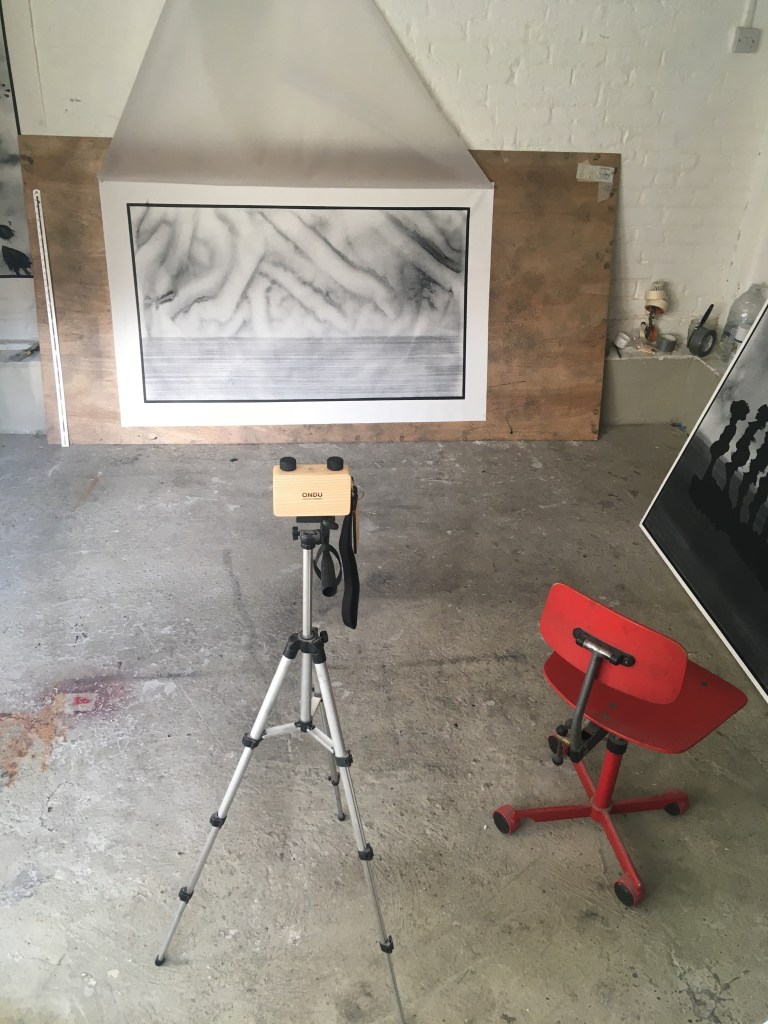
Measure canvas using golden ratio

Tape up and paint border

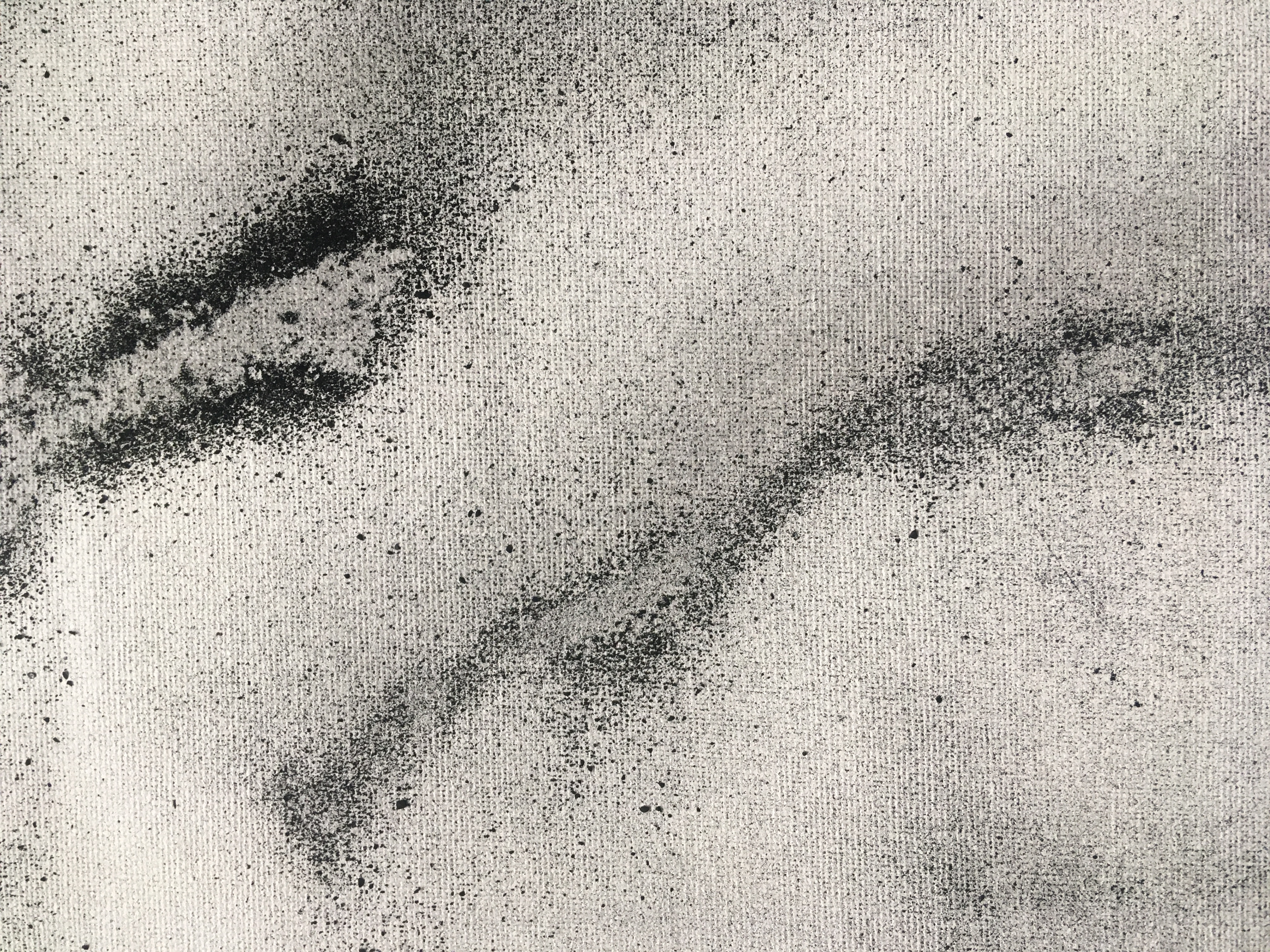
Grate compressed charcoal into carbon dust over canvas on floor

Gently shake the canvas and the dust coalesces

Spray fix

Peel off tape, pin to board and lean it against wall

Sit down, walk around, look at it, walk away, do other stuff, come back, sit down, look at it.

What am i going to do?

I like these shapes – I don’t want to fuck this up

Tension

All I’ve done is mingled some dust together on some canvas with a bit of shaking and a garden broom. Now I’m confronted with this weird landscape. I could do nothing. But i anticipate spreading the paint. I want to see what happens. I want to see what the material has to say.

I ask myself

You’re staring at the horizon

Anticipating cataclysm

Cezannes cataclysm of painting but also cataclysm in general – seeing ones own extinction approaching – a basic psychic fear of the ego being overwhelmed

What does it look like? This Cataclysm on the horizon, appearing from over the edge of the seen

How does the cataclysm appear?

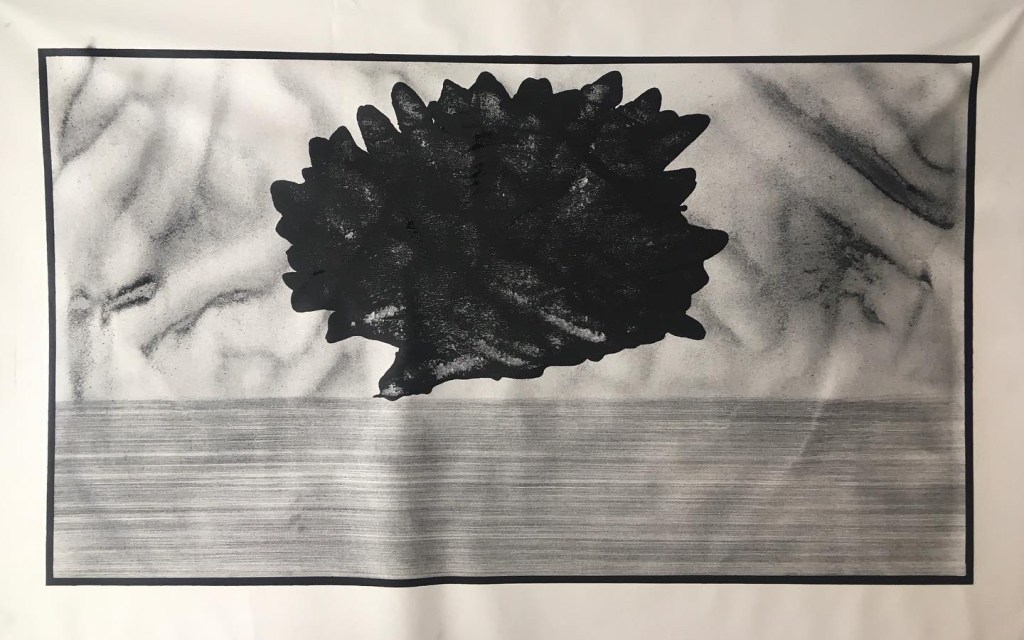
I use the small trowel to apply wedge strips of paint. I’m thinking about the Scylla or the dragon in Jason and the Argonauts. A great monster gradually filling the sky as it nears

But this has three necks three heads

I drop the tracing paper down and begin to spread the paint with the blade

It takes its own shape

When i peel back the paper some of it has bonded with the paint and canvas – good i like that. I like the whole thing. Cataclysm averted. Or achieved

“God is a lobster”

A 1.5 by 2m length of canvas pinned to a piece of 3mm ply. The canvas was fairly floppy. When I shook the board the carbon settled into interesting drifts which I sprayfixed. Ive been using acrylics because of the drying time so I had a large tube of oil paint left over. I squeezed it out randomly, this time with the canvas still on the floor to avoid any run off, put a sheet of tracing paper on top and started moving the paint with the blade. My only intention was to try to keep the paint from closing all the internal gaps so that the background wasn’t completely covered by a blot.

When one is trying to surrender some agency to the material, the picture self-composes. I don’t mind that. There is tension in the off-centred paint in relation to the frame. It’s unsatisfactory and adds to the movement and nausea. It’s trying to avoid the centre. Or find it.

I like the carbon dust coalescing into tube like clouds of spores that seem to emanate from the oil that has taken on a kind of plant crustacean form. Or maybe the plant-crab is forming itself from the particles that pour in through the cracks.

Gives me the creeps.

Deleuze talks about rhizomes, striation, smooth shapes, holey space, lobsters

(“God is a lobster, the double-pincered abstract machine of natural stratification, and thus part, but only part, of nature”)

And i seem to see a kind of representation of all of these things here.

In fact I haven’t read any Deleuze for over a year. Though I have just finished Federico Campagana’s Prophetic Culture, Timothy Morton’s Hyperobjects and Nagerastani’s Cyclonopedia which have all combined to bring on a feeling of creeping Deleuzian nausea in me.

But I have never sought to paint or sculpt a representation of what I have read, like an illustrator. And there is no conscious intention to the painting beyond the mechanical practicalities – the behaviour.

Perhaps its the plasticity of the finished oily forms that lends them to what one has read, or heard, or seen. Or the placing of an apparent blob in an apparent landscape. I make the painting and then I look for meaning. Or familiarity. Or metaphor, sign or symbol.

That’s what the human mind does.

And it watches itself looking.

I’m interested in making art that is unopinionated, that isn’t a representation, statement or metaphor, or sign or symbol.

The work happens quickly.

Materials + Process

No slow building up of detail and generalities or layers.

But I can’t stop the mind, any mind, then taking the finished piece and colonising it. It does this in two ways. First it invades the space, the canvas or sculpture, occupying it in detail. Then it absorbs it whole, categorises it, placing it hierarchically, externally with opinion as the weapon of control.

Opinion, good or bad, is generally unhelpful. It raises barriers, closes doors. To live, or die, without opinion would be a good thing. We express thousands of little opinions every day, about every little thing our senses encounter. They are little closed units of categorisation and judgement that serve to defend our sense of our own importance in the world. They are an expression of vulnerability. And they are invariably boring.

New Artists Statement!

You are walking along a road, on a pavement, past trees, people. You consider the path ahead of you. You can see it ready and waiting for your shoes contact. You can see the corner of the street where you will turn. It’s ten minutes away but it is there waiting. It exists in your immediate future! So the path, trees, people and their particles exist in the future? How far into the future? All the way to eternity? Or does everything coagulate and coalesce out of nothing in the present, into solidity, certainty, truth in an act of perpetual worlding?

I am interested in what either of these possibilities might look like before our senses, mind and language conspire to paint our reality: the potential of pre-objects prior to their being subjectively observed.

In this series of paintings I bring particles of carbon, black oil or acrylic, paper or canvas together, allowing behaviour and material to engage with each other in mutual activation. The dust is worked in with a broom and agitated, or activated with a stick. Paint is applied directly from the tube or trowelled on indiscriminately before being covered with tracing paper and spread with a blade, allowing the tools, materials and gestures to make unsettling shapes in tension, that appear to have not yet decided on their final forms.

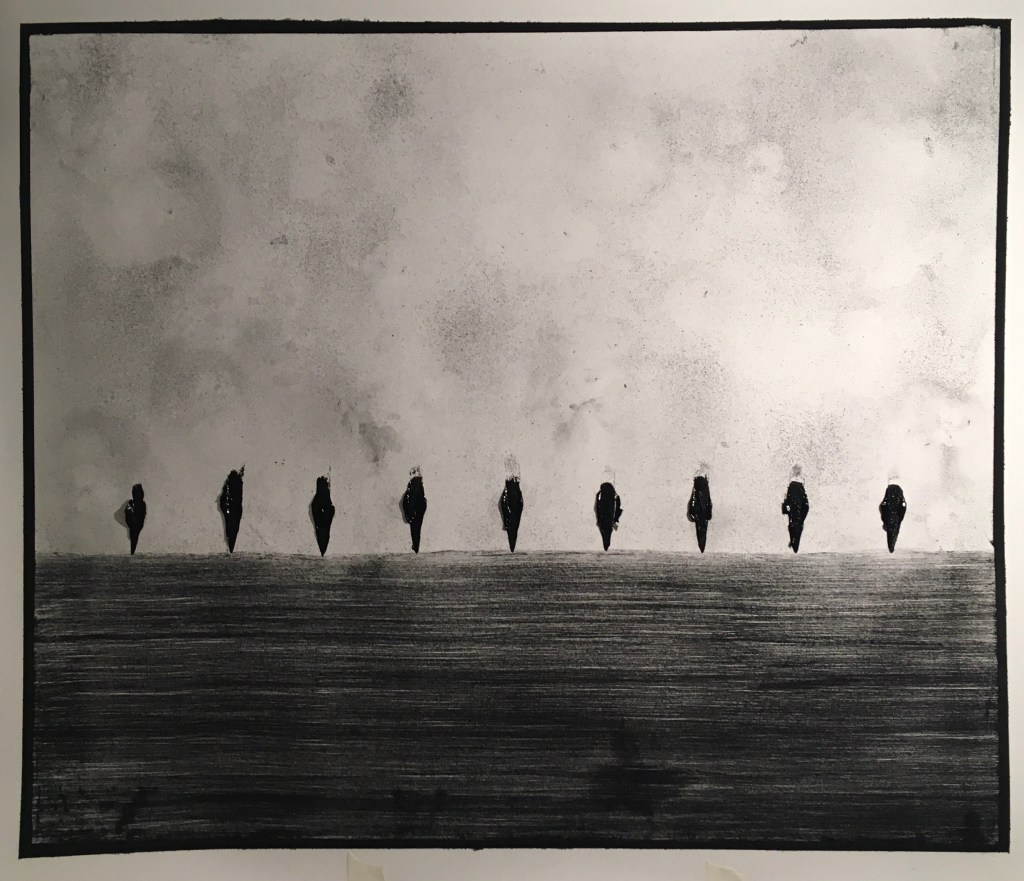
Nine for the nine bright shiners

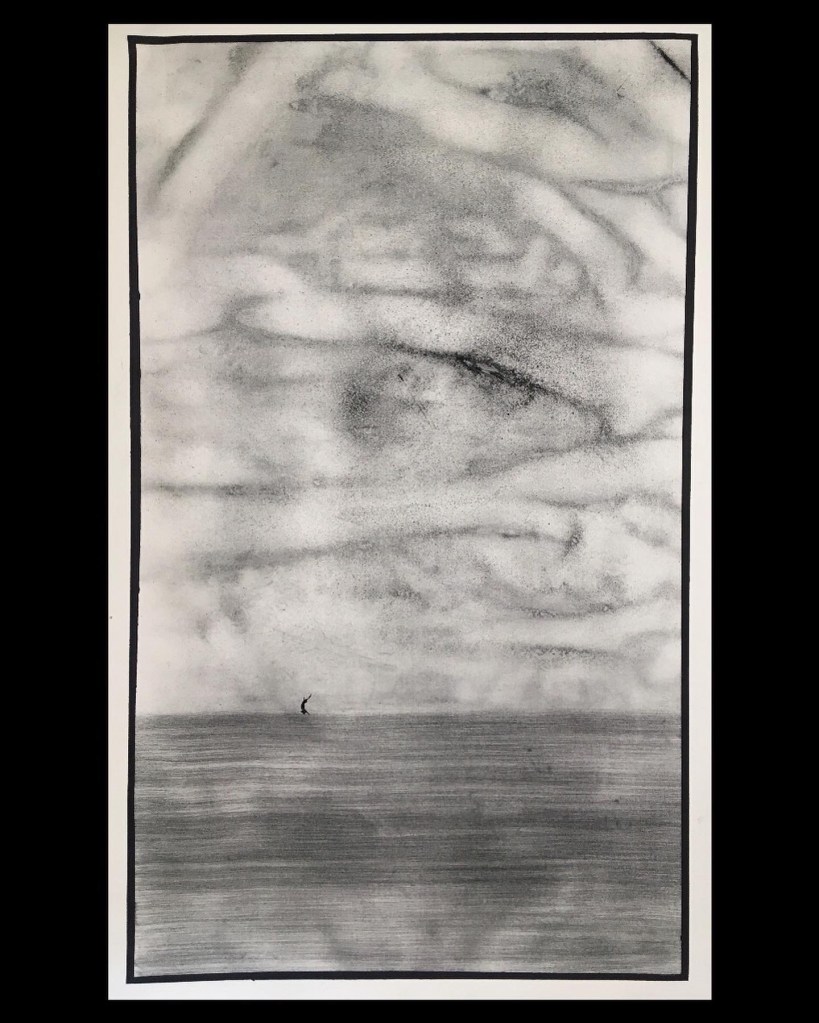
Materials: About a metre square Arches paper, compressed charcoal, spray fix, black oil paint

Equipment: Masking tape, coarse sandpaper, garden broom, small pointing trowel

Made the frame the usual way. Tending toward a thinner frame, resembling, it seems to me, a hand printed black and white photo frame. I worked in a darkroom for a while and remember the thrill of the alchemical processes, the risk of pushing things too far, knowing when to stop. I like the excitement and fear when confronted with the delimited area.

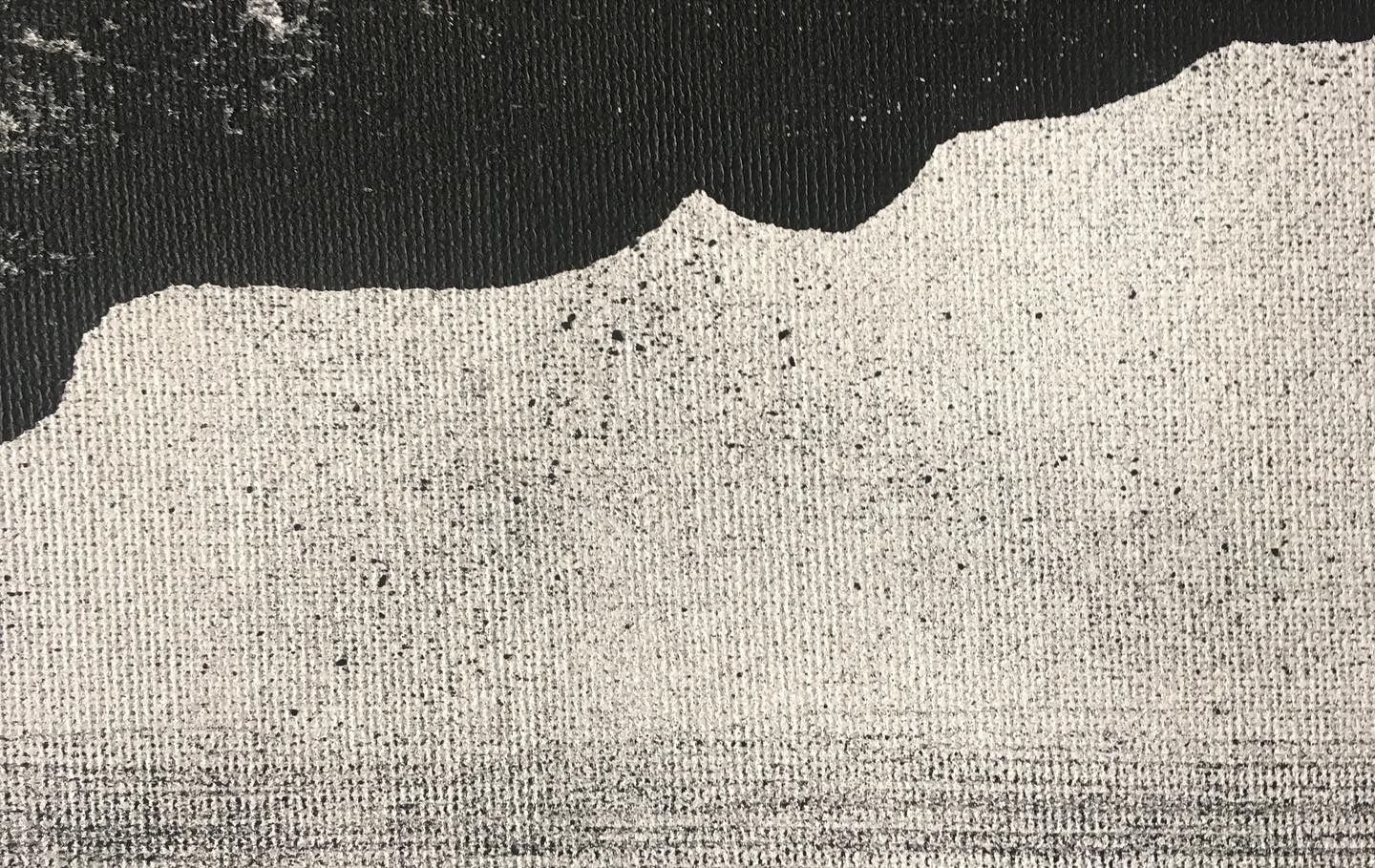
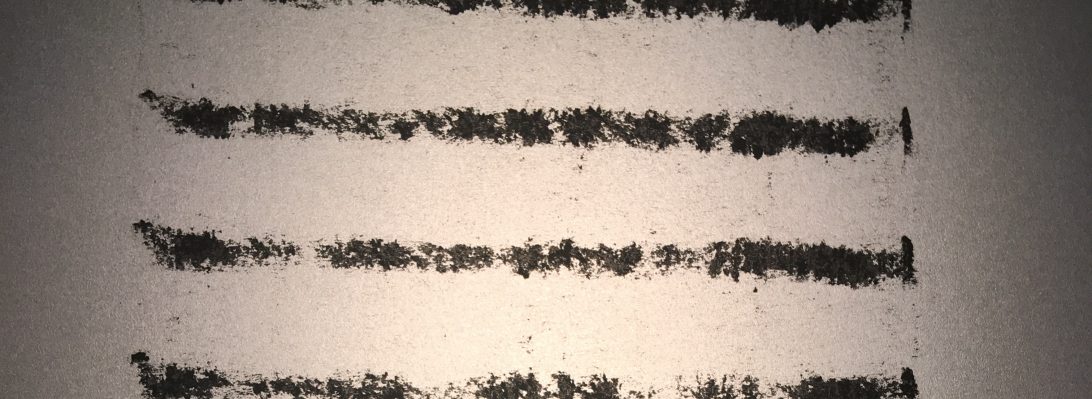
Once the frame is made what happens next is unplanned. I’m coarsely grating compressed charcoal over the paper mixed with the sweepings from the previous work. I look around the studio. There’s a broom here, part plastic part wire bristle, from the garden. I’m brushing the width of the head across the paper. It’s making beautiful lines, picking out shapes from the cardboard beneath. Shadows. It’s difficult not to think strata, radar, horizon, sky, cloud. I’m mark making, interacting with material. I’m not trying to represent landscape. But the human mind, in league with senses, does what it does and once done its hard to undo, though its fun to try. Without language everything would be two dimensional. With language even two dimensions become three. It’s fun to remind oneself, force oneself, to go back from three to two.

Now I’m confronted with this moody flat landscape and I want to place some oily sculpture into it.

I poke the thin trowel into the tube of paint as far as it will go and pull out a sort of wedge of oil paint. A shining black sliver of potential.

I place the point on the brushed pencil lines where they meet the dust and push the flat of the blade onto the paper slightly drawing it upward. Paint squelches out the sides and blurs at the top. I repeat, trying to divide up the paper equally.

At this point I might apply my tracing paper technique with the Stanley knife blade and see what happens. But I like these strange little monoliths all in a line. Pilgrims? Refugees? Soldiers?

None of the above.

Smears of paint and manipulated carbon on paper.