Drawings

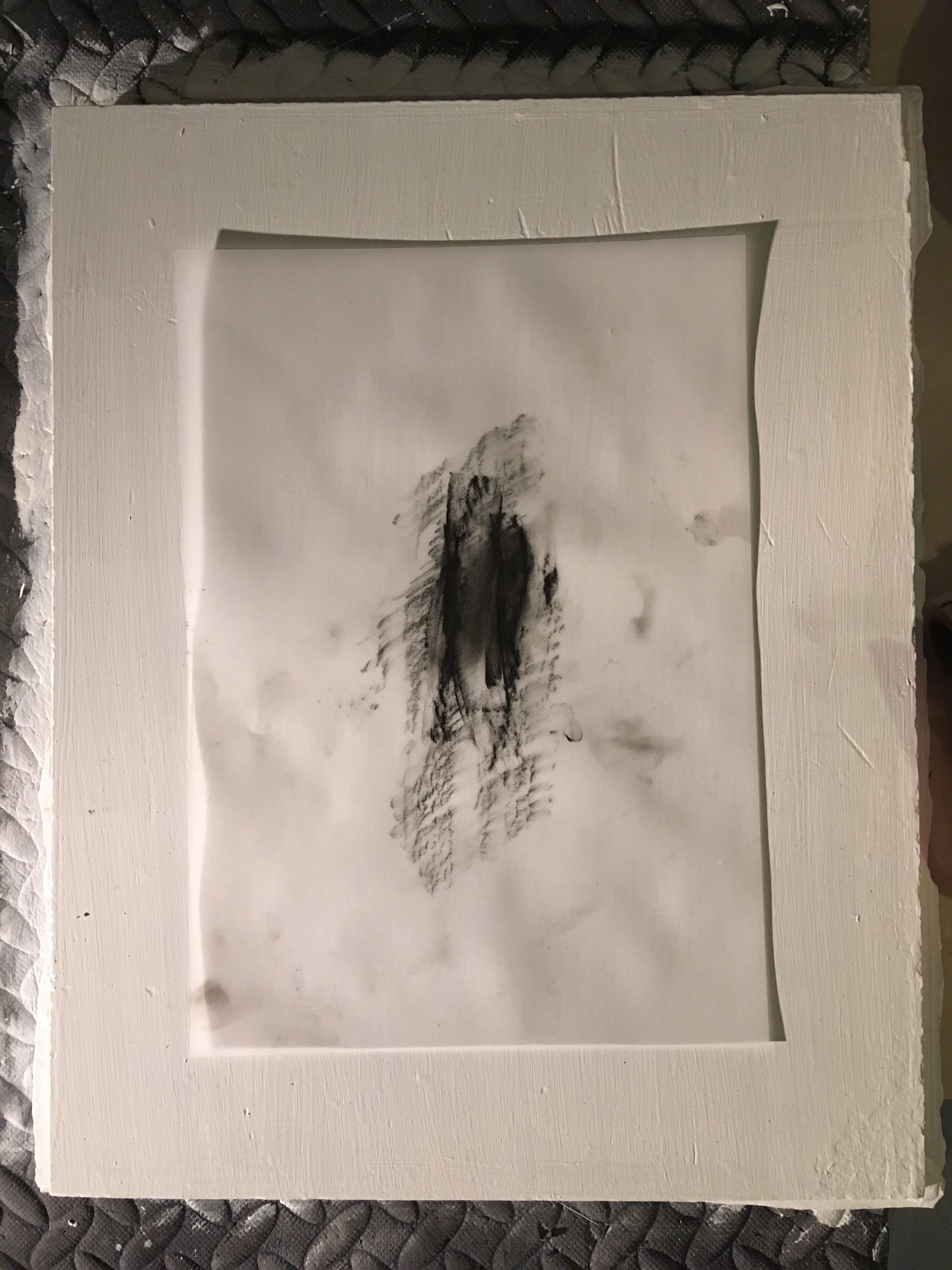
image_c7d670f1-8294-47c5-b7af-1f9dc7abd318.img_6355

image_b774903e-4bf8-430a-aa66-164a5f8ba44b.img_6340

80gsm tracing paper

Compressed charcoal

String

Cardboard

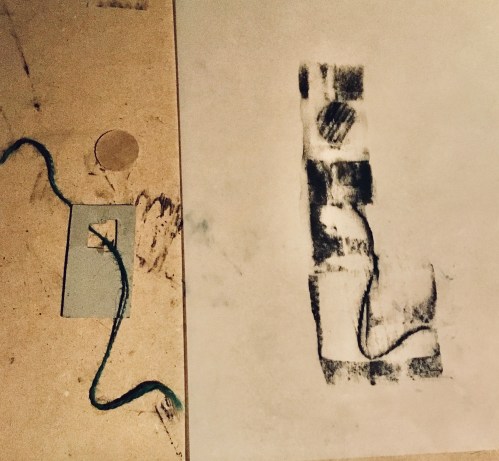
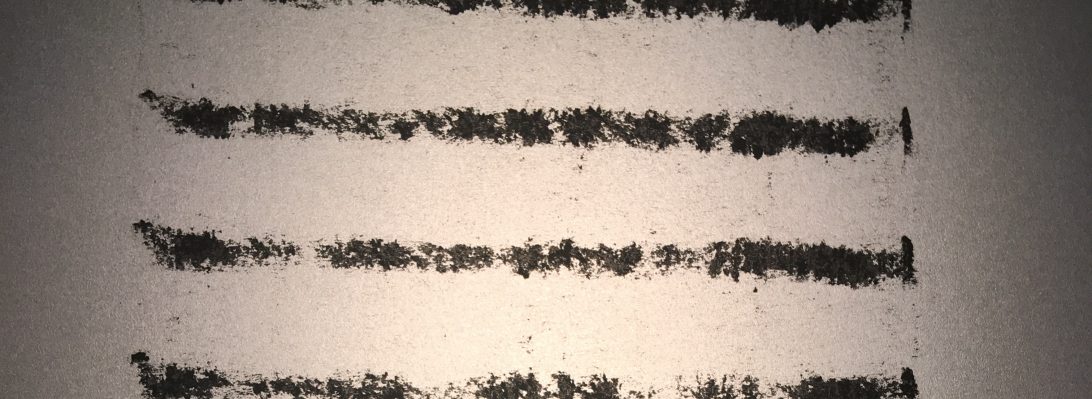
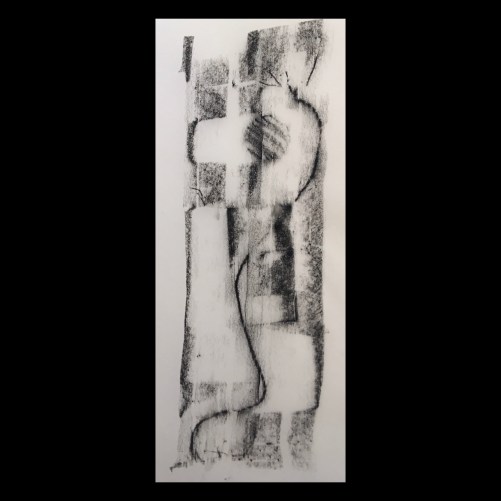
I placed the string and cardboard (taken from packaging – bits that caught my attention) on the work surface in random order with no thought given to producing a specific image. Placed paper over them and traced over in a downward gesture with carbon in as few strokes as was needed to produce an image. one, two or three depending on width of material or length of carbon stick.

The carbon cylinder tended to snap in half from the pressure. Or a curvature on the surface of the carbon cylinder would produce leg-like shapes.

Made as few conscious decisions as possible. Kept things mechanical. Didn’t make multiples or adjustments to create changes in effect. Didn’t make dozens and choose the ‘best’ ones. These were the only ones I made.

I had no intention of making anthropomorphic images. Indeed are they only anthropomorphic to me?

What was my intention?

To play with surface, the on, between and beneath.

To replicate the photographic dark room experience with its light-dark alchemies of revelation.

There is something Tarot about them

Coalescence: Dust, Time and Language


img_2403

(I have written at length about what led up to this work in my contextual essay but here I look more closely at the thing itself and the thinking and experience that surround it).

I have been thinking about time and language. I think that the story of Achilles and the Tortoise (Zeno’s Paradox), that my father taught me, is not a tale of paradox at all but a metaphor for the behaviour and role of language and its necessary unsuitability for the job of describing the world. Language protects us by dividing and separating the data that our senses are exposed to and expose us to. We experience more than our language allows us to access.

Past, present and future are just words for concepts that are divisions of a whole.

We think of the future collecting or harvesting the present, the present is the cause of both the past and the future and the past is a sump where the present and future drain into but is the present  a coalescence of the past and the future, or rather is each  a coalescence of the others?

Looking at a bamboo in sunlight in a breeze, as I am ‘now’

What happens if I ask not when does its present end, or its past and future begin, at what instant, but where? Is the bamboo perpetually occurring and perpetually ceasing to exist? And what does that occurring and ceasing look like? What are the physics?

When one asks this it becomes apparent that either the past and future of the bamboo do not begin and are therefore always present,  or the language is not suited to the reality. Time is spatial or it is just a word for our limitation.

Unless the bamboo, along with everything else, ceases to exist where the past, present or future meet, having only memory or potential, in a sort of blank absence.

Or everything occurs simultaneously and only perception creates temporality.

Or perception creates existence (Berkeley?).

If it is not perpetually occurring and ceasing , then it exists prior to my perception of it, in the future and post my seeing it, in the past.

Thus there is either no time or human language is not the right tool for the job of understanding/describing it. I have written elsewhere in this journal how I think our senses, in league with language, dismantle the world then reassemble it, sentenced. And about why I think this is the case – reality is too much for our minds and would have hindered evolution. That is to say, we exist because our mind evolved to exist in a niche universe over which causal time appears to reign. But that niche universe in return evolved as a result of the nature of human consciousness. Coalescent evolution of sensory perception, language and environment.

Proust located the past in memory but the bamboo seems to me to persist comfortably in time and space,  forwards and backwards, in its own right. Without my memory of it is there really just a non-bamboo?

But I don’t make art about this stuff. I make art and I am interested in this stuff and they coalesce.

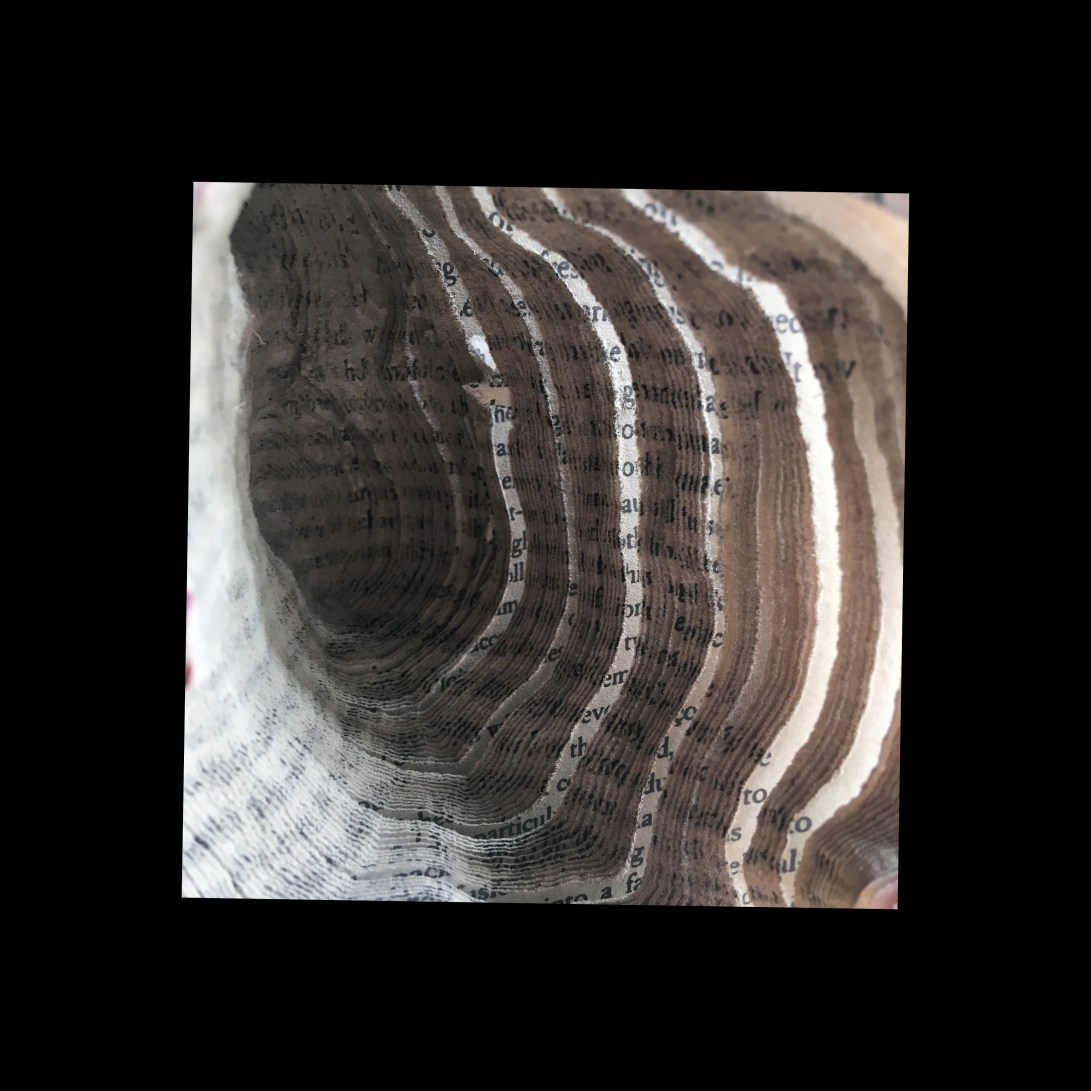
I didn’t conceptualise the obliteration of my copy of Swann’s Way. I didn’t think ‘ah now I will make a grand iconoclastic gesture of eroding my modernism!’. Or ‘now I will make a sculpture about my theory of the non-existence of time and the role of language in the evolution of human consciousness etc!!’ Rather I found myself finishing reading it after many years at the same time as I became/was made aware of my modernism at the same time that i was sand blasting stuff, at the same time as thinking about language and time. Also I was being encouraged by my tutors to work with non-stone materials, so I had been sand blasting paper, and so I sand blasted the book and collected the dust.  What accumulation of data led to this might be possible to collate, but to what purpose?

After ‘making’ the pile of dust i read that

‘In a modern world of stupefying banality, routine, cliché, mechanical reproduction or automatism, the problem is to extract a single image, a vital, multiple way of thinking and saying, not a substitute theology’ (May, T, p25 quoting John Rajchman) and

‘Lodge yourself on a stratum, experiment with the opportunities it offers, find an advantageous place on it, find potential movements of deterritorialisation, possible lines of flight, experience them, produce flow conjunctions here and there, try out continuums of intensities segment by segment, have a small plot of new land at all times’ (Deleuze and Guattari, 1000 Plateaus)

(‘deterritorialisation’ and ‘lines of flight’ meaning, I think, a nomadic, non-conformist momentum of thought and philosophy, a deliberate continuous, self-unsettling)

But May says that ‘the creation of concepts, which in Deleuze’s view is the only significant endeavour in which philosophy can engage, seeks to palpate and give voice to this difference that disrupts all projects of identification. Philosophy is ontology; it speaks of what there is. But what there is cannot be identified…What there is is difference’.

So if Deleuze’s advice on Deterritorialisation holds true for art,  what, or where, is ‘the only significant endeavour’ of the artist? Where is the difference? In my view it is in the attempt to behave artistically. Behaviour as the antithesis of Conceptualism. But that does not mean that Behaviour and Conceptualism, or Art and Philosophy cannot or should not Coalesce, as they seem to have done here, with the making (Making? Destruction? Salvaging?) of the book-dust sculpture.

‘The difference between materials and substantial elements is one of organisation; there is a change in organisation, not an augmentation’. (Deleuze and Guattari, p57).

Here I seem to be primarily changing the organisation of a book. Any conceptual meaning and metaphor is secondary. The sculpture is the result of a coalescence of my finishing reading the book, experimenting with process, being lead by the materials, being urged and guided by tuition, a developing understanding of notions of equivalence (non-augmentation) and deterritorialisation (my recognition that I was restricting my expression through expertise with stone) etc etc.

But Coalescence allows for temporal non-linearity. Concept can attach itself to the work and augment meaning after it is made, because ‘made’ does not mean ‘finished’. I made the work and then I read Deleuze’s explanation of the work. The explanation was waiting for the work to be made in order for it to have meaning in this instance. I behaved in accordance with Deleuze’s concepts and the product is an illustration of his concepts but after the fact. The work was waiting in the present for the future reading made in the past to coalesce.  Of course I might just as well have read any piece of literature and positioned my sculpture within its geography with some exertion and contortion. And yes, I make art that is about this kind of transference too.  But the literature that I encountered happened to be Deleuze’s. The past and future harvest the present and the present generates the future and the past, certainly personally but perhaps also universally. Each bleeds into the other.

For example, I finished reading Proust’s Remembrance a couple of months ago. I started reading Deleuze around the same time. I made the Proust dust work shortly after, but only now do I read, in Sauvagnargues, (p153)  that ‘one can proceed as Proust does and liberate characters from “the minute fragments of an impalpable material”‘.

The Causal explanation of existence is limiting and linear (one-dimensional). The Cause is the active subject and the Effect is the passive object that becomes the Cause. It is a symptom of a metempsychotic, reincarnatory paradigm and an expression of the limiting nature of language.  Time is a transaction with consciousness via language. The present, future and past are diverse only when experienced. Eternal Return is a thought experiment the rules of which are set by language, which itself is a set of signs that indicate that consciousness requires, or IS being outside, transcendent, whilst longing for, or unconsciously knowing, immanence.

I disagree with Deleuze, Bergson and Nietschze on time (as far as I understand them).

If time is a whole, with no beginning or end, then everything happens simultaneously, and only language divides it in order for us to experience it.

This artwork is not a link in a chain of time or even a temporal manifestation of something that came from somewhere and is on the way to somewhere else but is a coalescence in non-linear space time just like everything else. Equivalent, immanent, coalescent, univocal at the time of making. Only at the time of consideration, like now, or when exhibited, does it becomes a sign, a metaphor, an illustration.

The Dust IS data. But once displayed it becomes a metaphor for data also. I was pleased by the inverted map-ness of the contoured, eroded pages. As I said in my essay the map was a statement of power and dominance. Here I have used the book against itself, mining it for something, some meaning, that isn’t there – it is just material. Language it turns out, is just a system of sign and symbol that we think is used to build truth and reality but is really designed to divide truth and reality into packages of data that we can cope with.

‘The expressivity of art…is measured by the encounters that it arranges for the spectator, and in the way art’s materiality forms or reforms our lived relations’ (Sauvagnargues, p152). I agree but on the condition that the artist is also a spectator of his/her own work (as opposed to Huyghe who is the spectator of the spectators).

‘There aren’t any abstract thoughts that are indifferently actualised in such or such image, but concrete thoughts only exist through these images and their means’

and

‘an image is only as valuable as the thought that it creates’ (Sauvagnargues, p20)

I agree, behaviour creates the image and the image stimulates thought; and my work, as a consequence of behaviour, can be used to illustrate both behaviour and concepts. But as soon as thought alone creates an image the image is devalued (though not perhaps un-valued set within the terms of equivalence).

Data behaves strangely in and around a Black Hole. Unless it behaves normally there, and strangely here.


Materiality and Process


What am I writing about? I don’t know until it is finished. Finished=no more time+no more words? or Finished=Concluded=Ended=Closed? Unless I write about where I have been) what have I been doing? What with? What has it done to me? How did I get to this place where I am starting this essay?

Let’s start at the end which is a beginning. A sand bank in a Deleuzian Flow (that is not linear from left to right but like all things, a coalescence of many things from many directions: an expression of interaction. the flow is affected and affects the sand that is affected by and affects the flow.

What am I looking at? an object? a subject?

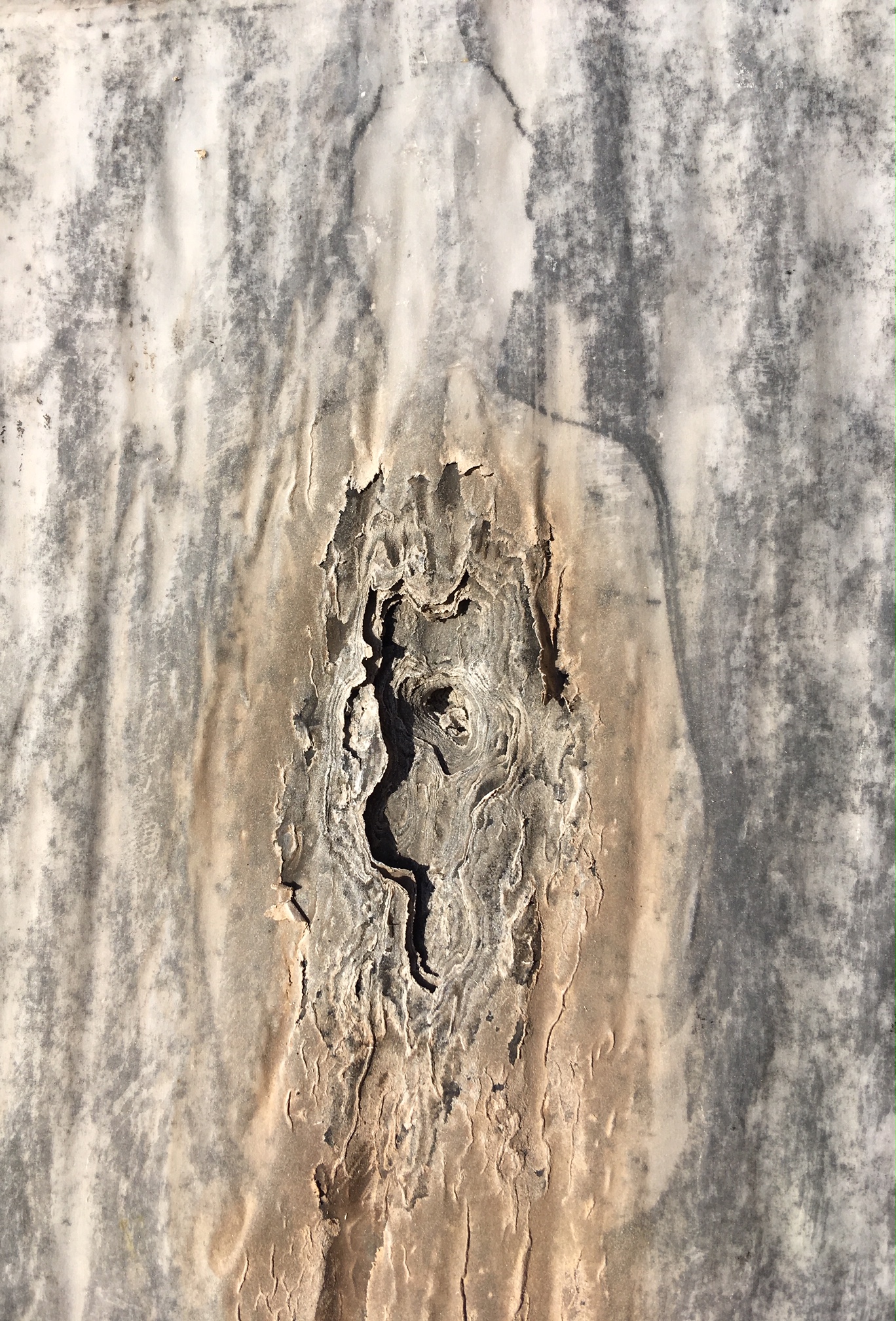
A block of crinkled grey plastic that is in fact paper, 90gsm tracing paper to be precise, A4, part together, part apart, curving, curling, is it inhabiting space or does space inhabit it? an image of a body, on-in the surface, in-on the block, contoured, did I see the image or the block first? Did I see the hole, the terrible hole or the black carbon first? The presence or the absence? Or the blistered, yellowed skin around the hole?

I don’t like it. But I liked it less when I first encountered it, shortly after I made it (did I make it? or did the material and the process make it? With me the what? The artist as conduit for the Flow, the Coalesc-ant for the coalescence?) Then I was repelled by the image and textures and appalled by the messy space it occupied/displaced. Not only not like my ‘previous’ objects but entirely other to them. Disappointed. A failure.

Before that the noise, dust, excitement of the process – the baffling resistance of the paper and glue to the compressed air and grit, the particles entering between the leaves, the popping sound as the glue gave up to the probing forces…

But what is the point of this description?  a sort of revelation – a sudden awareness of the status of practice and material in relation to the Finished Object. An insight into how one can view my work as as much about the displacing of material as the material left behind,  and as a thing that displaces space, equivalent to its volume, just as our bodies do, as they move, and the uncomfortable feeling this can give one, thinking about it. An awareness that the material displaced is equivalent to the space left behind….

What am i doing in the film? I am obliterating material that is imprinted with with 2 d images of myself qua human from a positive/negative sand blasted stone and in so doing am revealing underlying versions of the same image (Strata?), thus obliterating material to reveal material, and stopping at the point where the material resists the process, or where the process is neutralised by the material.

the dust is a symbol of the Ness, or our desire to identify it, or in fact the Ness rendered as material, but it is also The actual Ness of the material.

what is the you-ness of you?

Coalescence

img_1318IMG_1237img_1313

is this the piece of art for which all previous stages were mere apparatus?  A series of events culminating in an object?  I have decided not to make any more drawings from the sand blasted (particle-collided) block of paper other than this one. This work has coalesced toward this synchronised point with my reading whereby days after finishing this cycle I have learned of Deleuze’s and Artaud’s Body Without Organs, the non-organic body, which I take to mean a body without senses that respond to the material, the non-sensing body, the body itself,  not of and not experiencing the world, but in the world. The body into which one can fall, away from the surface, into the universe AOT the Body With Organs that exists on the surface and is the sensual body that responds to the material, and experiences the universe as an external on the other side of its boundary/skin. I suddenly think as i write – Is the universe an expression or a coalescence? cause and effect or attraction?

to illustrate, I have been making this work, thinking about, for no particular reason, producing an object that shows internal contours of myself (only myself through convenience (is it?) – I am the material with which I can most conveniently work). close behind this in time I am reading Deleuze and stuff about object equivalence. These things COALESCE in the object as after i finish the work i read stuff that seems to comment on it. We in/of the west have a linear thus 1-d causal paradigm. Big bang beginning causes linearity. But whilst (at the same time) we think in terms of cause-effect we also magically think about ‘what would have happened if…?’ or ‘everything happens for a reason’, or ‘if only this had happened then that would not have happened’ for eg in relation to catastrophe that all contradict linearity. Or we ironicise this and fantasise a catastrophic future (potential) in order to ensure it cannot happen. the symptom of this conflict is nausea/ alienation. to reconcile these forces i propose a different paradigm: Coalescence, whereby the primal force is not violent but attractive, not time-causal but gravitational in that as an event it attracts from all directions – past and future though these terms lose meaning outside of 2-d thinking. Big bang coalescence of emergence from centre in all directions simultaneously means linearity is an illusion (look at how language struggles with the non-linear and reaches for metaphor to save it!)

in this body of work i have been attempting to lose the initial cause. But there was still linearity even if circular or maze like. by losing the plot i have stumbled upon  coalescence as an alternative paradigm. we can never know the unknown we can only ‘palpate the unknown’ (Todd May on Deleuze), feel through the skin, especially as our main device is language. but where this phrase relates to doctors palpating the sick body, artists palpate nature because a side effect of consciousness is separation.  art practice coalesces with  individuation. art is the sick body palpating its environment. But that would mean that art is a manifestation of illness and maybe it is in a 1-d sense. but illness/cure/health are equivalent (Deleuze and Schizophrenia?)?

and this object is not a culmination, not even a manifestation, but a coalescence.

Cause and effect suggests a difference between cause and effect, and suggests that effect is somehow an improvement on, or evolution of cause whilst being secondary to it. The effect has evolved from the cause but the cause was the power behind the effect. But cause and effect coalesce and are equivalent. There are never only one cause and one effect though history and language suggests otherwise.  They come from all directions and go in all directions simultaneously. simple complexity/complex simplicity.

what is me-ness or cow-ness or dog-ness or dog-with-cow-ness?

what is the -ness of things?

what is Ness-ness?

manifestations of coalescence – do things happen because of what happened before, or because of what we are now?

is potential a coalescent from the linear future?

coalescing – everything

ness-ness is just produced and we can’t really explain it because language divides by its nature (see journal page Thoughts on Language)

ego and the individuation and consciousness – a manifestation of the ego… me-ness; western immaturity; (eastern maturity – east far more advanced, they have a clear science that describes nature of how you as an individual relates to everything)

western language only really probed such things fully since freud

coalescing is an elegant way to represent how things work – not how things are, but represents how things are – we step back, and with our egos we look out… we are separate – this is a symptom of western consciousness = separateness – atomised? eg) most of romanesque church sculpture was anonymous until a certain period….1250?… one sculptor wrote “Giselbertus made this” – representing immaturity…? (Giselbertus Hoc Fecit)

language tied up with this immaturity

the linear is oppressive, in fact is oppression. it is necessary to liberate ones self from the linear. coalescence is a useful tool in this – intuitive understanding… idea of the linearity, one must set out on a path to get further along it… things coalescing – ‘we can only be here because of what happened before’ – culminative, restrictive, deterministic, imprisoning… not happy, nausea, alienated – and yet we have all these other experiences (non-Hegelian non-marxist?) – lets look at our experience… what is this experience… we always have this ‘experience’ –> being-there

lets look at an anarchist grand unifying theory of existence?

the behaviour of matter is coalescent

an objects presence in a place, in a space, must involve displacement of an equivalent space. Similarly, my work can be seen to be about what material I have removed,  absented or redistributed as much as the material left present or intact or non-redistributed.

We also desire to map, that is, render our non/multi dimensionality as area: the worlds volume and mass as area. That is, multi/non-d as 2-d. In fact our inner volume as area.

Truth and reality do not matter and will continue to shift and change in relation to the thing-in-itself, dasein, haeccaety, paradigm etc. What matters is our interest in, desire and longing for an understanding. Because it demonstrates our outsideness. Our alienation. Our ness-ness.

the work, like the conscious being, is in the material (immanent), on the material (liminal) and outside the material as dust and displaced space (transcendent). Its about in-ness, on-ness and outside-ness. But what is -ness? what is the Ness-ness of ness? : )

‘all things can be easily figured in the form of statues inasmuch as it is possible to orderly explicate all their ways of being as certain hypostatic configurations’  Campagna quoting and translating Giordano Bruno p8


Huyghe interview Serpentine, 2018

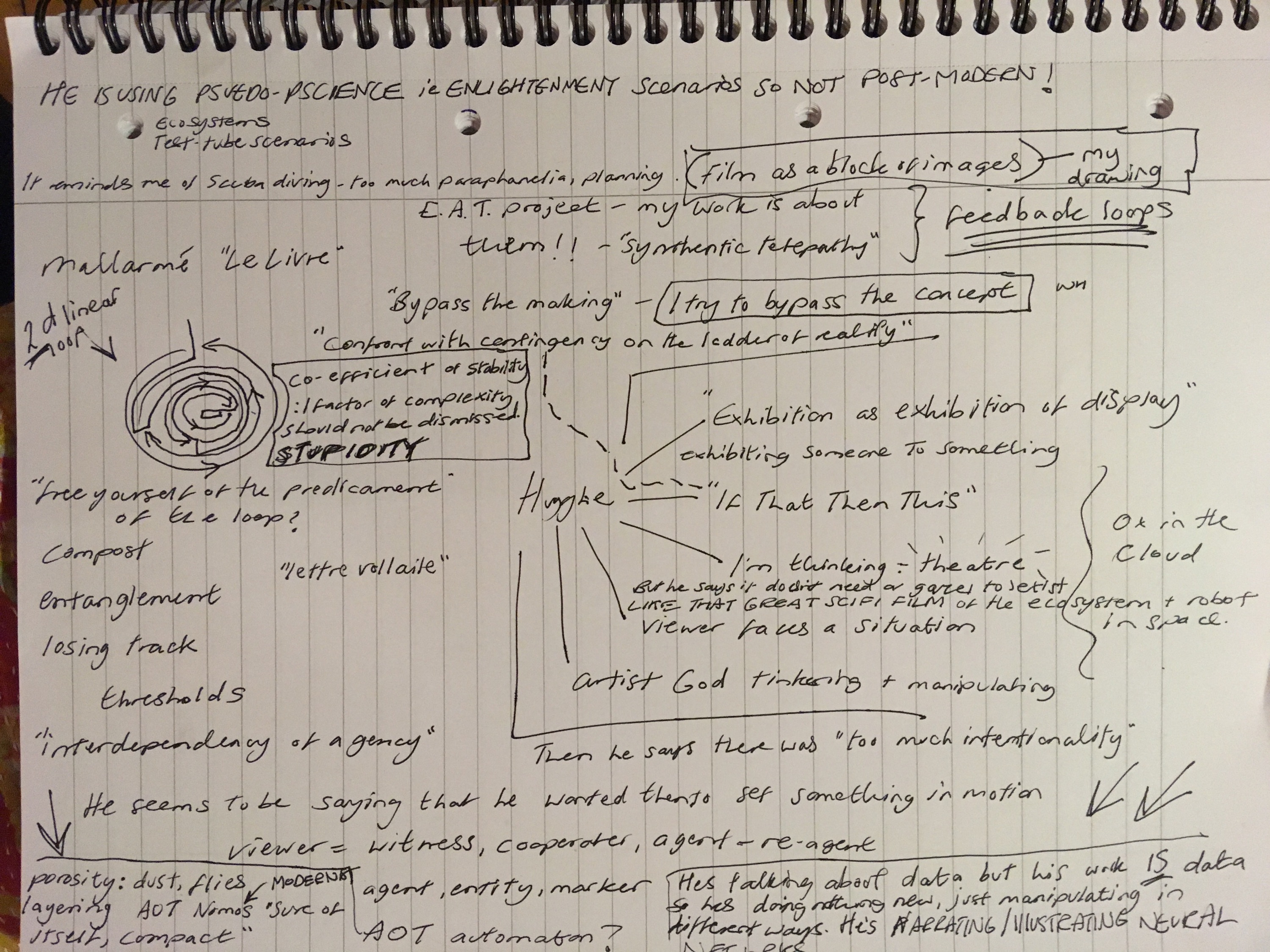
Huyghe is interested in effect. He makes art like one plays chess – “how can I justify this move? Can I justify this move?”. He treats (in the exact sense of that word) the space as his stage and engages in/with scientific discourse as though it is all an experiment in which he is setting up the apparatus and then lets go but really he knows what the conclusions will be: the Witnesses will experience a manufactured encounter with the dog with the pink leg and consume the experience, be made to feel special and changed, and then disseminate their narrative of the encounter. He then harvests their narrative, moves to the next environment and repeats, God-like, playing with automatons that bore him. Its Fried’s nightmare but its also ironically Modernist, employing alchemical technique as though alchemy was proto-science and not an occidental expression of the drive toward individuation. In ‘by-passing the making’ he is a an illustrator of the conceptual, whereas I try to by-pass the concept through behaving (making) in order to discover or look at the nature of desiring/needing to discover.

More making


: sandblast sculpture

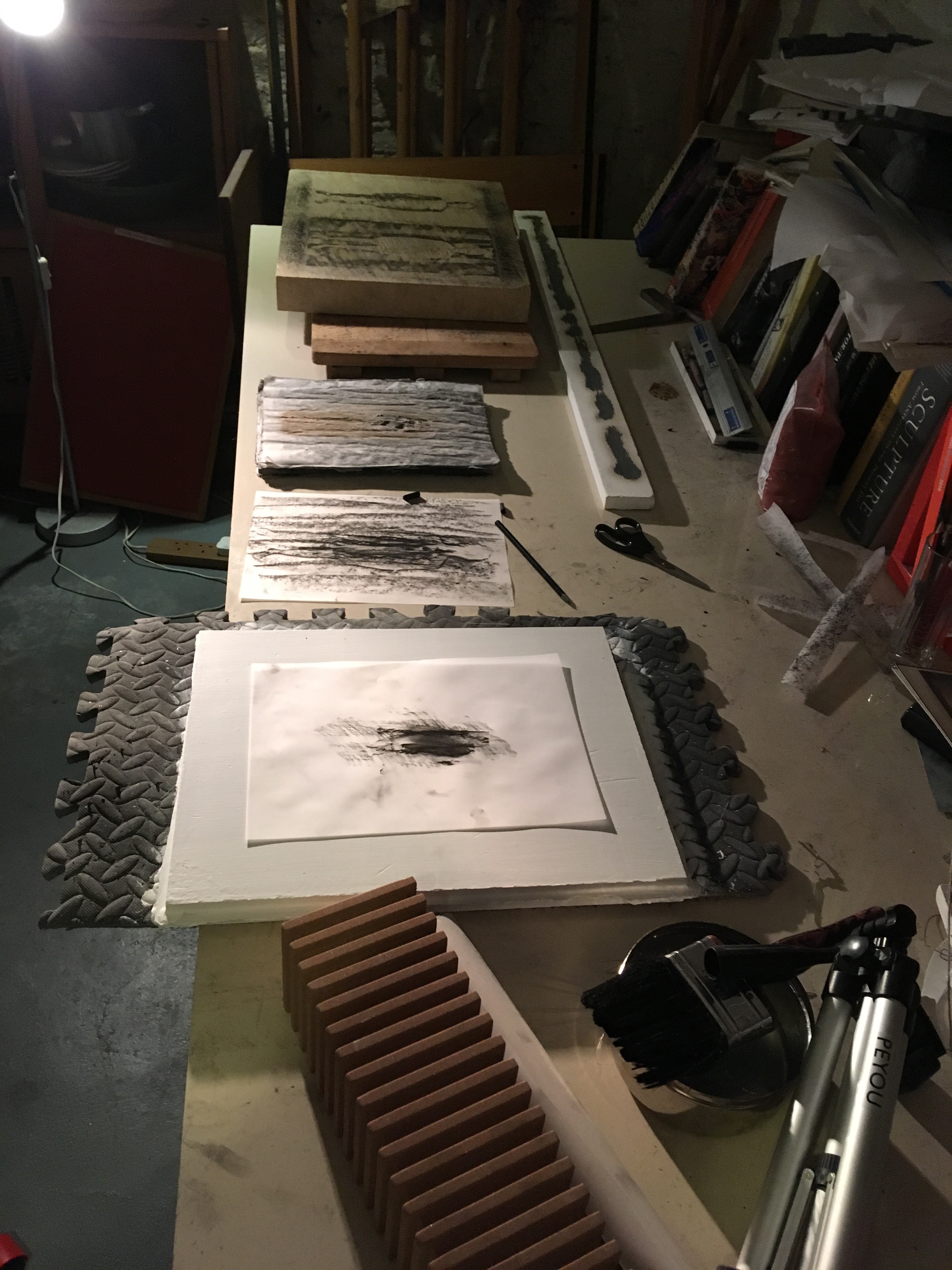
materials: compressed air, sand, 90 gsm paper, charcoal, pva, timber

equipment: compressor, sand blaster, clamps, a-frame, banker, water wall dust extractor

intent materiality: dust noise vibration pressure wind vortex chaos melting erosion

reason:

environment: MA

purpose: exploration

conclusions: paper and pva resist sand blasting. sandblasting turns paper brown

emotions: trepidation fear horror surprise disappointment curiosity


This pseudo-scientific introduction is reminiscent of doing o level chemistry

(apparatus: bunsen burner litmus paper acid alkali potassium pomangenate…)

(a metaphor for contemporary art practice with its epistomology, ontology, metaphysics, theory, discourse, categories, research, exploration, fragmentation, findings from failure, vitrines and tele-micro scopic differentiations. Ironic that contemporary, post-modern art uses the language and method of Enlightenment Modernism. But does it do so ironically? Indeed does it do this at all or is this me imposing my modernism upon post-modernism?)

Here I seem to have attempted to penetrate my modernist aesthetic using a suitably wide set of materials and methods akin to alchemy, or proto/pseudo-science (is contemporary science really pseudo-alchemy? Alchemy was as much proto-psychology as proto-science, or even a new expression of older ongoing psychology and ideas of individuation)

Philosophy seems to have expended its energy on our relationship with things. But all it has to show is what we have always known: We can only have relationship with ourselves. There is the territory: the only territory we can explore with written/spoken/thought language. However there are other languages eg faith (aot religion, and which btw i lack but do not discount) and art. Maybe there are others. In fact much, no, all, of art and literature has left a record of the exploration of that territory and its’ topology. What else can it be a record of? Even the language of mathematics has to interface with us at a certain wavelength. Or rather we are the interface of that language.

At the same time I am thinking, looking at this object that ‘I have made’ and reflecting on life, as my father dies, that life generates from a centre, not a beginning. That life is non-linear but generative, multi-dimensional and even non-temporal in the human sense: think of the big bang as a centre rather than as a beginning and therefore, of our lives as layers of expression rather than linear narrative.

‘When you will have made of him a body without organs, then you will have delivered him from all his automatic reactions and restored him to his true freedom’ (Artaud)

when I work I am demolishing structure, attacking solid form and creating dust clouds. The dust cloud is made of the material I am attacking and is equivalent to it. If i am sandblasting a me shaped impression in stone or paper I am creating a dust cloud shaped ‘me’ in the atmosphere. Some of that dust goes onto me and some goes into me.

What is it like to be me? What is my me-ness? my haecceity? where is it located? What are my structures? Do they serve me well? Am I conducting experiments in attempting to demolish my structures?

‘what is it in this stone by which as by a proximate foundation it is absolutely incompatible with the stone for it to be divided into several parts each of which is this stone, the kind of division that is proper to a universal whole as divided into its subjective parts?’ (Duns Scotus, ordinatio II)

Am I attempting to demolish metaphor so that in my work ‘this is like that ‘ becomes ‘this is that’? But then isnt that a metaphor for my desire to isolate my me-ness as an expression of univocity? Can I separate my work from me so that it is a thing directly of nature rather than a creative act with me as Transcendent Creator?

Is the this-ness of an art object, its haecceity,  within it? Within the space it occupies/displaces?  Or is it also to be found around it? That is, amongst the factors that led to its existence – the process and the material. Is it the everything-ness of the thing? Can only the everything-ness, all of its data, be the thing? But the everything-ness must include all responses to it, all opinion, and this involves flux.