
MA 2 Studio Practice
Please date individual entries and choose a title to indicate the contents of your post.
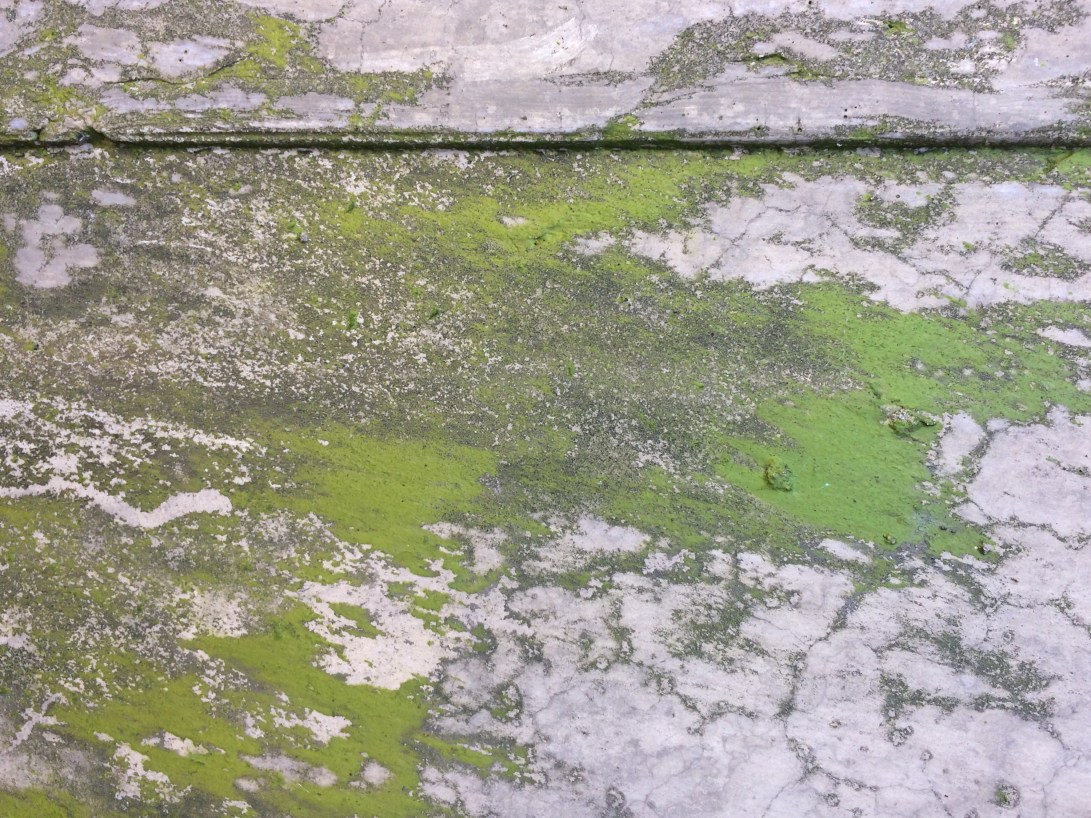
Algae on concrete
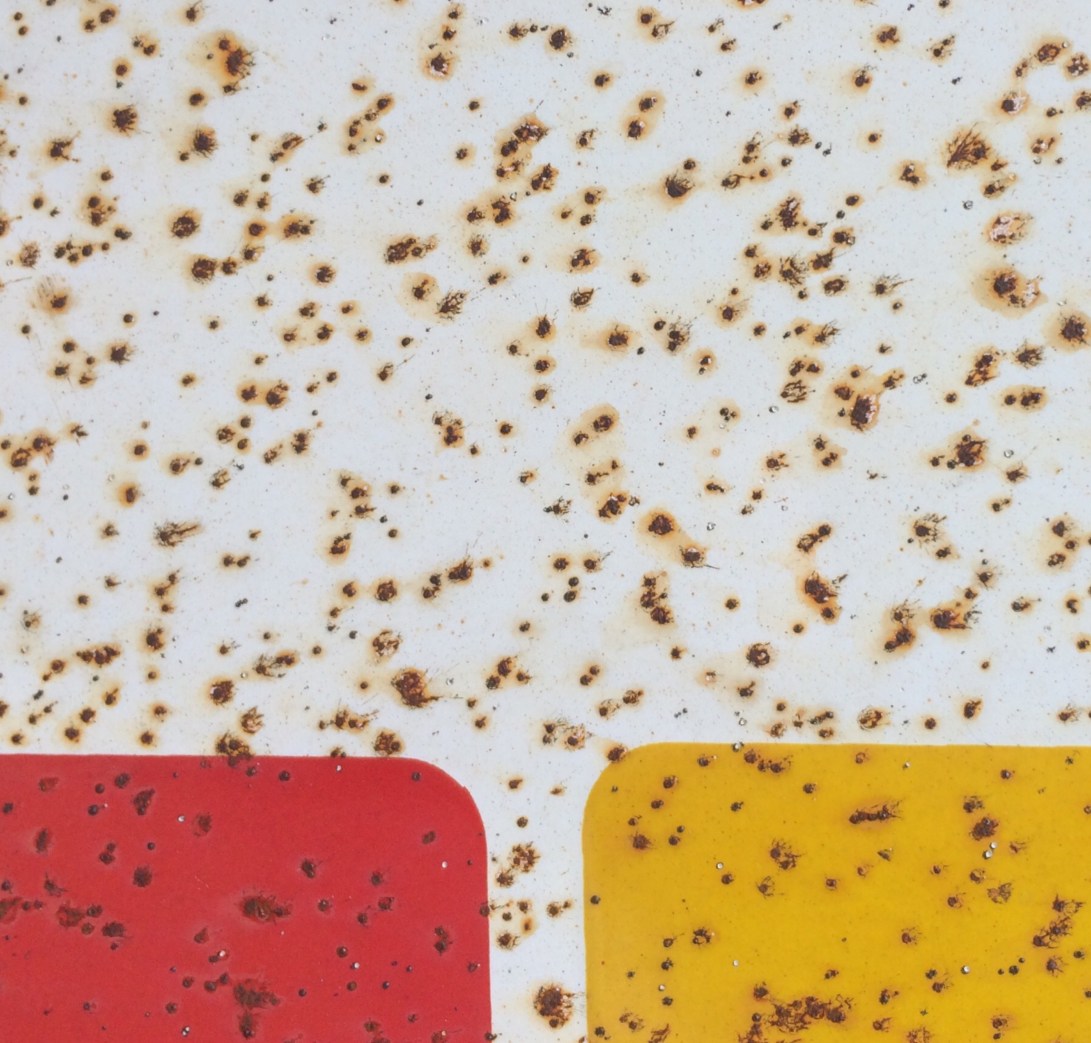
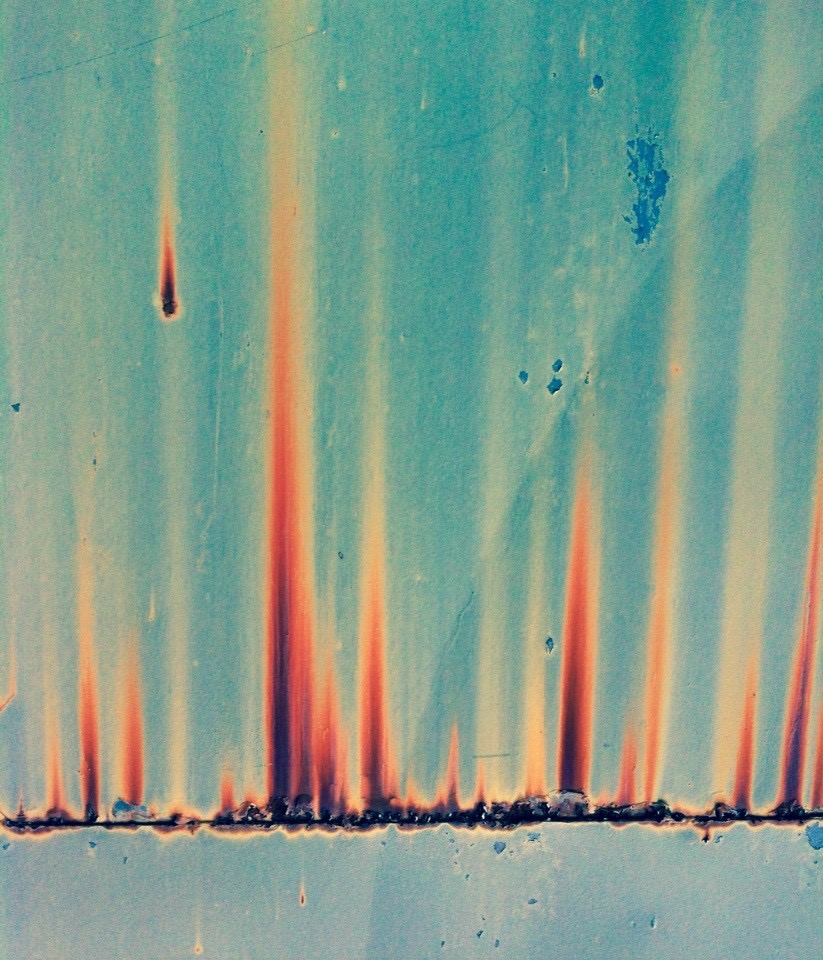
Rust

Some thoughts on art
We are constantly fed (not always nourished), by external stimuli that come in, are mapped, and go out as response. And when we think about internal stimuli we talk about moods, nature, instinct. But what does that really mean. What is the data that is affecting us? How? Where does it originate? Why? Certain birds are born with the ability to cower in the nest when a predator flies overhead, yet not when a non-predator flies over. This is an Innate Response Mechanism built from millennia of experience and evolution. Imagine the spectrum of our human innate responses.
For example, I have just reread The Sun Also Rises by Hemingway and recognised several motifs that correspond with the tale of The Wounded Fisher King of Arthurian Romance legend, who is excluded from the hunt by his injury, leaving the world a wasteland. Hemingway’s protagonist has been wounded in the groin in the First World War and left infertile. His is the emotional wasteland of ‘The Lost generation’. He gains pleasure from fishing for trout in the streams of the Pyrenees (Romance country) and from watching the bullfights in which he cannot take part. I looked up Hemingway and the Fisher King online and there is a commentary on this subject but it seems to me to be in error. The debate centres on whether or not Hemingway was aware of the Romance tales of which TS Eliot was writing contemporaneously in The Wasteland, influenced by the academic treatment by Jesse Weston. However the tales of heroes wounded in the thigh or groin are many and ancient, (here are the ones of which i am aware – King Amfortas by a spear, Jacob by the angel, Tristan by Morold, Telephus by Achilles, Chiron by Hercules, Hercules himself, Adonis by the wild boar and Alexander by a spear. Of course Jesus was also wounded in the abdomen with a spear). I suggest that Hemingway is not knowingly retelling the tale but channeling the archetype that maybe concerned with spiritual infertility – who knows? That is to say, the Archetype of The Wounded King is expressing itself through Hemingway, carrying with it whatever the dream like message is that it needs to make us aware of. Such is the creative principal of the universe and the nature of our evolved, inherited, shared and subtle Innate Response Mechanisms.
So, in other words, where is the place where I stop and Everything begins? This is what interests me as an artist.
*
The Ego gives us a thick skin and sets us on a promontory that necessarily separates and protects us from Everything. As TS Eliot says
‘Human kind
Cannot bear very much reality’ (Four Quartets, Faber and Faber)
However there is a longing on our part and on the universe’s for a reconciliation (Science probes this. As does religion (re-ligio trans. re-link (ligament, ligature) or reconnect. Also Sanskrit Yuj – root yoga, union etc) and art.
*
Is there a sense that when Barthes wrote about the death of the Author God it was interpreted as an instruction to artists as doxa to remove themselves from the production and/or product of their labour in the name of the viewer/consumer? a sort of ideal, democratic self-immolation? presumably with the kernel ambition of producing pure, inclusive objectivity. Im attracted to this idea and I like dogmatic art. Im sort of jealous of it. I like the idea of producing work in which a feedback process of copy, paste, copy, paste becomes a mechanical separation of the producer from the product, the personality is removed in a sort of creative degradation.
And yet Hermann Hesse wrote about how he sometimes imagined taking all his work back from the altar on which he first proffered it as sacrifice to be cut up and dismembered by reader-consumers, critics and subjective opinion. I make subjective art. I make it for me. Consumption by others is incidental and a sort of justification. The conversation i am having is not primarily with an audience but between myself and Everything. In fact it is a probing of the relationship between myself, as a subset of everything, and the set that is Everything.
*
Create
Curate
Collect
all attempts to address (control) ownership of the creative act and its issue.
Owning is a form of creativity, an expression of the creative drive.
*
Looking at the primal matter and activity of human consciousness is like staring into the crater of an active volcano filled with potential for creation and destruction and its going on ALL THE TIME.
*
Money is a symbol of value.
Art is a concretion of value
Art Is Value.
*
There is still some discursive connection between Beauty and Art – a sense that the art object should … what? contain beauty? represent beauty? BE beautiful? But does beauty inhere an object or is it a response? It is an effect, not a cause. It takes place not in the object but within us.
*
I think of Postmodernism as the consequence of gravity, volume and velocity. Many streams become one torrential river becomes shallow delta as its waters reach sea level, as all water pursues its own level: losing momentum and depth there is deposition and dispersal. The result, a myriad of rippled sandbanks spread over a wide area finally merging in oceanic conformity. And Post- Postmodernism? a hacking and slashing climb back up in search of the source or a new universalism? Or a compression of the deposition into a new stone to be mined? Of course it might also be dammed water, deep but virtually stagnant, as The Market releases just enough to power itself and irrigate a narrow strip along its downstream banks.
Gursky, Picasso, Whiteread
Gursky at the Hayward
Big flat expensive perspective defying photographs
one mans battle against parallax
technical experimentation, cut and paste, photograph as painting
postmodern materialism and its effluent.
He takes photography, flattens it, abstracts it, then with nowhere left to go, paints it.
I was occasionally minded of a cross between Jacques Tati, Monet and Wheres Wally.
The Hayward is a fascinating space. I know its surface textures intimately from my skateboarding youth but I haven’t been inside the gallery before. The skylight ceiling upstairs is a joy. The pace and measure of the show was human, generous and belied the weight of the material that could have overwhelmed but didn’t.
*
PICASSO 1932 – LOVE, FAME, TRAGEDY at Tate Modern
Picasso the soap opera
This had the lot – love, fame, tragedy, octopuses.
Shock revelation – artist responds to life.
I hope to go back for another look. I didnt leave feeling as energised as I have done after other Picasso shows.
Despite the materialist pedagogy of the exhibition (which wasn’t uninteresting – just banal) seeing Picasso’s work always offers glimpses into the interplay of internal and external stimuli – conscious and unconscious forces in his work.
Unpleasant dynamics and usual confusion as to which way to go etc. When a show is hung by date, and room by Ikean room, one feels constrained to pursue it by the calendar or miss some important connection. But because everyone is following the same path there is congestion and so one is forced to break rank and go against the order of things. Like the Bad Machine in Midnight Express. It suggests that there is an understanding to be gained by following all the clues, history and succession of the work and that if you miss a clue or see it in the wrong order you will not ‘get it’. And of course there is understanding to be gained in this way. However it therefore requires 2 visits – one for the pedagogy and the other for ones own experience. The conceit at the heart of this show was a sort of partial rehang of Picasso’s first big retrospective and although it was a bit like a Dan Brown recap it was great to see those works.
WHITEREAD AT TATE BRITAIN
The casts of the beehive like undersides of chairs is beautiful and some how evocative of my childhood – translucent colours of exotic soaps or perspex skateboard decks and wheels full of trapped light – desperate to touch them but the non-touching is a type of touching.
No plinths (see Research essay) but tape on floor and tripwires.
But once in I spent very little time in front of each piece. Having done a bit of casting I marvelled at the craftpersonship of the casts and at the technical audacity and ambition. I think the sheer density of the effect of the Holocaust Memorial is overwhelming. The demolished House cast joyous, magnificent and tender.
But mattresses and hot water bottles whilst fun are less demanding of my time and i find myself outside after 10 minutes thinking that she needed to diversify somehow.
Beautifully curated with dividing walls removed from the gallery making a vast but well used room. (For more of my views on Whiteread see Research paper and response to the Whiteread film).
PICASSO 1932 – LOVE, FAME, TRAGEDY
Picasso the soap opera
This had the lot – love, fame, tragedy, octopuses.
Shock revelation – artist responds to life.
I hope to go back for another look. I didnt leave feeling as energised as I have done after other Picasso shows.
Despite the materialist pedagogy of the exhibition (which wasn’t uninteresting – just banal) seeing Picasso’s work always offers glimpses into the interplay of internal and external stimuli – conscious and unconscious forces in his work.
Intersections and Articulations
Fran Stafford and John Barraclough
For the first part of these enquiries I had to listen to the audios whilst on the move and couldn’t take notes and when I returned to listen again I had run out of time and they were unavailable.
From memory, neither speaker was describing any aspect of the art world that resonated with my little corner of it, while they both described their own wide ranging approaches to getting art seen. Fran Staffords seemingly inexhaustible energy and Barracloughs teenage fanzine enthusiasm for communicating was fairly humbling, and both seemed quite well connected which counts for so much in the competitive market place that is the art world. Im sure I would have benefited from a second listening. I wonder why there is a time limit on these audio files.
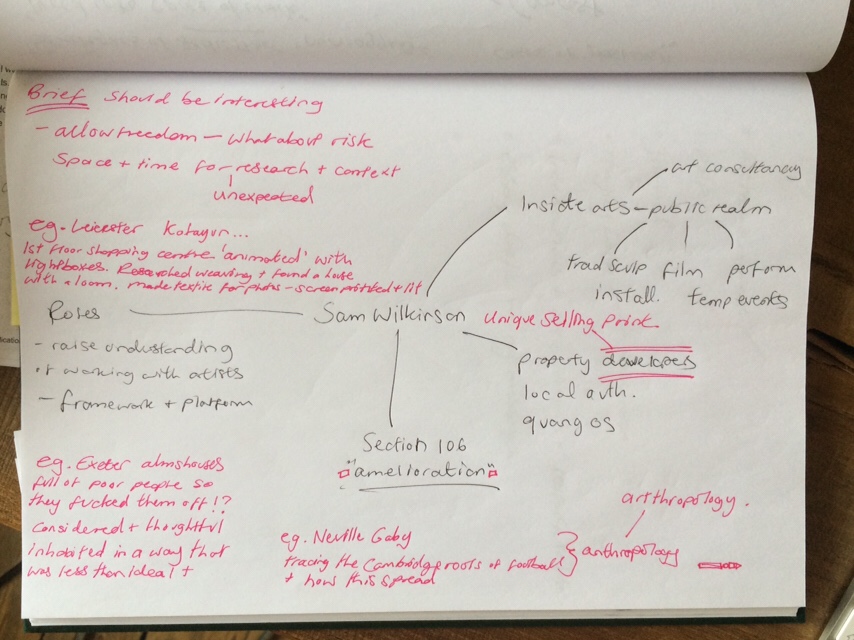
Sam Wilkinson
I made a point of listening to the second part from Sam Wilkinson whilst taking notes. Whilst the art that she chose to illustrate her business practice looked very slick the idea of attempting to sell my labour to property developers through an ‘ameliorative’ art broker to adorn their shopping centres as a kind of Unique Selling Point does not inspire me. I was waiting for her to explain exactly what happened to the ‘homeless people’ of Leicester who ‘inhabited (the almshouses) in a way that was less than ideal for a commercial developer’ if Insites Art takes pride in being ‘considerate and thoughtful’.
Thats not to say that I thought the research undertaken by the artists in her examples didnt sound very thorough and worthy although I couldn’t see evidence of the artist making a connection between the almshouses and their historic role in ameliorating poverty.
Plus before I sound too principled and worthy I have completed several contracts to make stone sculpture to a brief for Muf Architects that adorn commercial space (Science Museum), housing developments (East Hackney Estate) and public space (Altab Ali Park, Whitechapel and Commercial Rd, Mile End) that involved close collaboration with a range of contractors and local organisations. There was just something about Wilkinsons presentation that I found personally uninspiring. And I kept wondering how much risk the clients and contractors are really prepared to take in allowing the artist a free hand.
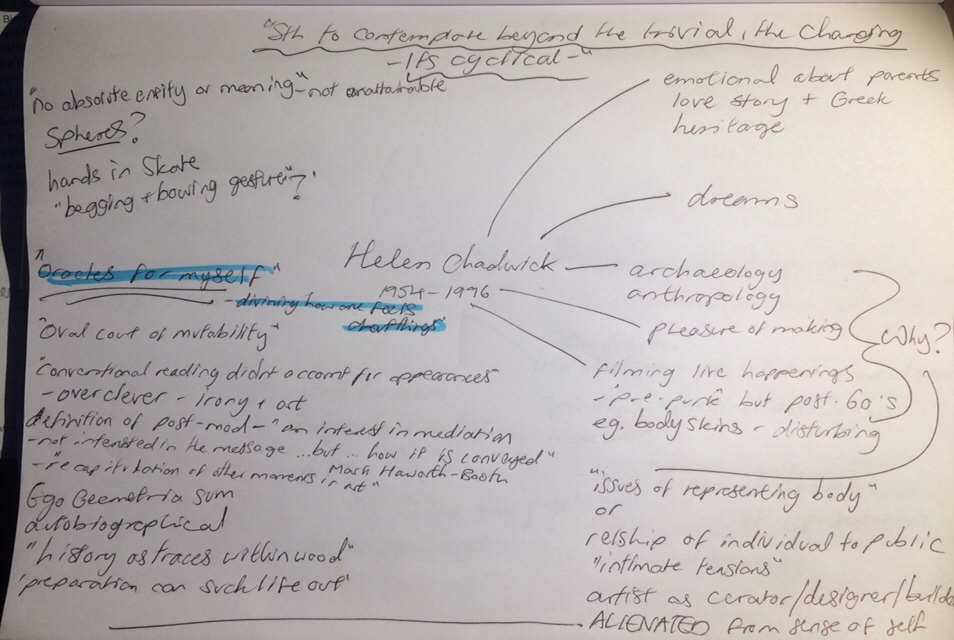
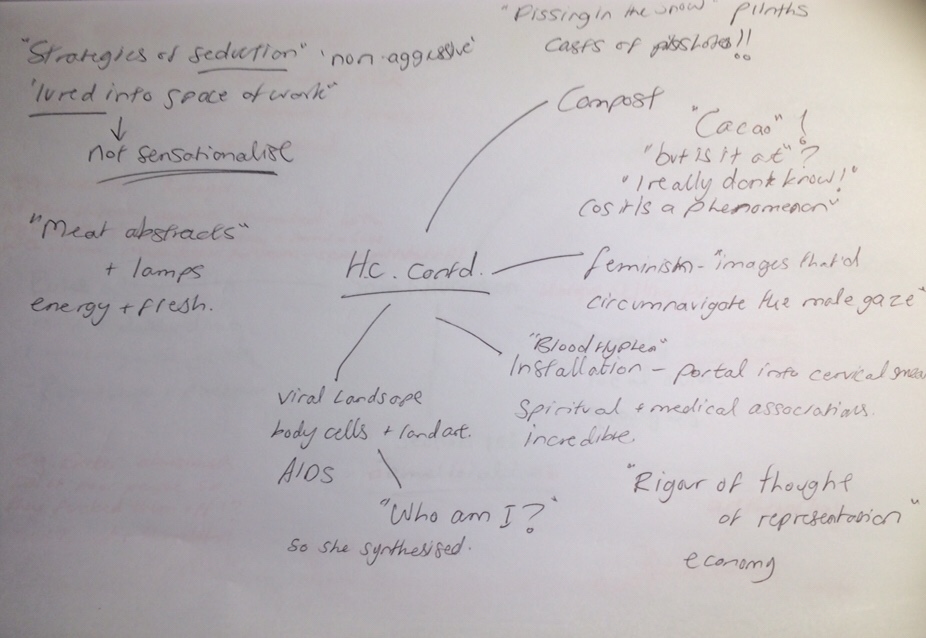
Helen Chadwick
It took me a while to get beyond the weird trancey crashing orbs in the frame and the sound speed that exaggerated the speech into a parodic bourgeois drawl of the various talking heads and Chadwick herself. However once drawn into Chadwicks orb I was mesmerised by her vision and felt my entire understanding of art evolving.
She was intrigued by her own work in an un-selfconscious way
Of her ‘Oval Court of Mutability’ she says they are ‘oracles of myself…divining how one feels about things’. That in itself is a wonderful thought that helps and validates my own efforts to understand my work.
There is a moment where she observes her hands in the skate fish and describes a
“begging and bowing gesture” which to me is an astonishing, tender and powerful insight into her own work. ‘Divining’ meaning from behaviour.
Over and over she asks herself ‘why?’ and answers the question.
On seeing ‘Cacao’ in the gallery for the first time she says
“but is it art?”
and answers
“I really dont know…because it’s a phenomenon”
She asks herself
“who am I”
and answers with Viral Landscape, synthesising body cells and land art.
Of the compost piece she says its
‘something to contemplate beyond the trivial. The changing – its cyclical’
as though she is learning from her own creation. Where much art seems to say
‘here is what I know’
Chadwick seems to say
‘lets see what I can find out if i make this’.
The evolution of her work from one exhibition to the next is mesmerising. Ego Geometria Sum and her description and explanation seems to me a perfect body of art – exciting, adventurous, tender and exploratory.
One of the commentators speaks of her
“rigour of thought, of representation” of which I was left in awe.
My understanding both of contemporary art and of how I see myself as an artist has significantly shifted as a result of watching this short film.
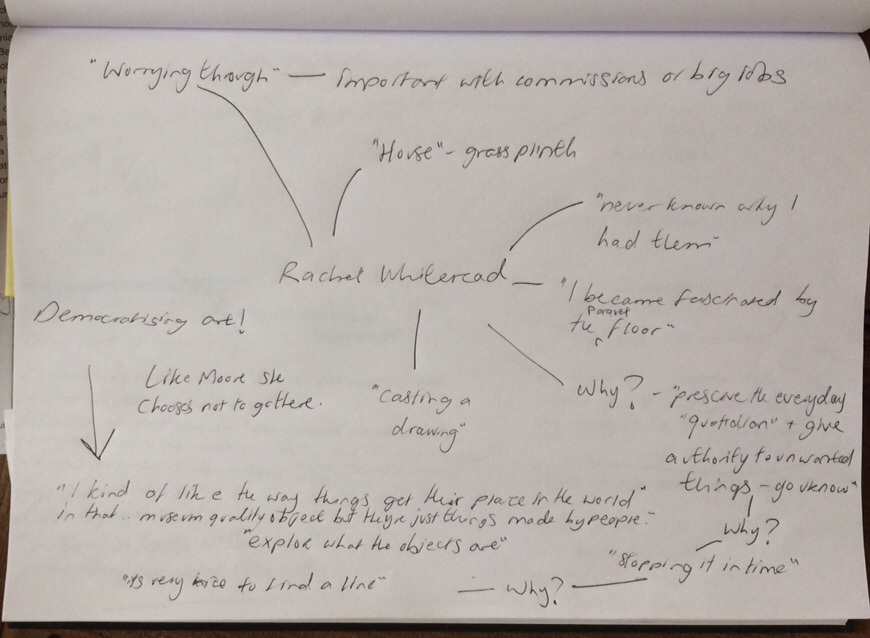
Rachel Whiteread
I like Rachel Whiteread’s monumental work. But I visited her show at Tate Britain and was in and out within half an hour. I hoped for some insight from this film into her inner process but where Chadwick asked why and answered, Whiteread barely asked and never answered, beyond
“I became fascinated by the parquet floor”
“…preserve the quotidian”
“…give authority to unwanted things – you know”
“its very nice to find a line”
“stopping (things) in time”
BUT WHY?
Perhaps like Henry Moore she is afraid to analyse the forces beneath the surface in case the creative bubble is burst. It occurs to me that both his and her work resembles a skin or surface that is inflated to bursting point due to the inner forces remaining unaddressed.
In fact her work takes the inner space of objects and renders it as surface.
She says
“I kind of like the way things get their place in this world”
but offers no analysis. Sadly I was left thinking wow all she does is cast stuff, draw a bit and print. Except she employs a printer.
John Dewey said
‘an artist is compelled to be an experimenter because he has to express an intensely individualised experience through means and materials that belong to the common and public world. This problem cannot be solved once and for all. It is met in every new work undertaken. Otherwise an artist repeats himself and becomes aesthetically dead’
(Dewey, J, Art As Experience, Penguin, New York, 1934 p150 2004 edition)
Making Day 7am Saturday 7 April
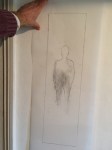
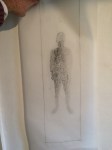
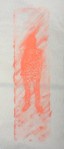
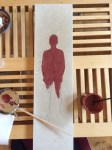
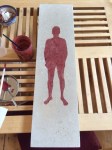

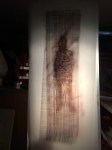
I currently think of Consciousness having evolved from pre-conscious stages and like all evolution it doesn’t discard its causes and stages. They remain in, underpin, influence and cause ‘modern’ consciousness. Indeed, early cave painters were modern humans (and it now seems, Neanderthal) and their work marked the dawn of individuality that we have pursued to a kind of end and now yearn for some kind of return to the herd state from which it emerged. What has evolved in our species? Our intellect, our technologies, or our individuation? This sculpture is about my interest in probing the layers of our consciousness, it’s relationship with the unconscious and instincts, and the data that flows between the layers. The deeper one probes, the further back one travels, the more the archetypes are common, and the thinner the membrane between our ego and the universe becomes. Also, given the current trajectory of human technologies, and continuation of the species for a sufficient length of time, we early 21st Century humans shall eventually telescope backwards into a kind of primitive.
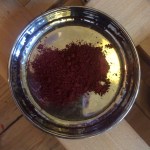
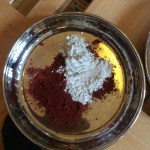
I had the idea of staining stone with iron oxide (ochre), the pigment used in rendering the hands and prey of palaeolithic peoples on cave walls as a gesture of super-temporal communication and to represent the continuum of the human experience and our drive to individuate. The magic and mechanics. Which is the stronger drive behind the human experience?
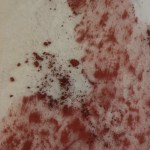
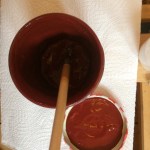
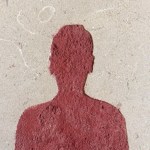
I mixed the ochre with hydraulic lime as a fixative and added water to make a wash. I applied the paint in dabs watching the porous stone soak in. Of particular interest was what would happen at the border, the ridge between the exposed material and the honed surface. I was worried that it might absorb across, obliterating the outline. However it barely went beyond a millimetre in places in a fascinating sort of osmotic fashion. I repeated the process 5 or 6 times through the day until the ochre formed a consistent colour.
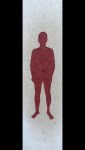
I was pleased with the result. It allowed me to imagine falling backwards and fitting through the aperture or portal (it reminds me of cartoon characters that smash through walls leaving a self shaped hole), – a visual aid to help meditate on the layers within the unconscious that lie beneath the honed surface of our daily, conscious state.
Ochre (iron oxide powder), lime, water on sand blasted portland limestone
Drawing Data Portal


 JON WHITBREAD ART