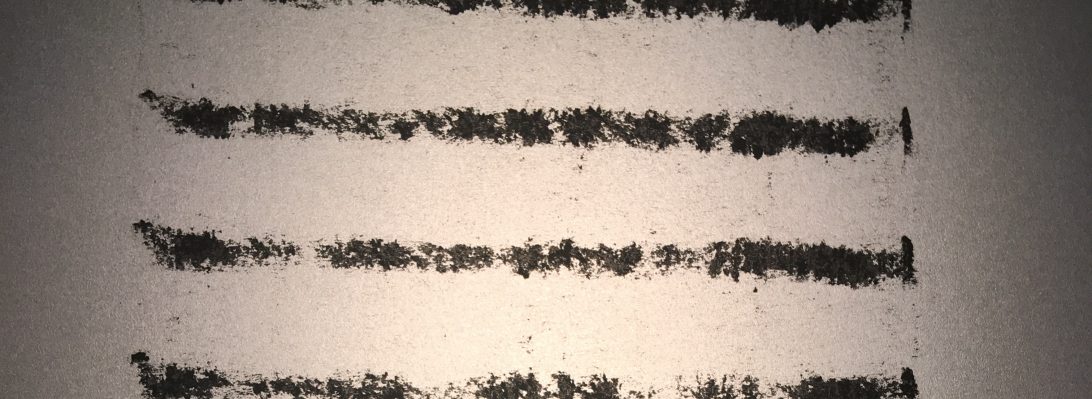
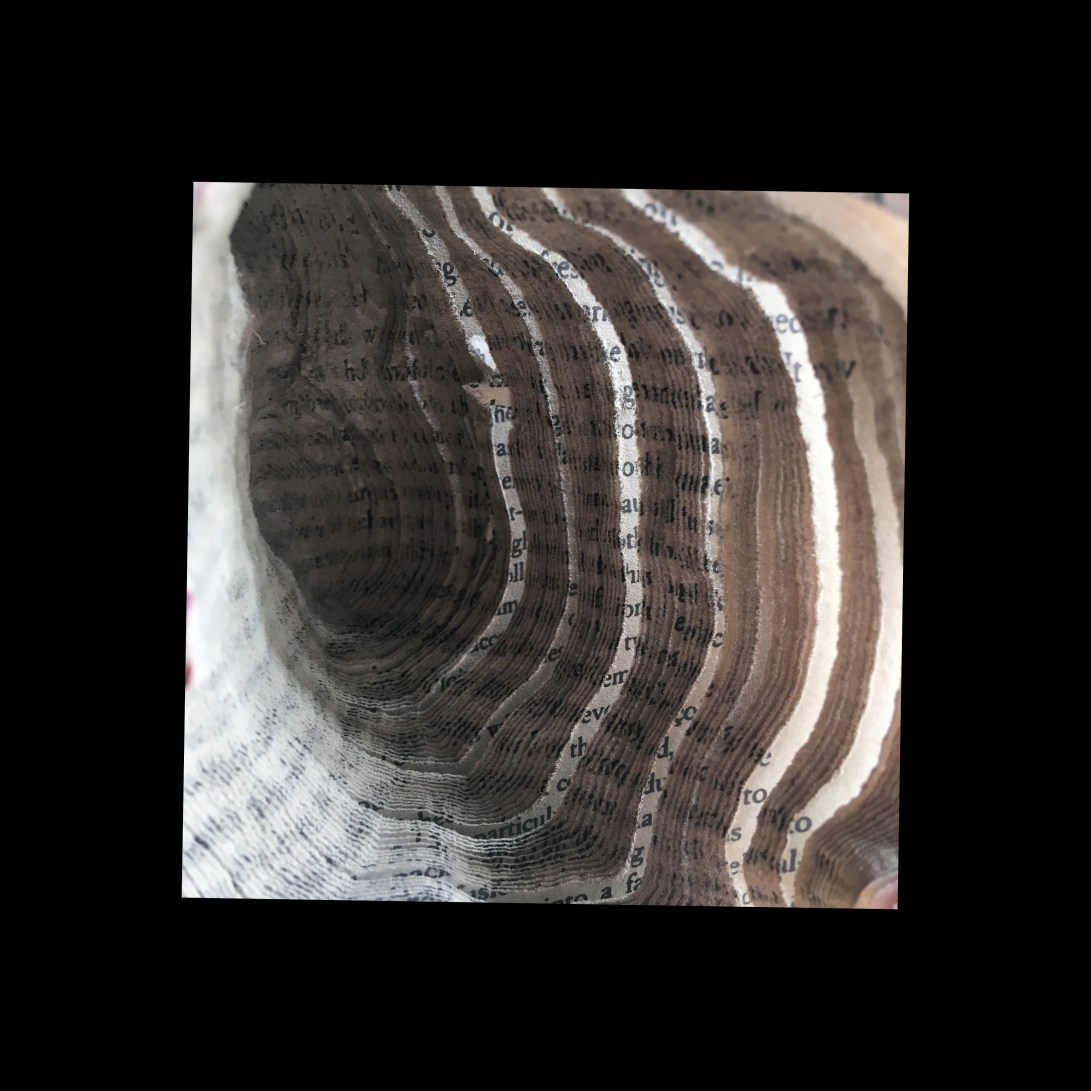


(I have written at length about what led up to this work in my contextual essay but here I look more closely at the thing itself and the thinking and experience that surround it).
I have been thinking about time and language. I think that the story of Achilles and the Tortoise (Zeno’s Paradox), that my father taught me, is not a tale of paradox at all but a metaphor for the behaviour and role of language and its necessary unsuitability for the job of describing the world. Language protects us by dividing and separating the data that our senses are exposed to and expose us to. We experience more than our language allows us to access.
Past, present and future are just words for concepts that are divisions of a whole.
We think of the future collecting or harvesting the present, the present is the cause of both the past and the future and the past is a sump where the present and future drain into but is the present a coalescence of the past and the future, or rather is each a coalescence of the others?
Looking at a bamboo in sunlight in a breeze, as I am ‘now’
What happens if I ask not when does its present end, or its past and future begin, at what instant, but where? Is the bamboo perpetually occurring and perpetually ceasing to exist? And what does that occurring and ceasing look like? What are the physics?
When one asks this it becomes apparent that either the past and future of the bamboo do not begin and are therefore always present, or the language is not suited to the reality. Time is spatial or it is just a word for our limitation.
Unless the bamboo, along with everything else, ceases to exist where the past, present or future meet, having only memory or potential, in a sort of blank absence.
Or everything occurs simultaneously and only perception creates temporality.
Or perception creates existence (Berkeley?).
If it is not perpetually occurring and ceasing , then it exists prior to my perception of it, in the future and post my seeing it, in the past.
Thus there is either no time or human language is not the right tool for the job of understanding/describing it. I have written elsewhere in this journal how I think our senses, in league with language, dismantle the world then reassemble it, sentenced. And about why I think this is the case – reality is too much for our minds and would have hindered evolution. That is to say, we exist because our mind evolved to exist in a niche universe over which causal time appears to reign. But that niche universe in return evolved as a result of the nature of human consciousness. Coalescent evolution of sensory perception, language and environment.
Proust located the past in memory but the bamboo seems to me to persist comfortably in time and space, forwards and backwards, in its own right. Without my memory of it is there really just a non-bamboo?
But I don’t make art about this stuff. I make art and I am interested in this stuff and they coalesce.
I didn’t conceptualise the obliteration of my copy of Swann’s Way. I didn’t think ‘ah now I will make a grand iconoclastic gesture of eroding my modernism!’. Or ‘now I will make a sculpture about my theory of the non-existence of time and the role of language in the evolution of human consciousness etc!!’ Rather I found myself finishing reading it after many years at the same time as I became/was made aware of my modernism at the same time that i was sand blasting stuff, at the same time as thinking about language and time. Also I was being encouraged by my tutors to work with non-stone materials, so I had been sand blasting paper, and so I sand blasted the book and collected the dust. What accumulation of data led to this might be possible to collate, but to what purpose?
After ‘making’ the pile of dust i read that
‘In a modern world of stupefying banality, routine, cliché, mechanical reproduction or automatism, the problem is to extract a single image, a vital, multiple way of thinking and saying, not a substitute theology’ (May, T, p25 quoting John Rajchman) and
‘Lodge yourself on a stratum, experiment with the opportunities it offers, find an advantageous place on it, find potential movements of deterritorialisation, possible lines of flight, experience them, produce flow conjunctions here and there, try out continuums of intensities segment by segment, have a small plot of new land at all times’ (Deleuze and Guattari, 1000 Plateaus)
(‘deterritorialisation’ and ‘lines of flight’ meaning, I think, a nomadic, non-conformist momentum of thought and philosophy, a deliberate continuous, self-unsettling)
But May says that ‘the creation of concepts, which in Deleuze’s view is the only significant endeavour in which philosophy can engage, seeks to palpate and give voice to this difference that disrupts all projects of identification. Philosophy is ontology; it speaks of what there is. But what there is cannot be identified…What there is is difference’.
So if Deleuze’s advice on Deterritorialisation holds true for art, what, or where, is ‘the only significant endeavour’ of the artist? Where is the difference? In my view it is in the attempt to behave artistically. Behaviour as the antithesis of Conceptualism. But that does not mean that Behaviour and Conceptualism, or Art and Philosophy cannot or should not Coalesce, as they seem to have done here, with the making (Making? Destruction? Salvaging?) of the book-dust sculpture.
‘The difference between materials and substantial elements is one of organisation; there is a change in organisation, not an augmentation’. (Deleuze and Guattari, p57).
Here I seem to be primarily changing the organisation of a book. Any conceptual meaning and metaphor is secondary. The sculpture is the result of a coalescence of my finishing reading the book, experimenting with process, being lead by the materials, being urged and guided by tuition, a developing understanding of notions of equivalence (non-augmentation) and deterritorialisation (my recognition that I was restricting my expression through expertise with stone) etc etc.
But Coalescence allows for temporal non-linearity. Concept can attach itself to the work and augment meaning after it is made, because ‘made’ does not mean ‘finished’. I made the work and then I read Deleuze’s explanation of the work. The explanation was waiting for the work to be made in order for it to have meaning in this instance. I behaved in accordance with Deleuze’s concepts and the product is an illustration of his concepts but after the fact. The work was waiting in the present for the future reading made in the past to coalesce. Of course I might just as well have read any piece of literature and positioned my sculpture within its geography with some exertion and contortion. And yes, I make art that is about this kind of transference too. But the literature that I encountered happened to be Deleuze’s. The past and future harvest the present and the present generates the future and the past, certainly personally but perhaps also universally. Each bleeds into the other.
For example, I finished reading Proust’s Remembrance a couple of months ago. I started reading Deleuze around the same time. I made the Proust dust work shortly after, but only now do I read, in Sauvagnargues, (p153) that ‘one can proceed as Proust does and liberate characters from “the minute fragments of an impalpable material”‘.
The Causal explanation of existence is limiting and linear (one-dimensional). The Cause is the active subject and the Effect is the passive object that becomes the Cause. It is a symptom of a metempsychotic, reincarnatory paradigm and an expression of the limiting nature of language. Time is a transaction with consciousness via language. The present, future and past are diverse only when experienced. Eternal Return is a thought experiment the rules of which are set by language, which itself is a set of signs that indicate that consciousness requires, or IS being outside, transcendent, whilst longing for, or unconsciously knowing, immanence.
I disagree with Deleuze, Bergson and Nietschze on time (as far as I understand them).
If time is a whole, with no beginning or end, then everything happens simultaneously, and only language divides it in order for us to experience it.
This artwork is not a link in a chain of time or even a temporal manifestation of something that came from somewhere and is on the way to somewhere else but is a coalescence in non-linear space time just like everything else. Equivalent, immanent, coalescent, univocal at the time of making. Only at the time of consideration, like now, or when exhibited, does it becomes a sign, a metaphor, an illustration.
The Dust IS data. But once displayed it becomes a metaphor for data also. I was pleased by the inverted map-ness of the contoured, eroded pages. As I said in my essay the map was a statement of power and dominance. Here I have used the book against itself, mining it for something, some meaning, that isn’t there – it is just material. Language it turns out, is just a system of sign and symbol that we think is used to build truth and reality but is really designed to divide truth and reality into packages of data that we can cope with.
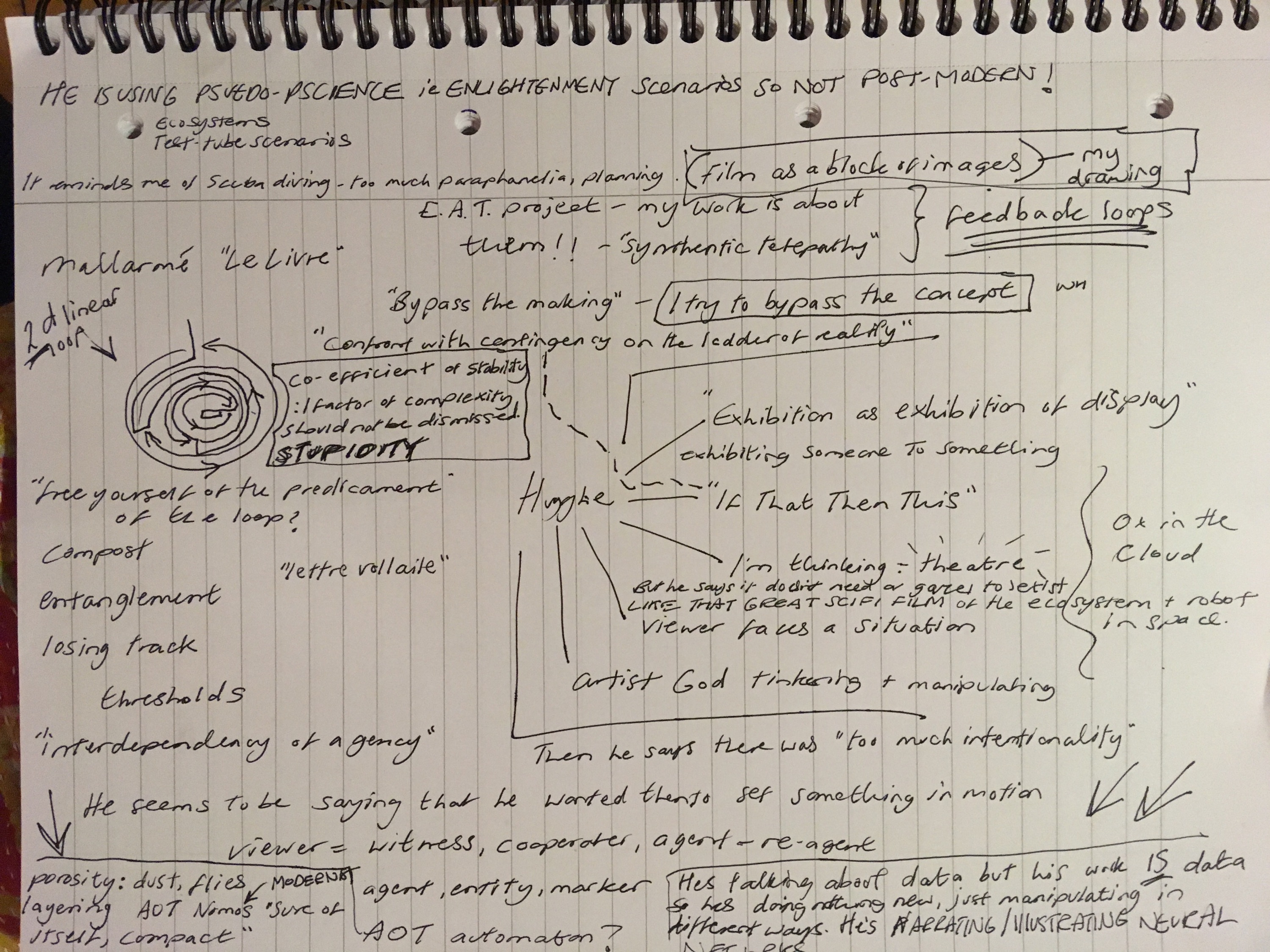
‘The expressivity of art…is measured by the encounters that it arranges for the spectator, and in the way art’s materiality forms or reforms our lived relations’ (Sauvagnargues, p152). I agree but on the condition that the artist is also a spectator of his/her own work (as opposed to Huyghe who is the spectator of the spectators).
‘There aren’t any abstract thoughts that are indifferently actualised in such or such image, but concrete thoughts only exist through these images and their means’
and
‘an image is only as valuable as the thought that it creates’ (Sauvagnargues, p20)
I agree, behaviour creates the image and the image stimulates thought; and my work, as a consequence of behaviour, can be used to illustrate both behaviour and concepts. But as soon as thought alone creates an image the image is devalued (though not perhaps un-valued set within the terms of equivalence).


Data behaves strangely in and around a Black Hole. Unless it behaves normally there, and strangely here.





 JON WHITBREAD ART