Thoughts and Questions

art is one of the ways in which the universe examines itself. Tries to work itself out. It uses humans, amongst other things, to do this. Not that there is an active principal involved. That’s just language. its more just a principal.

Does Huyghe illustrate or manifest Object Oriented Ontology? Do I illustrate or do I manifest? Or both?

When I work I manufacture the apparatus to allow for the data to come through like constructing an oil rig.

I am in the material like a witness to a demolition.

I definitely strive to be indefinite, for indefiniteness, in a definite material.

Not being steeped in the discourse of/surrounding art, my work is Naive.

Research based art is ironic and metaphorical. Unintentionally. Which is ironic.

Illustration is on/of the surface. Metaphor is of the surface, hinting at beneath the surface. Good art is from beneath the surface.

Kant? Kierkegaard? Deleuze? OOO? its a matter of personal taste, not of Truth.

A by-product of being conscious is being separate. A by-product of being conscious is being seperate.

if there is a Hyperreal Object then surely it is Consciousness. An object to which only Occidentalism has been oblivious.

object/subject. passive/active. Allow yourself to be, for example, tired versus actualise your tiredness.  Allow yourself to make art or actualise your art making? What is the nature of involvement?

Every new advert informs you that what you bought before was shit. definition of avant-garde? Linear. Its about trying to demolish previous structures, for its own sake.

Philosophy is the love of knowledge. Art thrives in not-knowing. In the Uncertain. Am I too certain in what I do? It might come across like that. The shapes are definite. Stone is a definite material. I have a definite skill set. But I am using all of these things to express and probe and narrate and investigate and interrogate and research subjective and objective Uncertainty. Conversational. If one used a less certain material to explore uncertainty, that is, a deliberately uncertain material, one would be making a certain, closed and non-conversational statement and would be in danger of being literalist.

Last night I dreamed I was riding on the back of a brown cow walking with a dog. Not being a cow, or a dog, however, I could not have dreamed ‘them’. I can only have dreamed a ‘my cow’ and ‘my dog’. If I am active/subject in the dream then the cow and the dog are the ‘my cow’ and the ‘my dog’. ie if the dream is a product of my brain then it has created a ‘my cow’ and ‘my dog’ based on my experience. Or rather my unconscious is using the my-dog as a symbol to probe my ego. If however I am passive/object in the dream then I didn’t dream either cow or dog. I experienced/encountered a ‘dream cow’ and a ‘dream dog’, or indeed, The dream-cow and The dream dog. Therefore, now I am awake the cow may still be walking with the dog. I might still be on it’s back. Or maybe someone else is.

Similarly, I’m not interested in visually presenting concepts. That is for illustrators. Or rhetorical and ironic art. I’m more interested in presenting the interest in concepts that are interested in us. Like symbols. Symbols are not man-made. They are manifested. A symbol is the subject and we are their objects. They act upon us. If we attempt to act upon the symbol, that is, claim it as ours,  commodified and exploited, it deteriorates into drama, irony and metaphor. That is, representational. For example, Did Hemingway first read about the Fisher King and then use him as a trope or metaphor in his own semi-autobiographical oeuvre? And if he read about him first (there is no evidence that he did), then where did the author of that story hear about him? And if not then what? How did the Symbol of the Fisher King come to manifest in Hemingway’s work? And if, as I suggest, the Symbol (subject) used ie acted upon Hemingway (object) then is that what makes his work so resonant? Is it the Faustian deal? To have the Symbol speak through you? I may start with a difficult problem, say, make an art object about knowledge, and fail, but at the very least I will have made an object that is about the problem of knowledge. However this object would then be illustrative of the nature of the problem and hence Illustration rather than sculpture. I would prefer to make an object, or rather be involved in the realisation of an object and then see what it might be about. Art that attempts to use symbol tends toward irony and the symbol decays into metaphor, the binary – the idea and the object, where both are somehow secondary, the primal is removed and the work is linear: 2-d, non-conversational. When the Symbols lost interest in Hemingway he BECAME The Fisher King, deteriorated and died an empty shell.

If as the sufis say ‘the apparent is a bridge to the real’, the apparent being the material and the real being the non-material, is the material required by us to avoid being overwhelmed by the real?

There is Exchange Value and Integral or Personal Value. Exchange Value is exterior. Integral Value is inherent. Value can be concentrated or diffuse. Integral Value is wordless. Something that has Exchange Value is spoken or expressed and easily commoditised ie cheapened or made available. If Integral Value is expressed it becomes diffuse ie more readily available and therefore cheapened. An example of something that has Integral Value is Intention. If Intention is expressed it is done so in order to discover its Exchange Value. However an expressed Intention loses its integrity and becomes diffuse and non-inherent, that is, external to itself.  So can a thing that has Integral Value be made available without being cheapened, either for the producer or the consumer? yes, Integral Value does not have to be expressed or spoken to be communicated. It is entirely resistant to any explanation. It has Integrity.

One should avoid accumulating an excess of artistic intentions.

Is Post-modern art art that resembles art. Does this matter? (Baudrillard?) Have we entered The Ironic Age? Which is, of course, The Post-Ironic Age.

Words are exclusive – they both trap and protect us. We cannot cope with immediate Universe-reality as it is a non-dimensional, non-human place. Without words Everything is flat. Imagine a wordless mind interpreting a blackbird flying between two green bushes.

Anything that cannot be commoditised is Untrue. Anything that cannot be put into words lacks Value. Anything that lacks value cannot be commoditised. Therefore the Ineffable is Untrue and is without value. However, thoughts require words. Try and express what you are thinking without words to yourself. You are on the edge of the wordless abyss. Words and grammar explain the world to you. Without language the world is flat, simultaneous and appalling. Like Plato’s Republic excluding Illusionary painting as Untrue. my work is not about the unknowable, the ineffable, but about how and why we require and search for it. Thus I use sand blasting to expose and obscure.

Plato’s Republic is Ego’s Paradise. But it wont suffice. Its borders cant keep out Consciousness. Like Language it seeps through and while Ego mans the barricades, The Witness is already inside.

What is that sense of you? That feeling of you-ness that you have?

Ponge: “the object is always more important, more interesting, more capable (full of rights): it has no duty towards me, it is I who am obliged to it”. I agree and yet he goes on, in The Banks Of The Loire for example, to impose himself upon The Wasp. Indeed, in true colonialist fashion, he places all words under his command and sends them into battle with the object, in order to categorise, subvert and colonise it too, going to Proustian lengths in the process. I am interested in this Object Imperialism and how we harvest value from nature, that is, everything, for our own creative ends, be they poetry, painting or sculpture at the expense of the objects innate identity or truth. Thus we anthropomorphosize the cosmos. I also find it interesting that I struggle with finding the right word for the set that might be called Everything, Cosmos, Universe, Creation. In order to categorise or label an object I become, or have to be, outside of it. Language then requires externality, but we crave internality. The result is alienation and nausea. As artists we can only produce more objects, or rather a recombination of already-objects. That is to say, things that are acted upon by the subject,  ingested, consumed. But we can attempt to make objects that describe our requirement for the non-object, or the search for the reconciliation of subject and object, otherwise known as Truth, the search for which creates Meaning. In my work I make something and then try to see which archetype, if any and if such a thing can be said to exist, might be speaking, which symbol might be manifesting. Like making a subterranean lake to prove or measure the existence of neutrinos.

On religious and mythic art – The Religious takes place within Eternity, thus no time, no space, no mass, just Awe.  The Mythic takes place within a dialectic ie Modernism as Rodin makes a torso of the church of the Academies, Brancusi spears Father Rodin, Moore ingests Brancusi et al, Caro disembowels Father Moore, Gods versus Titans versus Man versus Gods.

Artists expend much creative energy jostling for position, trying to create some elbow room in the overcrowded spaces of art history, contorting themselves to join the dots, like a game of time travelling, self-categorising Twister – ‘Look! Here is something that hasn’t been expressed before in a way that hasn’t been used before and here’s how it fits within The Canon!’ ‘Novelty!’ they cry, and ‘Relevance!’. Sometimes, however, with correct intention, that is, the need/requirement to discover, this works viz Charlotte Prodgers curated set of self-portrait paintings in a landscape using open sided fluid framing and spoken narrative about narrative.

we cannot use symbols. If we think we are using a symbol, that is putting a symbol to our use, it transforms or deteriorates into metaphor. Symbols use us.

Why do we try to go deeper looking for answers when we can just go deeper. If we are looking for meaning it implies we have lost it or that there is none. It means that when we think we have found It, and we all think we have found it in some size, shape or form, we stop and go no further.

For two and a half thousand years Artists have, with growing urgency, been trying to think of a way to get into Platos’s Republic. Only recently has a concerted assault on the border begun, by disguising themselves as, or even becoming, searchers of The Truth. But even as this becomes possible, they are infiltrated or distracted by, the search for The New.

If a poet uses an object, say, a red leaf floating down a river through a city as a metaphor for something or other, eg to help us understand our place in the universe, as a symbol, what am i a metaphor for? the poet is an imperialist, helping herself to all objects for her own ends, placing herself at the centre of things, alienated, striving to get back in.

the geology of self:

sense

response

thought

emotion

instinct:

all occur on the surface of World. Its where we spend all of our time. but what lies beneath? and what lies at the core? A diamond? A spinning ball of magnetic molten iron influencing migration with magnetic waves? ( both are scientific theories for what lies at the heart of the material world) The journey has barely begun. Forget space and the bottom of the deep oceans. The journey within is the great adventure.

As an artist I feel that I am excused from having to break down my motivation into ever smaller pieces of Why as though i should be on the trail of some kind of Truth Particle. That’s the job of philosophers and psychologists. They only require proof. I require necessity and the right to not limit the description of my experience to words.

can art be metaphor? In other words should there be some intention behind the work or does it then fall into other categories like satire or politics and therefore ‘mere’ Illustration? Much of what is called Art is in fact Illustration in that it accompanies words and lives. Even true minimalism illustrates the artists intention not to illustrate.

as art migrates to the internet is it recontextualised and thus rendered Kitsch, as illustrations of peoples lives

digitalising art is like putting it on a life support machine

does the unconscious have intention? Gustave Meyrink wrote ‘…mankind does not father ideas; we are merely sensitive receivers for all the ideas that…the earth generates’. (The Green Face, 1916). Is this Arendt’s World?

is there such thing as reality? Or only Inside and Outside?

am I a Surrealist!?

Does rolling news enable memory loss? Is memory loss an exploitable resource or just a convenient phenomenon?

Im trying to concretise a personal language that helps me communicate with myself about the mechanics of the unconscious and conscious minds. But its like chasing shadows.

Is contemporary art consuming itself? Is this the self-referential nature of (post) post-modernism?

Nicolas Bourriaud says that “meaning is the precondition for art to exist’ but what does Meaning mean? In fact what does ‘precondition for art to exist’ mean? Is Meaning defined by the presence of Code, Clue, Sign and Symbol that lead to Truth or is it just that the work is imbued with the Meaningful Intention of the producer (artist) and consumer (viewer?)

He also talks of the viewer as being The Active Witness or Beholder as though the viewer activates the passive object but surely by internalising an exterior stimulus the viewer is consuming it?
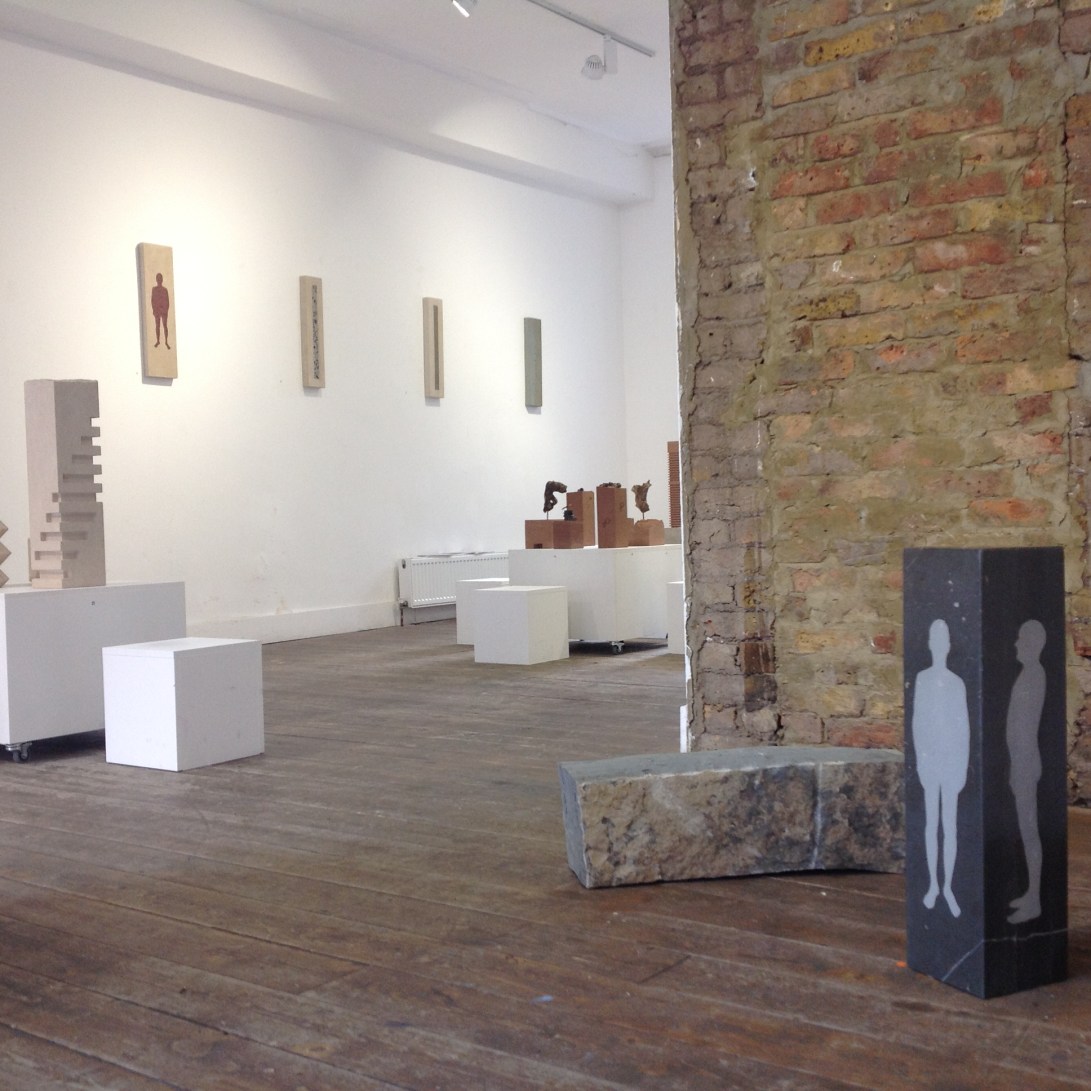
Exhibition: Aletheia


Over a year ago I was invited by Emma Somerset Davis to collaborate on an exhibition at the Lovely Gallery where both she and I have previously shown our work. Emma is deep into her Phd at the Royal College of Art, painting, performing and filming her performances. We felt our work was exploring similar themes and tackling similar problems of memory and behaviour, what forms and affects them, and how we feel we are central to their manufacture, are in control of them when really we may not be. A couple of weeks before the show we began trying to find a title. I had been reading Technic and Magic: The Reconstruction of Reality by Federico Campagna in which he says

‘Anything that appears to us as a true element of the world (that is, anything whose truthfulness, aletheia (his italics), consists in the removal of the veil that hid it from us, and its emergence as an object of our experience), does so within a certain frame’.

This resonated with both of us and from this I wrote a brief introduction related to the wider meaning of Aletheia days before the opening(see below).

In Emma’s work, as I understand it, she paints images related to personal memories she would rather forget, combined with her explorations of past poets and artists lives that she is researching,  who are being, or who have been, forgotten, then obscures them in layers of brush strokes, using a palette of colours that the artist used, or artists of that period of the poets life were using.

Unfortunately for her the attempt at obscuring her unwanted memories fails as each stroke of the brush that should act as a draught from the waters of the river Lethe serve only to reframe the memory in a metaphysical dimension where it takes on a hyperreal definition. For the viewer we can only guess as to what is hidden beneath the surface.

For my part the term seemed to resonate as my interests lie in trying to develop a personal language to assist in communicating with all aspects and layers of myself, analyse the nature of the information that flows between the layers, and investigate the portals through which that data flows, if indeed it can be said to do so. However the direct nature of the way in which I work means that meaning is only revealed, not intended. If there is intention it is only in an exploration of the possible, given the material, facilities and technique available to me. Thus by making art I am attempting to undo the effects of having drunk from the waters of Lethe as all humans have done by becoming material and forgetting our non-material nature, or at least probing the possibility that we are both material and non-material beings.

Interestingly, once the title was agreed and the gallery was set up, i spent some time alone with the work and was amazed at how the term Aletheia helped me to see a unifying theme of the mechanics of my work as they all in some way seem to be trying to offer a view of both surface and internal form that was not part of any conscious decision making.

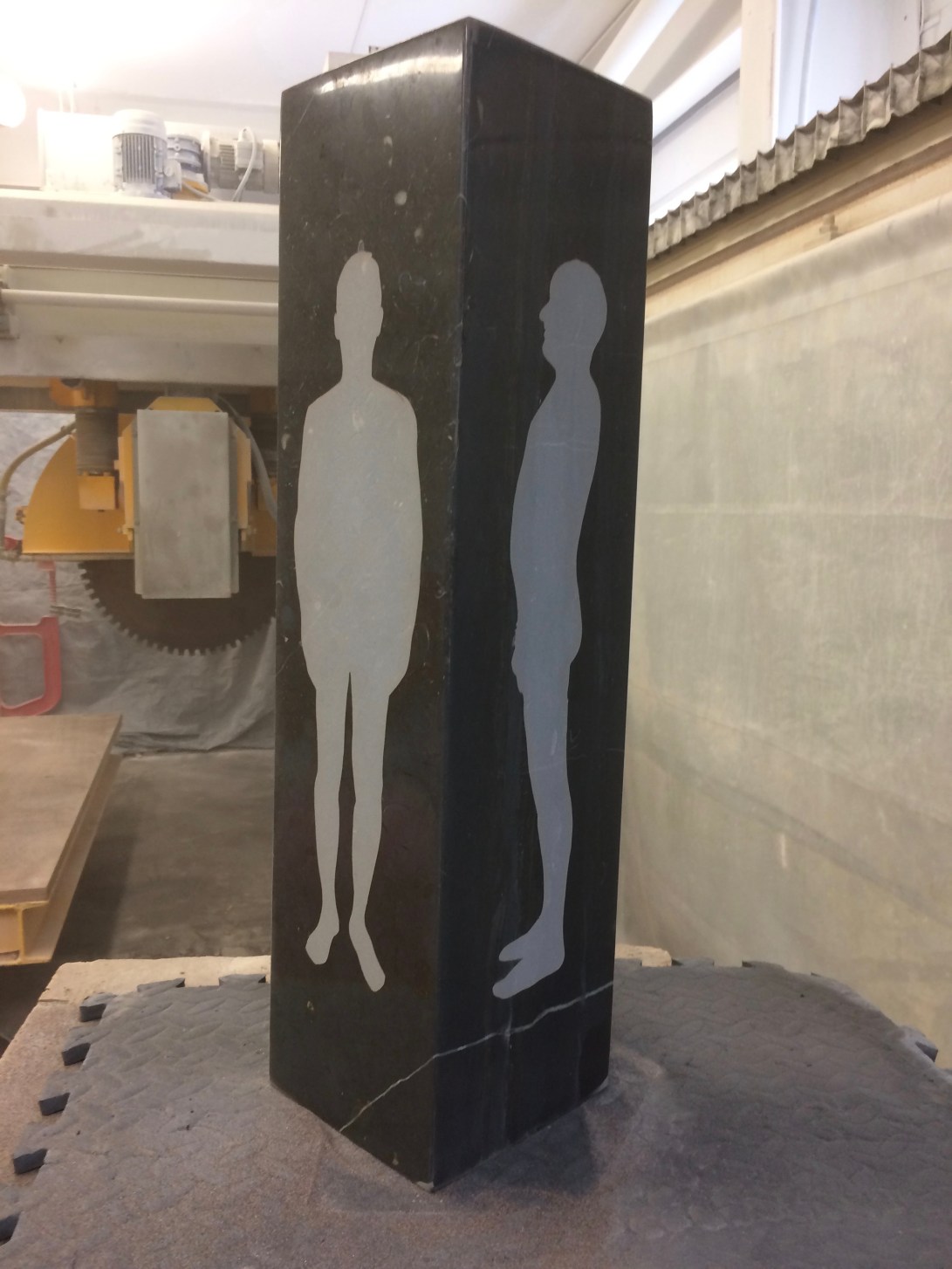
I made low plinths on wheels that would take groups of, rather than single sculptures and made smaller box plinths to act as seating, inviting the viewer to participate by choosing to spend time with each group so that the boundary between viewer as outside consumer and sculpture as object to be consumed, that is, internalised, was breached. The viewer, by choosing to place themselves on a plinth, becomes part of the show and the venn diagram bubbles start to join, float, separate and recombine in myriad ways. One sculpture, a sand blasted piece of very dense fossil Blue Lias limestone, was placed next to a raw block on which people could sit, thus: person sitting on stone looking at/being with representation of person on surface of stone though suggesting being inside the stone. The usual gallery experience of being pinballed from unique art object to unique art object, where one is thinking of the next piece as soon as one arrives at the first, like scrolling through instagram images, is disrupted. A personal relationship and narrative can be established. One has stepped outside of time, or into it. The viewer views viewers viewing …(since writing this I have watched a lecture by Nicolas Bourriaud where he describes the Active Witness whereby you exhibit someone to something, rather than something (object) to someone (subject).

Post Script

Our plan was to take this exhibition to the RCA. However within a week of it closing Charles Saatchi bought all of Emma’s work. Of course I’m thrilled for her but geez – the timing!

Aletheia

IMG-1032.JPG

Lethe, the River of Forgetfulness, ran through Hades emptying the memories of all who drank its waters. Aletheia then, means remembering but can also mean truth or ‘the state of not being hidden’. My sculptures can be seen as representing this opening up of things to see what lies within or beneath, or as openings through which data flows between the Unconscious and Conscious, non-material and material states.

Jon Whitbread

*

All matter feels, yearns, suffers, desires and remembers.  (Karen Barad, 2007).

We perceive ourselves as narratable, as protagonists of a story that we long to hear from others. My story is the outcome of relational practice, something given to me from another, in the form of a life-story, a biography. The desire for my story to be told creates a relational ontology of disclosure, vulnerability and the sharing of unique experience. I make works through painting and performance that dissolve and re-make the relationship between body, painting, support and temporal space, disclosing and re-enacting my intimate relationships and experiences.

Emma Somerset Davis

Aletheia

Can one reveal by eroding? Is there a difference between emergence and submergence?IMG_9913


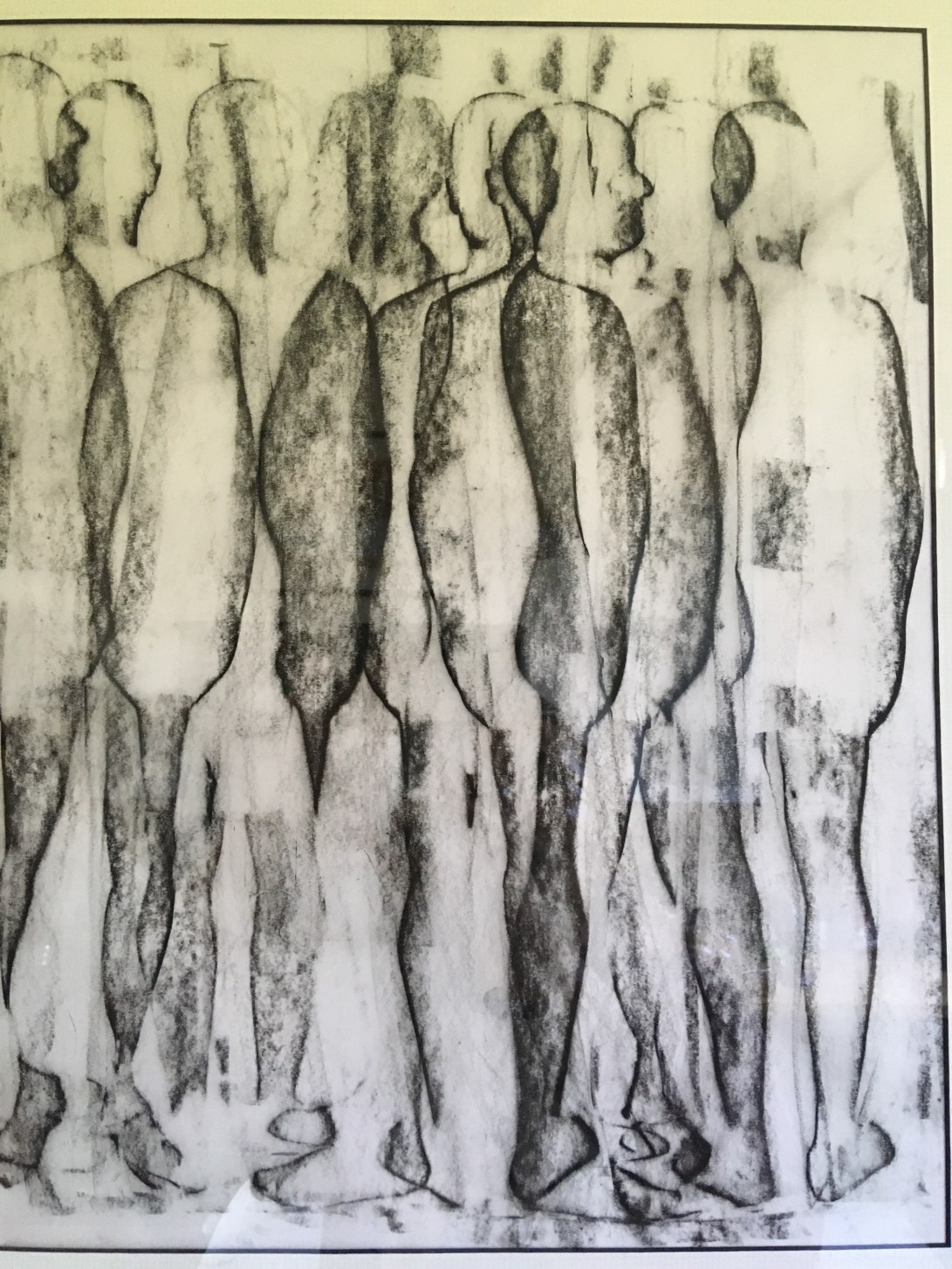
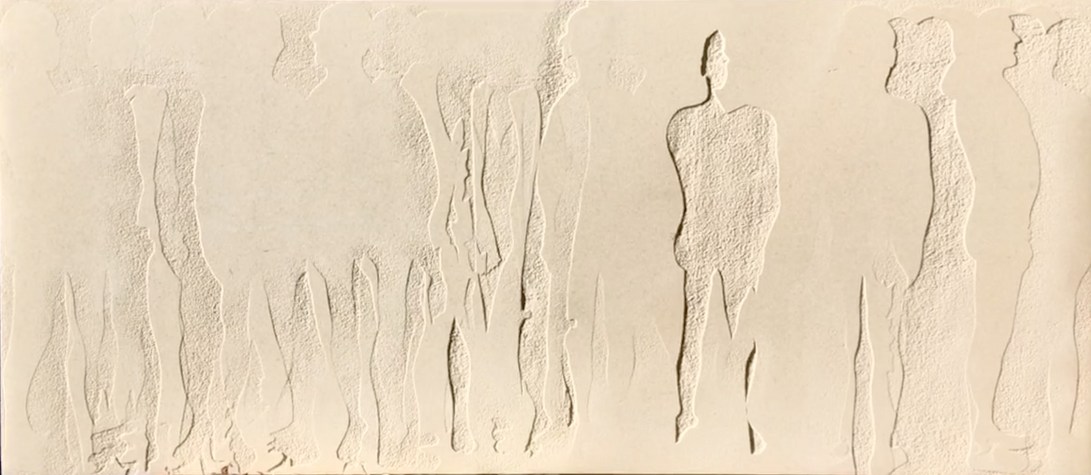
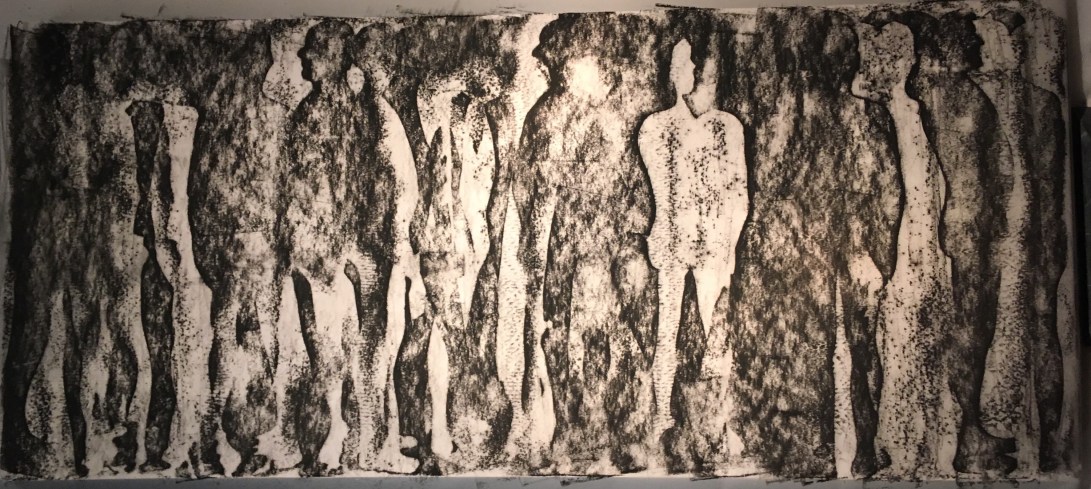
What defines us? Are we form or detail? Area or volume? Depth or surface? all of the above? What does ‘What defines us?’ mean? CAT scans and biology textbooks offer material advice. But how to pictorialise the non-material? Not its imagery, already so well represented, but its mechanics? Like CAT scanning cave art, Egyptian pictograms, Greek bas-reliefs and finding ghostly archetypes informing all. Its about how humans look for meaning, not about meaning itself.

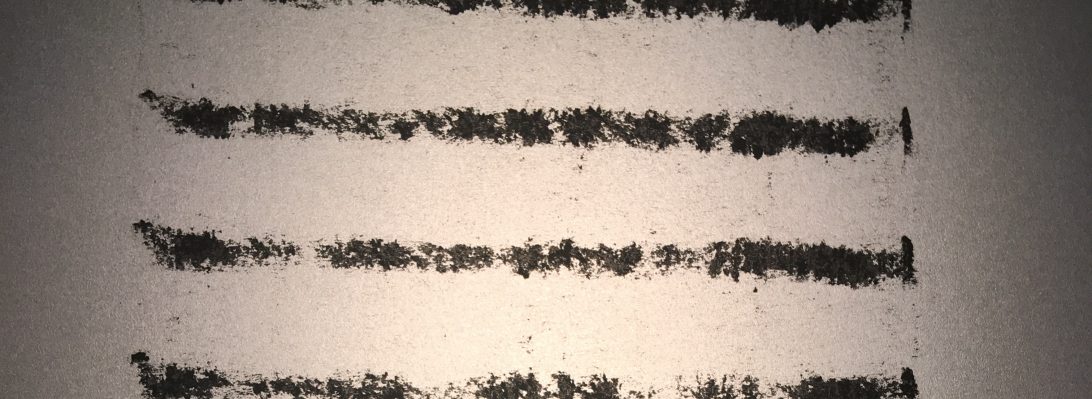
I took photographs of myself, used photocopier to set size, carbon papered onto template rubber, cut out template, cut raw stone to size, prepared surface, applied templates, sand blasted, peeled off templates, traced stone with charcoal and 90 gsm tracing paper, traced around drawing, carbon papered onto template rubber, cut out rubber, applied negative cut out to stone, added elements of previous template manifestations of the process, sand blasted, applied positive to stone, sand blasted. Now in process of tracing sculpture of drawing of sculpture of photo copies of photographs with view to making sculpture on which i will draw directly. This process has been punctuated and driven by risk and at times, disaster. The results have been thrilling, revelatory and perhaps disturbing…IMG_0086.jpg

…as I am left with the troubling thought that I may be a Surrealist. These are forms I would not consciously aim to produce.


Hayley Lock


On Reading ‘Falling Into The Void’ by Hayley Lock

Hayley writes of ‘the void that surrounds (us)’ but what about the void within? Can The Void perhaps be the space between material reality and the more real but less familiar, non-material reality. Its where I go when I fall backwards into the eternity of a two minute wait for the next tube train. The place beyond Boredom that seems at first glance empty but which is, like the deep ocean, full of nutrition, or, like deep space, teeming with information. The Void is the threshold from which most people recoil in a panic and quickly fill with their mobile phone, book, newspaper, worry, anxiety, crisis etc. We are losing the ability and desire to spend time with ourselves. Even yoga has come to resemble a sport. Like Seyerls bubble – all surface no content, or Arendts ‘on the earth’ vs ‘inhabit the world’, we live materially,  on the surface of ourselves and the Earth, oblivious to our depths and to the universe. Materialism requires that we place ourselves, individually and philosophically, at the centre of cosmology. Yet the journey into ‘space’ is the same as the journey into ourselves. Going further and going within are the same direction. ‘Nothing’ is superficial. Sink down into it and it is Everything.

The whole thing is made trickier by the fact that that ‘Nothing’ is a word and therefore something. It lends itself to wonderful paradoxes. King Lear frets that ‘nothing comes from nothing’ and is lost in its inescapable mad loop. It says much of the relationship between word and thought, material and non-material, Techne and Magic. Scientific Materialism, our current paradigm, confidently insists that Arendt’s World can, must and will be described. Hayley Lock quotes Heidegger’s ‘the nothingness itself nothings’ where he seems to be trying square this circle. It is the insistence that nothing is ineffable, when in fact Nothing IS ineffable lies at the heart of the paradox. Insisting that nothing is ineffable places us at the centre of things and so outside,  seemingly god-like but in fact alienated. Saying that Nothing is ineffable activates The Void and fills both it and us with creative data. Pressure equilibrates. The bubble bursts. Object and Subject reconcile.

‘Black’

Fludds primordial Black referenced by Hayley Lock, might also have been the Alchemical Nigredo, the blackening – sth to do with cooking matter until it is primal. Jung interpreted this as a dissociative stage before Albedo, the Light, or the whitening. Ive just read a short story by Hemingway, ostensibly a simple tale of a solitary fisherman. But to get to the idyllic spot from where to cast his line he has to pass through a town that has been burned to the ground. The surrounding land is blackened. Even the crickets have turned black. (as I write this a house is on fire across the road – the smoke is stinging my eyes). He is the Fisher King traversing The Wasteland, preparing himself in the sunny spots, the Albedo, the Light for the journey into the swamp, the Wyld Wood of deep consciousness. But did Hemingway know he was using ancient memes? His novel Fiesta also seems to use themes of wounds, bulls, infertility, chivalry, Amor, fishing, whilst ostensibly narrating a straightforward semi-autobiographical tale. Or is this a case of (Jungs) Archetypes forever bubbling up and nudging us in a particular direction? Is Hemingway referencing memes and archetypes or are they referencing him?

And does that nudge come from our instinct?  from nature? reminding us that we are non-material as well as material beings, participants of  and not just witnesses to the void that is Everything?


MA3 Current Work

I am beginning to think of my work as illustrations of my attempts to renegotiate a relationship with the non-material (currently by absenting the material through accelerated, forced erosion, tracing and making openings)  after having spent the bulk of my adult life applying my fathers scientific-materialist template to reality (the same father who has also begun re-addressing his own relationship with the universe through a direct negotiation with God, that he calls The Infinite, whilst recovering from surgery in hospital). But also as an accompaniment to my efforts to understand post-Nietzschean attempts by wider western materialism to cope with its exit from the non-material aspect of what was up to that point a reality that recognised that humans are both animal and spiritual. That is, with Modernism, we opted to leave the God-created universe for a new man-made, language-defined universe. The question being, was this a natural and necessary act in order for us to be ultimately reconciled with the cosmos on better terms than the previous relationship based as it was on God as Creator Entity and us as sinners, or is this a one way trip to Technic and the end of Magic (F. Campagna)? Is materialism a necessary step toward Jungs Individuation? Is democratic capitalism merely a symptom of this materialism?

‘The debate around the hierarchy of word over image has raged for a long while and will continue to do so. How we as artist work within this and use it to our advantage is a challenge’. (Caroline Wright commenting on OCAMA 16 seminar, Oct 18).

Technology can be seen as a symptom of a culture or a creator of it. The printing press is a primary example of this. It manifested at the beginning of the psychic shift from the non-material to a material reality. From the image-based Southern European ineffable Magic of Catholicism to the word-based, iconoclastic, Northern Techne of Protestantism. Was Protestantism successful because of the printing press, or was the printing press successful because of the Protestant paradigm? Or was the development of a protestant reality an expression of an energetic development that feeds off an insistence on non-ineffability: the World can, must and will be described. All else is witchcraft or weakness. Modern Science ensues. Art adopts language of scientific discourse. Techne victorious.

I am not interested in attempting to express the ineffable but I am leaving markers along the border between the expressible and inexpressible, at openings in the border, and about the nature of the data that passes from one to the other, in both directions. I am attempting to construct a language that helps me to communicate with myself, or rather the act of attempting to construct a language that helps me to communicate with myself about myself is symptomised by object making. Object making is a by-product of language -making. But at the same time there is an awareness of the unconscious using this process as a means to communicate, even up to the point of expressing itself IN the objects.

Words roam the surface of things. They serve the material. We exist on the surface, neglecting the depths where words cant penetrate. We look for signs in named things, some configuration, some alignment. Clues. Looking for meaning in the potential of things to combine and teach us something of Value. But this is a symptom of illness. We are trying to put elements together that are already together, which means we need to seperate them first, tear things apart in the search for potential. Because we are not part, having chosen to step outside, like little gods, in order to look in, judging, categorising, mining and extracting value.