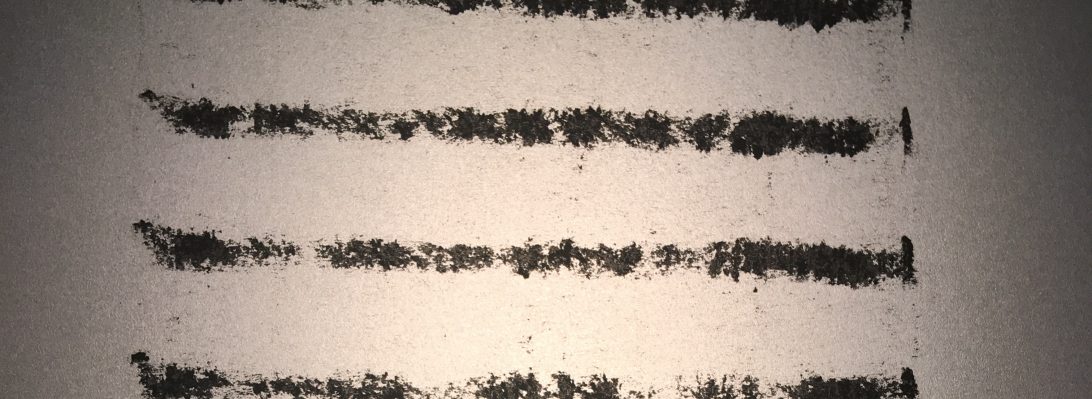
On Reading ‘Falling Into The Void’ by Hayley Lock
Hayley writes of ‘the void that surrounds (us)’ but what about the void within? Can The Void perhaps be the space between material reality and the more real but less familiar, non-material reality. Its where I go when I fall backwards into the eternity of a two minute wait for the next tube train. The place beyond Boredom that seems at first glance empty but which is, like the deep ocean, full of nutrition, or, like deep space, teeming with information. The Void is the threshold from which most people recoil in a panic and quickly fill with their mobile phone, book, newspaper, worry, anxiety, crisis etc. We are losing the ability and desire to spend time with ourselves. Even yoga has come to resemble a sport. Like Seyerls bubble – all surface no content, or Arendts ‘on the earth’ vs ‘inhabit the world’, we live materially, on the surface of ourselves and the Earth, oblivious to our depths and to the universe. Materialism requires that we place ourselves, individually and philosophically, at the centre of cosmology. Yet the journey into ‘space’ is the same as the journey into ourselves. Going further and going within are the same direction. ‘Nothing’ is superficial. Sink down into it and it is Everything.
The whole thing is made trickier by the fact that that ‘Nothing’ is a word and therefore something. It lends itself to wonderful paradoxes. King Lear frets that ‘nothing comes from nothing’ and is lost in its inescapable mad loop. It says much of the relationship between word and thought, material and non-material, Techne and Magic. Scientific Materialism, our current paradigm, confidently insists that Arendt’s World can, must and will be described. Hayley Lock quotes Heidegger’s ‘the nothingness itself nothings’ where he seems to be trying square this circle. It is the insistence that nothing is ineffable, when in fact Nothing IS ineffable lies at the heart of the paradox. Insisting that nothing is ineffable places us at the centre of things and so outside, seemingly god-like but in fact alienated. Saying that Nothing is ineffable activates The Void and fills both it and us with creative data. Pressure equilibrates. The bubble bursts. Object and Subject reconcile.
‘Black’
Fludds primordial Black referenced by Hayley Lock, might also have been the Alchemical Nigredo, the blackening – sth to do with cooking matter until it is primal. Jung interpreted this as a dissociative stage before Albedo, the Light, or the whitening. Ive just read a short story by Hemingway, ostensibly a simple tale of a solitary fisherman. But to get to the idyllic spot from where to cast his line he has to pass through a town that has been burned to the ground. The surrounding land is blackened. Even the crickets have turned black. (as I write this a house is on fire across the road – the smoke is stinging my eyes). He is the Fisher King traversing The Wasteland, preparing himself in the sunny spots, the Albedo, the Light for the journey into the swamp, the Wyld Wood of deep consciousness. But did Hemingway know he was using ancient memes? His novel Fiesta also seems to use themes of wounds, bulls, infertility, chivalry, Amor, fishing, whilst ostensibly narrating a straightforward semi-autobiographical tale. Or is this a case of (Jungs) Archetypes forever bubbling up and nudging us in a particular direction? Is Hemingway referencing memes and archetypes or are they referencing him?
And does that nudge come from our instinct? from nature? reminding us that we are non-material as well as material beings, participants of and not just witnesses to the void that is Everything?
 JON WHITBREAD ART